
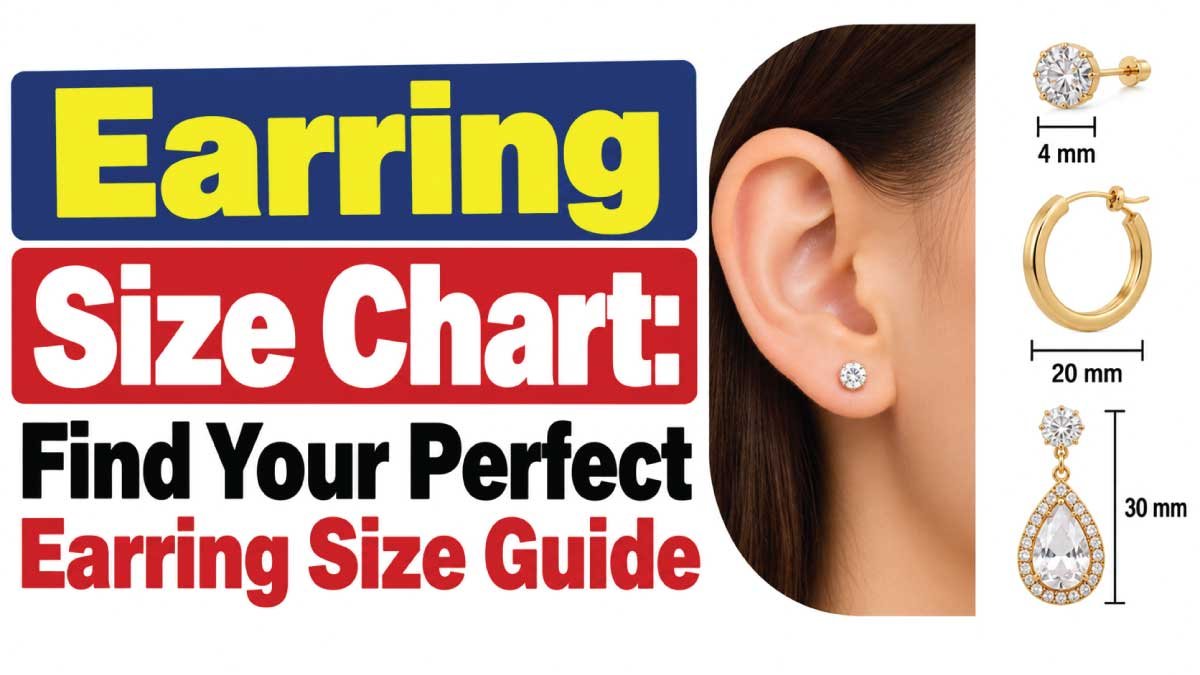
Choosing the right earring size can make a noticeable difference in your appearance, comfort, and overall style. Small studs create a subtle, minimalist look, while larger hoops, statement earrings, and long drops add more visual impact. However, the ideal size depends on more than personal preference. Earring diameter, length, width, weight, ear anatomy, and the occasion all influence how a pair looks and feels.
This earring size guide explains common earring measurements in millimeters, centimeters, and inches. You will learn how to compare stud sizes, hoop diameters, and drop earring lengths, measure earrings correctly, and select suitable styles for everyday wear, work, parties, and special occasions.
Whether you are shopping for yourself or buying earrings as a gift, understanding earring dimensions can help you find a pair that matches your style and feels comfortable to wear.
Earring Size Chart in Millimeters and Inches
Earrings come in a wide range of sizes, from tiny studs measuring just a few millimeters to statement hoops and drop earrings several centimeters long. The most useful measurement depends on the earring type.
Stud earrings are usually measured by the width or diameter of the decorative front. Hoop earrings are measured by their diameter, while drop earrings are measured by their overall hanging length.
The following chart provides general size categories for comparing common earring styles. These are practical style ranges, not universal industry standards, and individual products may use different dimensions.
| Size Category | Measurement (mm) | Measurement (cm) | Approximate Size (inches) | Typical Appearance |
|---|---|---|---|---|
| Tiny stud | 2–3 mm | 0.2–0.3 cm | 0.08–0.12 in | Very subtle |
| Small stud | 4–5 mm | 0.4–0.5 cm | 0.16–0.20 in | Minimalist |
| Medium stud | 6–8 mm | 0.6–0.8 cm | 0.24–0.31 in | Noticeable |
| Large stud | 9–12 mm | 0.9–1.2 cm | 0.35–0.47 in | Bold |
| Small hoop | 10–15 mm | 1.0–1.5 cm | 0.39–0.59 in | Close-fitting |
| Medium hoop | 20–30 mm | 2.0–3.0 cm | 0.79–1.18 in | Classic hoop |
| Large hoop | 40–60 mm | 4.0–6.0 cm | 1.57–2.36 in | Statement style |
Note: Stud size, hoop diameter, and earring length describe different dimensions. A 10 mm stud is not equivalent in appearance to a 10 mm hoop. Always check which measurement a product listing provides.
How to Read an Earring Size Chart
When comparing earrings, pay attention to the measurement that describes the part you actually see when wearing them.
Diameter: The distance across a circular stud or hoop.
Width: The measurement from one side of an earring to the other.
Length: The distance from the top attachment point to the bottom of the earring.
Thickness: The depth or material thickness of the earring.
Weight: How heavy the earring is, usually listed per earring or per pair.
Understanding these measurements makes online shopping easier because product photographs can make earrings appear larger or smaller than they are in reality.
Stud Earring Size Guide
Stud earrings sit close to the earlobe and are among the most versatile earring styles. They may feature gemstones, pearls, diamonds, metal balls, geometric shapes, or decorative designs.
Their size is generally measured across the visible front rather than by the length of the post that passes through the piercing.
Tiny and Small Stud Earrings: 2–5 mm
Tiny studs measuring 2–3 mm offer a discreet appearance. They are suitable for people who prefer minimal jewelry or want a subtle accessory for everyday use.
Small studs measuring 4–5 mm are slightly more noticeable while remaining understated. They work well for office wear, casual clothing, and simple jewelry combinations.
These sizes can also be useful for additional ear piercings, although suitability depends on the piercing’s location, healing status, and the jewelry design.
Medium Stud Earrings: 6–8 mm
Medium studs provide a balance between subtlety and visibility. They are often chosen for everyday outfits, professional settings, and occasions where a little sparkle is desirable without wearing a large accessory.
Popular options include pearl studs, gemstone settings, and simple round metal designs.
Large Stud Earrings: 9–12 mm
Large studs create a stronger visual presence. They may feature larger stones, floral shapes, or decorative metal designs.
Because their fronts cover more of the earlobe, check the actual dimensions and weight before purchasing. A large stud can be comfortable when lightweight, while a smaller design with a heavy setting may feel less comfortable.
Choosing the Right Stud Size
Consider these factors when selecting stud earrings:
- Choose 2–5 mm studs for a subtle, minimalist appearance.
- Consider 6–8 mm studs for versatile everyday styling.
- Select 9–12 mm studs when you want a more noticeable accessory.
- Check the post length, backing, and total weight, especially for frequent wear.
These categories are flexible. The best size is the one that suits your ear, personal style, and intended use.
Hoop Earring Size Chart
Hoop earrings are measured by their diameter, which is the distance across the circular shape. Some manufacturers specify the outside diameter, while others use the inside diameter. This difference can affect the actual appearance and fit.
The following chart describes common hoop sizes and their general styling characteristics.
| Hoop Category | Diameter (mm) | Diameter (cm) | Approximate Diameter (inches) | General Style |
|---|---|---|---|---|
| Micro hoop | 6–9 mm | 0.6–0.9 cm | 0.24–0.35 in | Very close-fitting |
| Small hoop | 10–15 mm | 1.0–1.5 cm | 0.39–0.59 in | Subtle everyday wear |
| Medium-small hoop | 16–20 mm | 1.6–2.0 cm | 0.63–0.79 in | Compact classic |
| Medium hoop | 21–30 mm | 2.1–3.0 cm | 0.83–1.18 in | Versatile statement |
| Large hoop | 31–50 mm | 3.1–5.0 cm | 1.22–1.97 in | Bold appearance |
| Oversized hoop | 51–70 mm | 5.1–7.0 cm | 2.01–2.76 in | Dramatic statement |
These diameter ranges are general shopping guides. A hoop’s position on the ear depends on its construction, opening, closure, and the location of the piercing.
Small Hoops for Everyday Wear
Small hoops are useful when you want the shape of a hoop without a large or dramatic appearance. They can complement casual clothing, work outfits, and simple evening looks.
Look for lightweight designs with a secure closure. If the hoop is intended to sit close to the earlobe, confirm that its inside diameter provides sufficient space for your ear.
Medium Hoops for Versatile Styling
Medium hoops provide more visibility than small hoops without necessarily dominating an outfit. They pair well with dresses, shirts, jeans, and many other everyday styles.
Their appearance also varies with thickness. A thin 25 mm hoop may look delicate, while a thick hoop with the same diameter can appear much bolder.
Large Hoops for Statement Looks
Large hoops draw more attention to the face and can become the main feature of an outfit. They are often worn with simple clothing, evening wear, or fashion-focused looks.
However, diameter alone does not determine comfort. Larger hoops may catch on clothing or move more during daily activities. Consider their weight, thickness, and closure before choosing them for extended wear.
Drop and Dangle Earring Size Guide
Drop and dangle earrings hang below the earlobe. They may feature gemstones, pearls, chains, geometric shapes, or decorative components.
Unlike studs and hoops, these earrings are usually compared by their overall length. Depending on the product, the stated measurement may include the hook, post, or attachment component, so check the manufacturer’s dimensions.
| Earring Length Category | Length (mm) | Length (cm) | Approximate Length (inches) | Typical Look |
|---|---|---|---|---|
| Short drop | 10–20 mm | 1.0–2.0 cm | 0.39–0.79 in | Subtle movement |
| Medium drop | 21–40 mm | 2.1–4.0 cm | 0.83–1.57 in | Noticeable accent |
| Long drop | 41–60 mm | 4.1–6.0 cm | 1.61–2.36 in | Elegant statement |
| Extra-long drop | 61–100 mm | 6.1–10.0 cm | 2.40–3.94 in | Dramatic style |
These categories are approximate. Two earrings of the same length can look very different depending on their shape, width, color, and construction.
Short Drop Earrings
Short drops offer a little more movement than studs while maintaining a relatively compact appearance. They are suitable for everyday outfits, business clothing, and casual occasions.
Medium Drop Earrings
Medium drops are versatile enough for dinners, parties, and many formal settings. Their length makes them visible without always creating the dramatic effect of a long chandelier earring.
Long and Statement Drop Earrings
Long earrings can complement evening dresses, formal events, and outfits with simple necklines. Before choosing an extra-long pair, check the weight and attachment style.
A lightweight long earring may be easier to wear than a shorter but heavier design. If earrings cause pain, pulling, or irritation, remove them rather than trying to tolerate the discomfort.
How to Measure Earring Size Correctly
Measuring earrings before purchasing them helps you understand their actual proportions. A ruler is sufficient for most basic measurements, while a digital caliper can help with small components when used carefully.
Step 1: Identify the Earring Type
Determine whether the item is a stud, hoop, drop, or another design. This tells you which dimension is most useful.
- For studs, measure the visible decorative front.
- For hoops, measure the diameter.
- For drop earrings, measure the overall hanging length.
- For thick or wide designs, check width and thickness as well.
Step 2: Measure Stud Earrings
Place the stud on a flat surface and measure straight across its widest visible point.
For a circular stud, this is its diameter. For a flower, square, or irregular design, measure the maximum width and height separately.
Do not confuse the decorative front measurement with the post length.
Step 3: Measure Hoop Earrings
Measure across the widest point of the hoop. If you need to compare the space available for your ear, look for the inside diameter rather than assuming the outside diameter represents the opening.
For example, a hoop measuring 30 mm across its outer edge may have a smaller usable opening because of its thickness.
Step 4: Measure Drop Earrings
Measure from the highest attachment point to the lowest point of the earring. Check whether the product listing includes the hook or post in the total length.
If you already own a similar pair, measure it in the same way and compare the results.
Step 5: Convert Millimeters to Centimeters or Inches
Use these basic conversions:
- 10 mm = 1 cm
- 25.4 mm = 1 inch
- 50.8 mm = 2 inches
- 76.2 mm = 3 inches
For example, a hoop with a diameter of 25.4 mm measures exactly 1 inch across. This conversion helps you compare product specifications provided in different units.
Also Read:
How to Choose the Best Earring Size for Your Face and Style
Earring size is a personal choice. Face shape, hairstyle, clothing, and the look you want to create can all influence which dimensions you prefer.
Earrings for Everyday Wear
For daily use, consider small studs, lightweight hoops, or short drops. These styles can be practical for work, errands, and casual activities.
Choose earrings that feel secure and do not interfere with headphones, glasses, scarves, or other accessories you regularly use.
Earrings for Formal Occasions
Formal occasions offer more flexibility for decorative studs, medium hoops, gemstone drops, and statement earrings.
Match the earrings to the outfit rather than choosing the largest available size. A detailed dress may pair well with simpler earrings, while a plain outfit can provide space for a more noticeable design.
Earrings for Different Face Shapes
Face-shape recommendations are styling suggestions rather than strict rules.
Round faces: Longer drops or angular designs can create visual contrast.
Oval faces: Many stud, hoop, and drop styles can work well.
Square faces: Rounded hoops and curved designs can soften the overall look.
Heart-shaped faces: Some wider-at-the-bottom drops can create visual balance.
Long faces: Wider hoops or compact statement earrings can add horizontal emphasis.
Personal preference matters more than following a particular face-shape rule. Try different styles to discover which proportions you enjoy wearing.
Matching Earrings to Hair Length
Short hairstyles and pulled-back hair can make earrings more visible, while long hair may partially cover smaller designs.
If your hair often covers your ears, consider earrings with a little more size or contrast. If you prefer understated jewelry, small studs may remain suitable regardless of hairstyle.
Also Read:
Earring Size by Material, Weight, and Piercing
Size is only one part of selecting comfortable earrings. Materials, construction, and the condition of your piercing also affect suitability.
Material and Construction
Earrings may be made from gold, sterling silver, stainless steel, titanium, plated metals, or other materials. Their suitability depends on the specific alloy, finish, and individual sensitivity.
If you have sensitive ears, look for clearly disclosed material information and consider jewelry designed for sensitive skin. The label alone does not guarantee that every wearer will tolerate a particular product.
Why Earring Weight Matters
Two earrings with identical dimensions can have very different weights. Solid metal, hollow construction, gemstones, and decorative components all affect the final weight.
For frequent wear, lightweight earrings may be more comfortable. Heavy earrings can place additional tension on the earlobe, particularly when worn for long periods.
Piercing Location and Fit
A hoop that fits a standard lobe piercing may not suit a higher piercing or a different part of the ear. Piercing location, jewelry thickness, and available clearance all influence fit.
For a new or healing piercing, follow professional aftercare guidance and use jewelry appropriate for that piercing. Do not force an earring into a piercing that feels tight or painful.
Also Read:
Common Mistakes When Buying Earrings Online
A product photograph can make it difficult to judge actual size. Avoid these common mistakes to reduce the chance of receiving earrings that do not match your expectations.
Ignoring measurement units: Confirm whether the dimensions are in millimeters, centimeters, or inches.
Confusing diameter with circumference: A hoop’s diameter is the distance across it, not the distance around its circular edge.
Overlooking earring thickness: A thick hoop can appear much larger than a thin hoop with the same diameter.
Ignoring weight: Check whether the listed weight applies to one earring or the pair.
Assuming all drop lengths are measured identically: Confirm whether hooks and posts are included.
Relying only on product photographs: Look for stated dimensions and compare them with jewelry you already own.
Forgetting closure details: Check that the backing, clasp, or hoop closure suits your intended use.
Taking a few moments to review these details can help you select earrings that look as expected and feel appropriate for your needs.
Frequently Asked Questions About Earring Sizes
What Is a Standard Earring Size?
There is no single standard size for all earrings. Small studs may measure around 2–5 mm, while common hoop styles can range from approximately 10 mm to 50 mm or more in diameter. Drop earrings vary considerably in length.
Are 6 mm Stud Earrings Big?
A 6 mm stud is a medium-sized option in many jewelry collections. It is more noticeable than a tiny 2–3 mm stud but remains relatively compact for everyday styling.
What Is a Good Hoop Size for Everyday Wear?
Hoops around 10–20 mm in diameter are common choices for a compact everyday look. Some people prefer larger hoops, so comfort, weight, and personal style should guide the decision.
How Do I Know If Hoop Earrings Will Fit My Ear?
Check the hoop’s inside diameter, opening, thickness, and closure. The outside diameter alone may not show how much room is available for your earlobe or piercing.
What Is the Difference Between Earring Length and Diameter?
Length measures how far an earring extends vertically, while diameter measures the distance across a circular shape. Length is especially useful for drop earrings, whereas diameter is commonly used for hoops and round studs.
Are Bigger Earrings Always Heavier?
No. Weight depends on the material, thickness, construction, and decorative components. A large hollow hoop can weigh less than a small, solid metal earring.
How Can I Choose Earring Size as a Gift?
Consider the recipient’s usual jewelry style. Small studs and compact hoops can be versatile options, while statement earrings suit someone who prefers bold accessories. Check product dimensions and material details whenever possible.
Conclusion
Finding the right earring size becomes easier when you understand the difference between stud diameter, hoop diameter, and drop length. Small studs offer a subtle appearance, medium hoops provide versatile styling, and longer drops create more visual impact.
Use the measurements in this earring size guide to compare dimensions, convert millimeters to inches, and evaluate the fit before buying. Consider weight, material, piercing location, and intended use alongside appearance. The best earrings are those that complement your style, fit comfortably, and suit the occasions when you plan to wear them.
