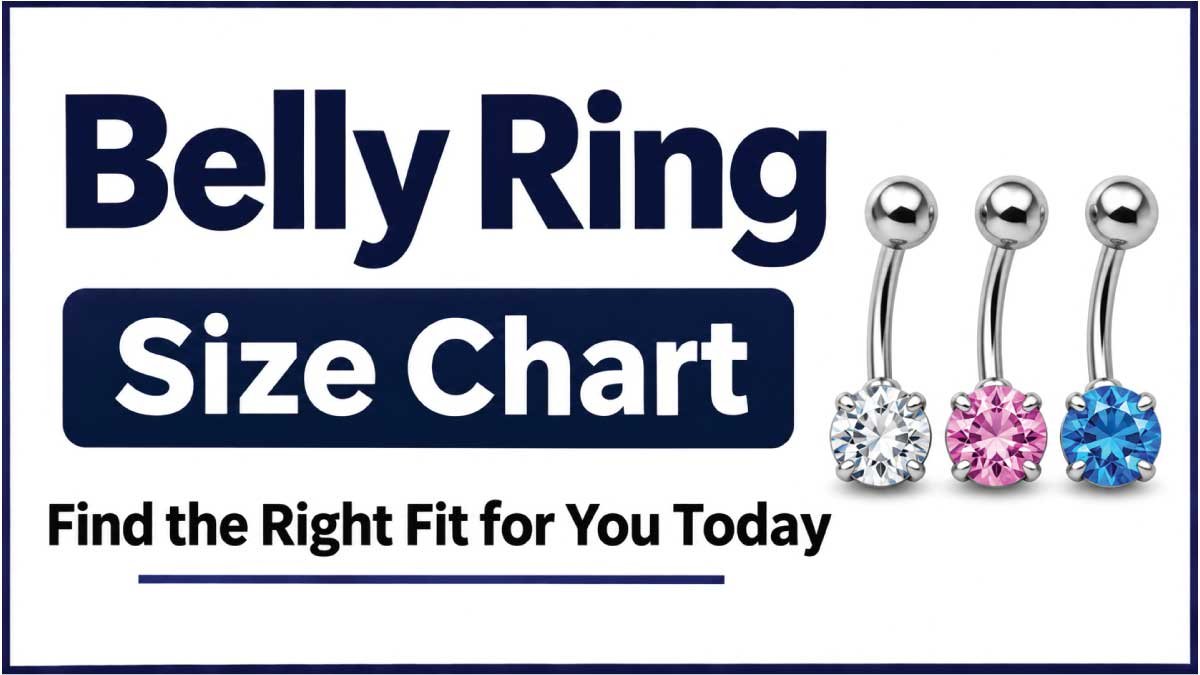
Choosing the correct belly ring size is essential for comfortable wear, proper positioning, and a secure fit. Whether you are purchasing your first navel piercing jewelry, replacing an existing belly ring, or exploring different styles, understanding jewelry measurements can help you make the right choice.
A Belly Ring Size Chart helps you compare jewelry thickness, wearable length, and decorative dimensions. Unlike ordinary earrings or necklaces, belly button rings must fit the piercing channel and surrounding tissue correctly. Jewelry that is too short may create pressure, while an excessively long barbell can move unnecessarily and catch on clothing.
This complete guide explains standard belly ring sizes, gauge measurements, barbell lengths, diameter conversions, different jewelry styles, and how to measure your existing piercing jewelry. You will also learn how to choose suitable materials, avoid common sizing mistakes, and understand important fitting considerations.
What Is a Belly Ring Size Chart?
A belly ring size chart is a reference guide that helps you identify the dimensions of jewelry designed for navel piercings. It typically includes three important measurements: gauge, wearable length, and decorative ball or charm size.
Understanding these measurements makes it easier to compare different belly rings and select jewelry that fits your piercing.
The main measurements include:
- Gauge: The thickness of the jewelry barbell.
- Wearable length: The length of the straight bar between the decorative ends.
- Top ball size: The diameter of the decorative upper end.
- Bottom ball size: The diameter of the lower decorative end.
- Charm size: The dimensions of additional decorative elements.
Most standard belly rings use curved barbells, but jewelry designs and measurements can vary depending on the piercing anatomy and manufacturer.
Standard Belly Ring Size Chart
Belly button rings are available in different thicknesses and lengths. The correct dimensions depend on the piercing location, tissue thickness, jewelry construction, and healing stage.
The following chart shows commonly available belly ring measurements.
| Gauge | Thickness (mm) | Thickness (Inches) |
|---|---|---|
| 12G | 2.0 mm | 0.079″ |
| 14G | 1.6 mm | 0.064″ |
| 16G | 1.2 mm | 0.051″ |
| 18G | 1.0 mm | 0.040″ |
| 20G | 0.8 mm | 0.032″ |
Important: 14G (1.6 mm) is a commonly used reference size for traditional navel jewelry. However, not every piercing uses the same gauge. Confirm your existing jewelry dimensions before purchasing a replacement.
Common Belly Ring Thicknesses
Gauge determines how thick the jewelry bar is.
- 12G: A thicker jewelry option used in some specialized piercing applications.
- 14G: A common thickness for traditional belly button jewelry.
- 16G: A thinner option available in some navel jewelry collections.
- 18G: A relatively thin jewelry option that may not be suitable for every navel piercing.
- 20G: A very thin option that should not be assumed suitable for a standard navel piercing.
Remember that lower gauge numbers represent thicker jewelry. Never force a thicker barbell into a piercing that cannot comfortably accommodate it.
Belly Ring Barbell Length Size Chart
Barbell length is another important measurement when choosing belly button jewelry. It refers to the wearable portion of the curved bar between the two decorative ends.
The correct length depends on the thickness of the surrounding tissue and the piercing’s anatomy.
| Barbell Length (mm) | Length (Inches) | General Description |
|---|---|---|
| 6 mm | 0.24″ | Short |
| 8 mm | 0.31″ | Short |
| 10 mm | 0.39″ | Medium |
| 12 mm | 0.47″ | Medium |
| 14 mm | 0.55″ | Long |
| 16 mm | 0.63″ | Long |
These are commonly available jewelry lengths rather than universal fitting recommendations.
How to Choose the Correct Barbell Length
The barbell should provide enough space for the tissue without creating unnecessary pressure.
Consider the following factors:
- Piercing thickness: Thicker tissue may require a longer wearable bar.
- Healing stage: Fresh piercings may require additional room for swelling.
- Anatomy: Navel shape and tissue depth influence the appropriate length.
- Jewelry design: Decorative ends and charms may affect how the jewelry sits.
A barbell that is too short can press into the skin, while one that is too long may move excessively or catch on clothing.
A professional piercer can assess your anatomy and recommend an appropriate length.
Belly Ring Ball Size Chart
Belly rings often feature decorative balls, gemstones, crystals, or charms. Their dimensions influence the jewelry’s overall appearance but do not determine the barbell gauge.
The following table shows commonly available decorative ball diameters.
| Ball Diameter (mm) | Ball Diameter (Inches) | Appearance |
|---|---|---|
| 3 mm | 0.12″ | Very Small |
| 4 mm | 0.16″ | Small |
| 5 mm | 0.20″ | Medium |
| 6 mm | 0.24″ | Medium |
| 7 mm | 0.28″ | Large |
| 8 mm | 0.31″ | Extra Large |
Choosing the Right Ball Size
Smaller decorative balls create a subtle appearance, while larger ones make the jewelry more noticeable.
When choosing decorative ends, consider:
- Your personal style.
- The size of your navel piercing.
- The amount of space available around the jewelry.
- Whether the decorative element catches on clothing.
- The weight and construction of the jewelry.
Decorative ends should remain secure and should not create excessive pressure against the surrounding skin.
How to Measure Your Belly Ring Size
Measuring existing belly jewelry can help you identify its dimensions when purchasing a replacement.
You will need:
- A digital caliper.
- A millimeter ruler.
- Your existing jewelry, if available.
Only remove jewelry if the piercing is fully healed and removal is safe. Never remove healing jewelry simply to measure it.
1. Measure the Gauge
Gauge refers to the thickness of the jewelry barbell.
Follow these steps:
- Place the jewelry on a clean, flat surface.
- Identify the straight section of the curved barbell.
- Use a digital caliper to measure its thickness.
- Record the measurement in millimeters.
- Compare it with the gauge conversion chart.
Do not measure the decorative balls because their diameter is different from the bar thickness.
2. Measure the Barbell Length
Wearable length is measured along the straight distance between the two ends of the curved bar.
To measure it:
- Place the curved barbell on a flat surface.
- Identify the points where the decorative ends connect to the bar.
- Measure the wearable section between these points.
- Record the measurement in millimeters.
Do not include the decorative balls or charms.
3. Measure the Decorative Ball Diameter
If you want to replace a decorative end, measure its diameter separately.
Use a digital caliper to measure across the widest part of the ball.
Compare the measurement with the manufacturer’s available decorative-end options.
Different Types of Belly Rings and Their Sizes
Belly button jewelry is available in several designs. Although many styles use curved barbells, their decorative shapes and fitting requirements can differ.
1. Standard Curved Belly Rings
Standard curved barbells are among the most recognizable types of navel jewelry.
They feature a curved bar with decorative ends, often including a larger bottom gemstone and a smaller upper ball.
Important measurements include:
- Gauge.
- Wearable length.
- Upper ball diameter.
- Lower decorative end diameter.
2. Reverse Belly Rings
Reverse belly rings feature a decorative element positioned above the navel rather than hanging primarily below it.
Their design may include larger top ornaments or dangling decorations.
Check the jewelry dimensions carefully to ensure the decorative section does not create unnecessary pressure.
3. Dangle Belly Rings
Dangle belly rings feature additional decorative elements that hang from the jewelry.
Common designs include:
- Crystals.
- Hearts.
- Stars.
- Chains.
- Gemstone drops.
- Decorative charms.
Because these designs may be heavier than standard jewelry, consider their weight and movement when selecting a piece.
4. Floating Belly Rings
Floating navel jewelry is designed for certain navel anatomies, particularly where a conventional lower decorative ball may press against the inside of the navel.
These designs can feature a flatter decorative element.
A professional piercer can determine whether this jewelry style is appropriate for your anatomy.
5. Non-Dangle Belly Rings
Non-dangle belly rings have a simple design without hanging decorative components.
They may be suitable for people who prefer minimal jewelry or want to reduce snagging on clothing.
Also Read:
How to Choose the Right Belly Ring Size
Selecting suitable belly jewelry involves more than matching a measurement on a chart. Your piercing anatomy, jewelry material, and healing stage all influence the appropriate fit.
Consider Your Piercing Anatomy
Not every navel has the same shape or tissue structure.
Some people have deeper navels, while others have flatter anatomy or different tissue thicknesses.
A qualified piercer should assess whether your piercing can accommodate a particular jewelry design.
Choose the Correct Gauge
Check the thickness of your existing jewelry before purchasing a replacement.
A different gauge may not fit your piercing channel properly.
Avoid forcing jewelry into the piercing or changing to a thinner or thicker size without professional guidance.
Select an Appropriate Barbell Length
The bar should have sufficient room for the tissue without excessive movement.
If the jewelry leaves deep indentations or feels tight, it may be too short. If it moves excessively or catches regularly, the length or design may need professional assessment.
Consider the Jewelry Material
Material quality is particularly important for body jewelry.
Common options include:
- Implant-grade titanium: A popular option for suitable body piercing jewelry.
- Solid gold: Available in different alloys and decorative styles.
- Niobium: Used in some body jewelry designs.
- Stainless steel: Composition and quality vary, so verify the specific material.
For healing piercings, use jewelry recommended by a qualified piercer. Avoid unknown alloys and plated materials when their composition cannot be verified.
Consider Your Clothing and Daily Activities
Clothing can influence how comfortable belly jewelry feels.
Tight waistbands, high-waisted trousers, belts, and sportswear may rub against the piercing.
If your jewelry frequently catches on clothing, ask a professional piercer whether a different design or fit would be appropriate.
Also Read:
Belly Ring Sizes for Different Piercing Stages
The appropriate jewelry dimensions may change as a navel piercing heals.
Initial Piercing Jewelry
Initial jewelry is selected according to individual anatomy and the need to accommodate swelling.
A qualified piercer should determine the appropriate gauge, length, material, and design.
Healing Stage
During healing, avoid unnecessary jewelry movement or changes.
Swelling, irritation, and pressure can affect how the jewelry sits.
Follow professional aftercare instructions and attend recommended checkups.
Healed Piercings
Once a piercing has healed, a professional may recommend different jewelry dimensions if the original bar is longer than necessary.
This process is sometimes called downsizing.
Do not assume that every healed piercing should use the same barbell length.
Also Read:
Common Belly Ring Sizing Mistakes
Choosing the wrong belly ring dimensions can create unnecessary discomfort and irritation.
Avoid these common mistakes:
Confusing Gauge With Barbell Length
Gauge measures the thickness of the jewelry, while barbell length measures its wearable length.
Both measurements are important, but they describe different dimensions.
Buying Jewelry That Is Too Short
A short barbell may create pressure against the surrounding tissue.
It can also become embedded if the jewelry does not provide sufficient room.
Choosing an Excessively Long Barbell
A bar that is too long may move unnecessarily, catch on clothing, and cause repeated irritation.
Ignoring Jewelry Material
Not all metals are suitable for every piercing.
Choose clearly identified materials from reputable manufacturers.
Choosing Jewelry Only by Appearance
Decorative charms and gemstones can look attractive but may not be practical for daily wear.
Consider weight, shape, movement, and fitting requirements.
Changing Jewelry Too Early
Healing piercings should not be changed casually.
Have a qualified piercer handle necessary adjustments.
Tips for Comfortable Belly Ring Jewelry
Proper jewelry selection and aftercare can help maintain a comfortable navel piercing.
Consider these practical tips:
- Choose jewelry with clearly identified materials.
- Have a professional assess your piercing dimensions.
- Avoid jewelry that presses against the surrounding skin.
- Keep clothing from repeatedly rubbing against the piercing.
- Follow appropriate piercing aftercare instructions.
- Avoid unnecessary touching or rotating of healing jewelry.
- Check that removable decorative ends are securely attached.
- Seek professional advice if jewelry repeatedly catches or moves excessively.
If you notice significant swelling, persistent pain, discharge, or jewelry embedding, seek appropriate medical or professional piercing advice rather than attempting to resize the jewelry yourself.
Frequently Asked Questions About Belly Ring Sizes
1. What Is the Standard Belly Ring Size?
14G (1.6 mm) is a commonly used reference thickness for traditional belly button rings. However, wearable length varies according to individual anatomy and piercing requirements.
2. What Gauge Is a Normal Belly Button Ring?
Many traditional navel rings use 14G jewelry, although other gauges are available. Always confirm your existing piercing’s thickness before purchasing replacement jewelry.
3. What Is the Standard Belly Ring Length?
There is no universal standard length for every navel piercing. Several lengths are commercially available, and the appropriate option depends on tissue thickness, anatomy, and healing stage.
4. How Do I Know What Size Belly Ring I Need?
Check the gauge and wearable length of your existing jewelry if it is safe to remove. A professional piercer can assess your anatomy and recommend suitable replacement dimensions.
5. Is 14G Bigger Than 16G?
Yes. A 14G barbell is approximately 1.6 mm thick, while a 16G barbell is approximately 1.2 mm thick. Lower gauge numbers represent thicker jewelry.
6. What Is the Difference Between Belly Ring Gauge and Length?
Gauge describes the thickness of the jewelry bar, while length describes the wearable portion of the barbell. Both measurements are important when selecting replacement jewelry.
7. Can I Wear a Shorter Belly Ring?
A shorter barbell may be suitable after healing if a professional determines that it fits correctly. However, jewelry that is too short can create pressure and embedding.
8. Do All Belly Rings Fit Every Belly Button?
No. Navel anatomy, piercing placement, tissue thickness, and jewelry design vary. Some people may require specialized jewelry, such as floating navel designs.
9. How Do I Measure Belly Ring Length?
Measure the wearable portion of the curved bar between the points where the decorative ends connect. Do not include the balls, gemstones, or charms.
10. Can I Change My Belly Ring While It Is Healing?
Avoid changing healing jewelry yourself. A qualified piercer should handle necessary jewelry adjustments and determine when a change is appropriate.
Conclusion
Choosing the correct belly jewelry size requires understanding gauge, wearable length, and decorative dimensions. A Belly Ring Size Chart provides a useful reference for comparing common measurements, but the ideal fit depends on your navel anatomy, piercing placement, and healing stage.
Before purchasing replacement jewelry, confirm the dimensions of your existing piercing and consider material quality, comfort, and jewelry design. When you are unsure about the correct size, consult a qualified piercer to help select suitable jewelry for a comfortable and secure fit.
