
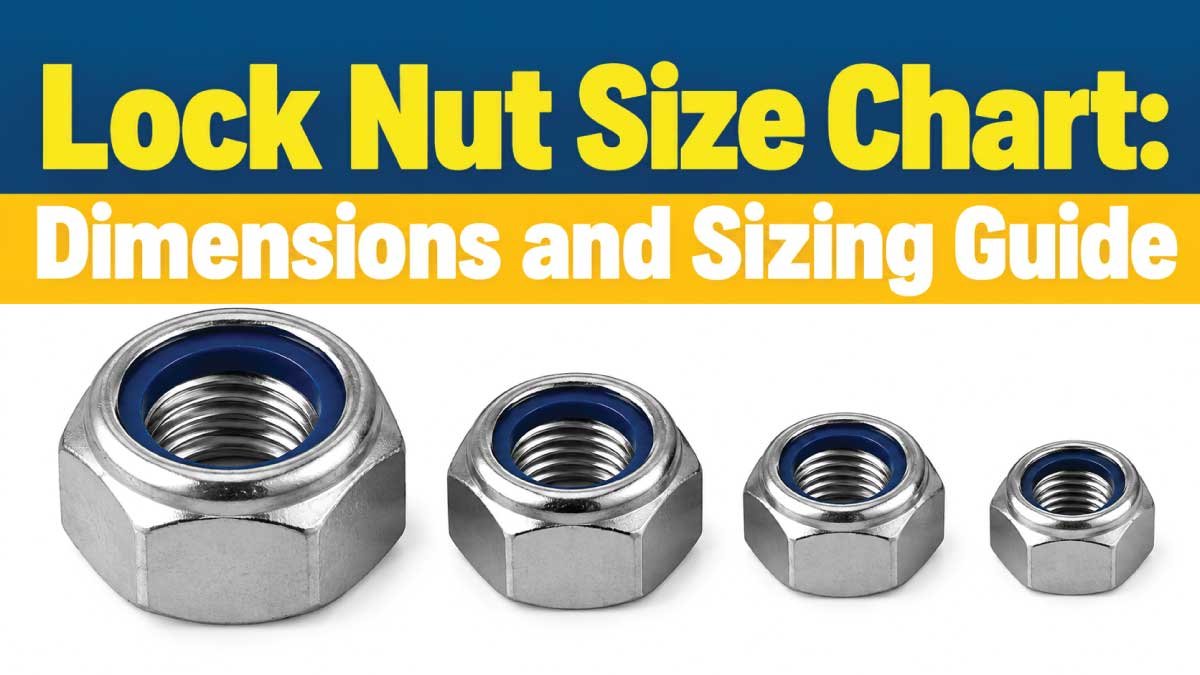
Lock nuts are essential fasteners designed to resist loosening when exposed to vibration, movement, or changing loads. They are widely used in automotive assemblies, machinery, construction equipment, plumbing systems, electrical installations, and industrial applications. Unlike ordinary nuts, many lock nuts incorporate special features that increase resistance to unintended rotation.
Choosing the correct lock nut requires understanding its thread diameter, pitch, wrench size, thickness, material, and locking mechanism. A lock nut size chart makes it easier to compare common dimensions and select a nut that fits the intended bolt or threaded rod.
This guide explains metric and imperial lock nut sizes, standard dimensions, common lock nut types, measurement methods, and practical tips for choosing the right fastener.
What Is a Lock Nut?
A lock nut is a threaded fastener designed to resist loosening after installation. It usually has the same basic internal thread arrangement as a compatible standard nut but includes an additional locking feature.
Depending on its design, a lock nut may use a nylon insert, distorted metal threads, a flange, or another mechanism to increase resistance to rotation.
Lock nuts are commonly used in applications where vibration or repeated movement could cause a conventional nut to loosen. Examples include vehicle suspension components, industrial machinery, agricultural equipment, mounting brackets, and mechanical assemblies.
Common lock nut dimensions include:
Nominal thread diameter: The bolt diameter the nut is designed to fit.
Thread pitch: The spacing between adjacent threads.
Across-flats width: The distance between two opposite flat sides, which determines wrench size.
Nut thickness: The distance between the nut’s bearing faces.
Locking feature dimensions: Measurements associated with a nylon insert, flange, distorted threads, or other locking mechanism.
Material and strength class: Properties that determine suitability for particular loads and environments.
The precise dimensions depend on the nut type, thread standard, material, and applicable manufacturing specification.
Metric Lock Nut Size Chart
Metric lock nuts are identified by an M designation followed by the nominal thread diameter in millimeters. Common sizes include M4, M5, M6, M8, M10, M12, and M16.
The following chart provides approximate reference dimensions for common metric lock nuts with standard hex-style external profiles. These are general identification values, not universal specifications for every nylon insert, all-metal, flange, or prevailing-torque lock nut.
| Lock Nut Size | Nominal Thread Diameter | Common Coarse Pitch | Typical Across-Flats Width | Approx. Standard-Style Thickness |
|---|---|---|---|---|
| M3 | 3 mm | 0.50 mm | 5.5 mm | Varies by design |
| M4 | 4 mm | 0.70 mm | 7 mm | Varies by design |
| M5 | 5 mm | 0.80 mm | 8 mm | Varies by design |
| M6 | 6 mm | 1.00 mm | 10 mm | Varies by design |
| M8 | 8 mm | 1.25 mm | 13 mm | Varies by design |
| M10 | 10 mm | 1.50 mm | 17 mm | Varies by design |
| M12 | 12 mm | 1.75 mm | 19 mm | Varies by design |
| M14 | 14 mm | 2.00 mm | 22 mm | Varies by design |
| M16 | 16 mm | 2.00 mm | 24 mm | Varies by design |
| M18 | 18 mm | 2.50 mm | 27 mm | Varies by design |
| M20 | 20 mm | 2.50 mm | 30 mm | Varies by design |
| M22 | 22 mm | 2.50 mm | 32–34 mm | Varies by design |
| M24 | 24 mm | 3.00 mm | 36 mm | Varies by design |
Important: The table lists common external wrench widths associated with standard-style metric hex nuts. Actual lock nut dimensions can differ, particularly for thin lock nuts, nylon insert nuts, flange nuts, and specialized prevailing-torque designs. Always verify the relevant product standard and manufacturer’s dimensional drawing.
How to Read Metric Lock Nut Sizes
An M10 lock nut is designed for a compatible M10 threaded fastener. The nominal diameter is 10 mm, and the common coarse thread pitch is 1.5 mm.
The M10 designation does not mean that the nut is 10 mm wide across its external faces. A typical standard hex-style M10 nut uses a 17 mm wrench, although specialized designs can have different dimensions.
Thread pitch is equally important. An M10 × 1.5 nut will not correctly match an M10 × 1.25 bolt because the threads have different spacing.
When buying metric lock nuts, confirm the complete thread designation, nut style, and material requirements.
Imperial Lock Nut Size Chart
Imperial lock nuts use inch-based thread sizes. Common nominal diameters include 1/4 inch, 5/16 inch, 3/8 inch, 1/2 inch, and 3/4 inch.
Imperial thread specifications commonly include Unified National Coarse (UNC) and Unified National Fine (UNF). UNC threads generally have fewer threads per inch than UNF threads of the same nominal diameter.
The table below provides representative thread sizes and common wrench widths for standard-style imperial hex nuts. Lock nut thickness and overall dimensions depend on the specific design and standard.
| Nominal Lock Nut Size | Thread Diameter | Common Coarse Thread | Typical Across-Flats Width | Thickness |
|---|---|---|---|---|
| 1/4 in | 0.250 in | 1/4-20 UNC | 7/16 in | Design-dependent |
| 5/16 in | 0.3125 in | 5/16-18 UNC | 1/2 in | Design-dependent |
| 3/8 in | 0.375 in | 3/8-16 UNC | 9/16 in | Design-dependent |
| 7/16 in | 0.4375 in | 7/16-14 UNC | 5/8 in | Design-dependent |
| 1/2 in | 0.500 in | 1/2-13 UNC | 3/4 in | Design-dependent |
| 9/16 in | 0.5625 in | 9/16-12 UNC | 7/8 in | Design-dependent |
| 5/8 in | 0.625 in | 5/8-11 UNC | 15/16 in | Design-dependent |
| 3/4 in | 0.750 in | 3/4-10 UNC | 1-1/8 in | Design-dependent |
| 7/8 in | 0.875 in | 7/8-9 UNC | 1-5/16 in | Design-dependent |
| 1 in | 1.000 in | 1-8 UNC | 1-1/2 in | Design-dependent |
The wrench widths above are common reference dimensions for standard-style hex profiles. Some lock nuts, especially thin jam-style nuts and products manufactured to different standards, use different across-flats dimensions.
Understanding Imperial Thread Designations
An imperial thread designation such as 3/8-16 UNC contains several pieces of information:
- 3/8: Nominal thread diameter in inches.
- 16: Number of threads per inch.
- UNC: Unified National Coarse thread series.
A 3/8-16 UNC lock nut must be paired with a compatible 3/8-16 UNC bolt. A 3/8-24 UNF fastener has a finer thread and requires a matching nut.
Never select an imperial lock nut based on diameter alone. Thread series and pitch must also match.
Types of Lock Nuts and Their Dimensions
Lock nuts come in several designs, each suited to different installation conditions. Their locking mechanisms can affect their height, outer diameter, installation torque, and suitability for repeated use.
1. Nylon Insert Lock Nuts
Nylon insert lock nuts, often called nyloc nuts, contain a nylon ring near one end of the nut. As the bolt enters the ring, the polymer creates resistance that helps prevent unintended rotation.
They are commonly used in machinery, automotive assemblies, furniture, equipment brackets, and general mechanical fastening.
Typical characteristics include:
- A hexagonal external shape.
- A threaded metal body.
- A nylon insert that grips the bolt threads.
- Additional installation resistance compared with a conventional nut.
- Temperature limitations determined by the insert material and product specification.
The nylon insert can make a lock nut taller than a comparable standard nut. However, the exact height and wrench size depend on the nominal thread diameter and applicable product standard.
Nylon insert nuts should not be used where operating temperatures exceed the insert’s rated limits. Their reuse suitability also depends on the manufacturer’s instructions and the condition of the locking feature.
2. All-Metal Lock Nuts
All-metal lock nuts use a metal locking mechanism rather than a polymer insert. The locking action may be produced by distorted threads, a deformed nut section, or another prevailing-torque design.
These nuts are often used in applications where a nylon insert is unsuitable because of temperature or environmental conditions.
Their dimensions vary according to design. Some resemble standard hex nuts, while others have a taller profile or specially formed upper section.
All-metal locking nuts can require higher installation torque than ordinary nuts. Follow the specified tightening procedure rather than applying a standard-nut torque value automatically.
3. Flange Lock Nuts
Flange lock nuts have a broad integrated flange at one end. The flange distributes the bearing load across a larger surface than a conventional nut.
Some designs have serrations beneath the flange to increase resistance to rotation. Serrated versions can mark the mating surface and may be unsuitable for finished, soft, or coated materials.
Important dimensions include:
- Nominal thread diameter.
- Across-flats width.
- Overall height.
- Flange outside diameter.
- Flange thickness.
- Thread pitch.
Because the flange extends beyond the main hex body, its overall diameter is larger than that of a comparable standard nut.
4. Jam Lock Nuts
Jam nuts are thinner than standard nuts and are commonly used in pairs. One nut is tightened against another to help resist loosening when installed correctly.
They are useful in assemblies with limited space, adjustment mechanisms, threaded rods, and certain machinery components.
A jam nut’s reduced thickness affects thread engagement and load capacity. It should not replace a standard or specified structural nut unless the application permits that arrangement.
5. Prevailing-Torque Lock Nuts
Prevailing-torque lock nuts resist rotation through a locking feature that maintains friction between the nut and bolt threads. The locking mechanism may be all-metal or use a nonmetallic insert.
These nuts are designed to provide resistance to loosening even before the joint develops its final clamping load.
Their installation and removal torque characteristics depend on the product specification. Reuse limits, if any, should be checked with the manufacturer.
6. Castle Nuts and Other Specialized Locking Arrangements
Castle nuts have slots at one end and are commonly used with a matching drilled bolt or stud and a retaining cotter pin. The pin provides a positive mechanical method of preventing the nut from rotating past the secured position.
Although castle nuts serve a locking purpose, they are dimensionally different from ordinary hex lock nuts. Their overall height, slot geometry, and compatible retaining hardware must be considered separately.
Not every locking nut works the same way. Select the design according to the application, required retention method, operating conditions, and relevant engineering requirements.
Key Lock Nut Dimensions Explained
Understanding each measurement helps you select a compatible lock nut and identify differences between nut styles.
Nominal Thread Diameter
The nominal thread diameter identifies the bolt size that the nut is intended to fit. Common metric examples include M6, M8, M10, and M12. Imperial examples include 1/4 inch, 3/8 inch, and 1/2 inch.
The nominal diameter does not describe the nut’s external width. It is the primary identifier for the threaded connection.
Thread Pitch
Thread pitch describes the spacing between adjacent thread peaks. Metric thread pitch is expressed in millimeters, while imperial threads are commonly identified by threads per inch.
For example, M8 × 1.25 indicates an 8 mm nominal diameter and a 1.25 mm pitch. A 1/2-13 UNC thread has a 1/2-inch nominal diameter and 13 threads per inch.
The pitch must match the bolt. A nut with the wrong pitch can cross-thread or damage the fastener.
Across-Flats Width
Across-flats width is the distance between two opposite flat faces of the nut. This dimension determines the wrench or socket size.
For example, a common standard-style M8 hex nut uses a 13 mm wrench, while an M10 version typically uses 17 mm. A common 1/2-inch imperial hex nut uses a 3/4-inch wrench.
Locking features do not necessarily change the across-flats width, but some specialized products may use different dimensions.
Nut Thickness and Overall Height
Nut thickness is the distance between the main bearing faces, measured parallel to the threaded hole. For lock nuts, the meaning of overall height may depend on the design.
A nylon insert nut may have a raised collar containing the insert. A flange nut includes a flange, while a castle nut has a slotted upper section.
When comparing products, use the manufacturer’s stated overall height and dimensional drawing instead of assuming all lock nuts share the same thickness as standard hex nuts.
Flange Diameter
For flange lock nuts, the flange diameter is the outside measurement of the integrated bearing surface. A wider flange can distribute the load over a larger area.
However, flange size alone does not establish whether the nut is suitable for a particular joint. Material, flange design, surface hardness, and load requirements also matter.
Material and Strength Class
Lock nuts can be manufactured from carbon steel, alloy steel, stainless steel, brass, and other materials.
The material influences corrosion resistance, strength, temperature suitability, and compatibility with the mating fastener. For demanding applications, verify the specified nut property class or grade rather than relying on the external dimensions.
Also Read:’
How to Measure a Lock Nut Correctly
Accurate measurement helps identify an existing nut and determine whether a replacement will fit.
Step 1: Measure the Across-Flats Width
Use a caliper to measure the distance between two opposite flat faces. Keep the measuring jaws square against the faces.
Compare the result with the appropriate metric or imperial reference chart. Remember that specialized lock nuts can have different wrench sizes from ordinary nuts.
Step 2: Determine the Nominal Thread Size
Identify the bolt or stud that fits the nut, if available. Check its nominal thread diameter and verify that the nut is designed for the same thread system.
If the bolt is unavailable, use suitable thread identification tools. Internal thread measurements alone can be misleading because the internal thread diameter is smaller than the nominal bolt diameter.
Step 3: Check the Thread Pitch
Use a metric or imperial thread-pitch gauge to determine the spacing. Match the nut to a compatible bolt with the same nominal diameter, pitch, and thread series.
Do not force the nut onto the bolt if it binds or fails to turn smoothly by hand.
Step 4: Measure the Height
Measure the nut parallel to the threaded hole. For a nylon insert nut, include the raised locking section when measuring overall height.
For flange nuts, identify the total height and flange thickness separately if those dimensions are required for clearance or engineering calculations.
Step 5: Inspect the Locking Mechanism
Check whether the nut uses a nylon insert, distorted metal threads, a flange, slots, or another locking feature.
Look for damaged threads, a worn insert, corrosion, deformation, or other signs that could affect performance. Follow the manufacturer’s instructions on reuse and replacement.
Step 6: Verify the Specification
Confirm the product type, material, strength class, coating, and applicable standard. This is particularly important for structural, automotive, industrial, and other safety-critical applications.
Also Read:’
Metric vs. Imperial Lock Nut Sizes
Metric and imperial lock nuts are manufactured using different thread systems and measurement conventions. Similar nominal diameters do not guarantee compatibility.
| Feature | Metric Lock Nuts | Imperial Lock Nuts |
|---|---|---|
| Measurement system | Millimeters | Inches |
| Common size designations | M6, M8, M10, M12 | 1/4 in, 3/8 in, 1/2 in |
| Thread pitch | Millimeters between threads | Threads per inch |
| Example coarse thread | M10 × 1.5 | 3/8-16 UNC |
| Common wrench sizing | Millimeter sockets | Inch-based sockets |
| Common locking styles | Nylon insert, all-metal, flange | Nylon insert, all-metal, flange |
For example, M10 and 3/8-inch threads have relatively similar nominal diameters, but their thread dimensions are not interchangeable by default.
Always confirm the complete thread designation before purchasing replacement nuts. This is particularly important when repairing imported machinery or combining components from different manufacturers.
How to Choose the Right Lock Nut Size
Selecting the correct lock nut involves checking the thread, external dimensions, locking mechanism, and intended service conditions.
Match the Bolt Diameter and Pitch
Start by identifying the nominal diameter and thread pitch of the bolt or stud. Both values must match the nut.
If the bolt has a fine thread, choose a compatible fine-thread lock nut rather than assuming a coarse-thread nut will fit.
Choose the Correct Locking Style
Consider the conditions in which the fastener will operate.
- Use a nylon insert nut when its temperature and environmental limits are suitable.
- Consider an all-metal lock nut where a polymer insert is unsuitable.
- Select a flange lock nut when its bearing surface and locking characteristics suit the joint.
- Use a specified jam-nut arrangement when space or adjustment requirements call for it.
- Follow the engineering specification for safety-critical assemblies.
No locking design is universally best. The right option depends on the load, vibration, temperature, materials, and service requirements.
Check Clearance and Wrench Access
Confirm the across-flats width, overall height, and external diameter. A nut may have the correct thread but still be unsuitable if a nearby component prevents the wrench from reaching it.
Flange lock nuts and nylon insert nuts can have different external dimensions from ordinary hex nuts.
Consider Corrosion Resistance
Choose a material and coating suitable for the operating environment. Stainless steel may be appropriate for some corrosive conditions, while coated carbon steel may be specified for other applications.
Ensure the nut and bolt materials are compatible. Also consider galvanic corrosion when dissimilar metals are exposed to moisture or other conductive environments.
Verify Strength and Installation Requirements
For load-bearing applications, use the specified nut grade and matching fastener system. Follow the recommended torque and installation procedure.
Prevailing-torque lock nuts can require additional torque to overcome the locking feature. Do not assume that the torque specification for a conventional nut applies unchanged to every locking design.
Also Read:’
Common Lock Nut Sizing Mistakes
Incorrect identification can result in thread damage, poor clamping, or loosening. Avoid these frequent mistakes:
Matching only the diameter: Thread pitch and series must also match.
Confusing wrench size with thread size: The external width is not the nominal thread diameter.
Ignoring the locking mechanism: Nylon insert, all-metal, flange, and jam nuts have different characteristics.
Assuming standard-nut dimensions apply: Specialized lock nuts can have different heights and external profiles.
Mixing metric and imperial fasteners: Similar diameters do not establish thread compatibility.
Ignoring temperature limits: Nylon inserts may be unsuitable for high-temperature service.
Reusing damaged lock nuts: Worn inserts or damaged locking features may not provide the required resistance.
Using an incorrect torque value: Locking resistance affects installation torque.
Ignoring the required strength class: Correct dimensions alone do not guarantee adequate load capacity.
Checking the complete specification is more reliable than selecting a replacement based only on appearance.
Frequently Asked Questions About Lock Nut Sizes
What Size Lock Nut Do I Need for an M10 Bolt?
You generally need an M10 lock nut with a thread pitch matching the bolt. For a common coarse-thread M10 bolt, that pitch is 1.5 mm. A standard-style M10 hex profile often uses a 17 mm wrench, but the overall height depends on the locking design.
Are Lock Nuts the Same Size as Regular Nuts?
Not always. Some lock nuts share the same nominal thread diameter and across-flats width as standard nuts, but their height, flange diameter, and locking features may differ.
How Do I Know the Wrench Size for a Lock Nut?
Measure across two opposite flat faces using a caliper. The measurement indicates the across-flats width, which usually corresponds to the required wrench or socket size. Check the manufacturer’s specification for specialized designs.
Can I Reuse a Nylon Insert Lock Nut?
Reuse depends on the manufacturer’s instructions, the nut’s condition, and the application. If the insert is damaged, loose, worn, or no longer provides the specified locking resistance, replace the nut. Some critical applications require new locking nuts after removal.
What Is the Difference Between a Lock Nut and a Jam Nut?
A lock nut uses a locking feature or design to resist rotation. A jam nut is typically thinner and is often tightened against another nut to help resist loosening. A jam nut is not necessarily a specialized prevailing-torque lock nut.
Are All-Metal Lock Nuts Better Than Nylon Insert Nuts?
Neither is universally better. All-metal lock nuts may suit higher-temperature environments where polymer inserts are unsuitable. Nylon insert nuts are useful where their locking performance and temperature rating meet the application requirements.
Can I Use a Lock Nut on a Fine-Thread Bolt?
Yes, provided the lock nut has the same nominal diameter, fine-thread pitch, and thread series as the bolt. A coarse-thread nut should not be used on a fine-thread bolt.
Does a Lock Nut Need a Washer?
That depends on the joint design, mating surfaces, and manufacturer’s instructions. Some flange lock nuts provide an integrated bearing surface, while other assemblies may require a separate washer. Follow the applicable fastening specification.
Conclusion
A lock nut size chart helps identify the correct fastener by comparing nominal thread diameter, thread pitch, across-flats width, and overall height. However, lock nuts come in several designs, and their dimensions can differ from those of standard hex nuts.
For reliable fastening, match the lock nut to the exact bolt thread specification, select a suitable locking mechanism, and confirm the required material and strength class. Use general sizing charts for identification, but consult the applicable product standard or manufacturer’s drawing when precise dimensions and performance are essential.
