
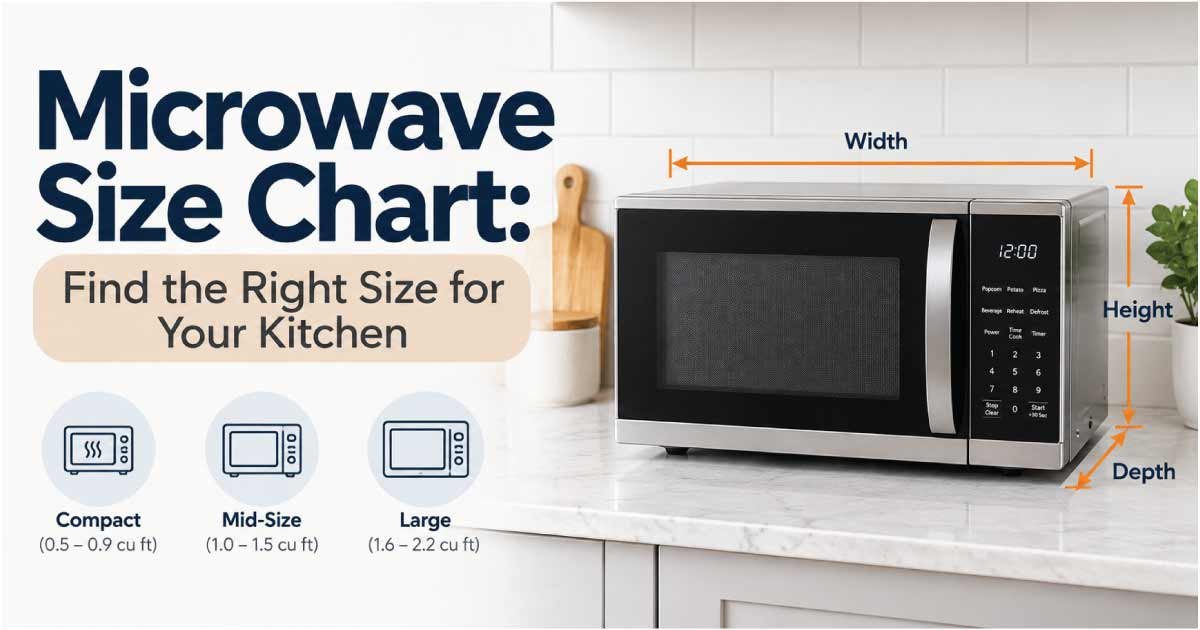
Choosing the right microwave is about more than finding a model that looks good on your countertop. Microwave size affects where the appliance can be installed, how much food it can hold, how much counter or cabinet space it uses, and whether there is enough room around it for safe operation and ventilation.
A microwave can have a large cooking capacity while having a relatively compact exterior, or it can take up considerable kitchen space without offering the capacity you actually need. That is why checking microwave dimensions, capacity, clearance, and installation type before buying is important.
This microwave size chart explains common microwave dimensions, interior capacity, countertop and over-the-range models, how to measure your available space, and how to choose the right size for your kitchen.
Microwave Size Chart
Microwave sizes are commonly described using both exterior dimensions and interior cooking capacity. Exterior measurements tell you whether the appliance will fit in its intended location, while capacity indicates how much food and what size dishes it can accommodate.
The following chart provides practical size categories rather than a single universal standard. Exact dimensions vary considerably by manufacturer and model.
| Microwave Size | Approx. Width | Approx. Height | Approx. Depth | Typical Capacity | Best For |
|---|---|---|---|---|---|
| Compact | 15–19 in | 9–13 in | 12–15 in | 0.5–0.9 cu. ft. | Small kitchens, dorms, light use |
| Small | 18–21 in | 10–13 in | 14–17 in | 0.9–1.2 cu. ft. | Apartments and couples |
| Medium | 20–24 in | 12–14 in | 15–19 in | 1.2–1.6 cu. ft. | General household use |
| Large | 24–30 in | 13–18 in | 17–20 in | 1.6–2.0 cu. ft. | Families and larger dishes |
| Extra Large | 28–36 in | 16–22 in | 18–23 in | 2.0+ cu. ft. | Large households and heavy use |
These ranges are general size categories, not manufacturer specifications. Always check the product’s published dimensions before purchasing, particularly for built-in, over-the-range, or cabinet installations.
What Are the Standard Microwave Dimensions?
There is no single universal microwave dimension that every manufacturer follows. Microwave dimensions depend heavily on the appliance type, capacity, design, ventilation system, and installation method.
For a countertop microwave, you will generally need to consider:
- Width: the horizontal space required from side to side.
- Height: the vertical space occupied by the appliance.
- Depth: how far the microwave extends from the back toward the front.
- Door swing: the additional area needed to open the door comfortably.
- Rear and side clearance: space required for ventilation and safe operation.
A microwave that measures 20 inches wide on paper may need more usable space than 20 inches because of ventilation requirements, a projecting door, power cord placement, or surrounding cabinets.
Typical Countertop Microwave Dimensions
Countertop models are available in compact sizes for small spaces and larger capacities for family kitchens.
A compact countertop microwave may be around 15–19 inches wide, while larger models can approach or exceed 30 inches. Height and depth also increase as capacity and features increase.
If your microwave will sit beneath a cabinet, measure the complete available opening rather than assuming that a particular capacity will fit.
Typical Over-the-Range Microwave Dimensions
Over-the-range, or OTR, microwaves are designed to install above a cooktop or range. Their dimensions are often influenced by the width of the cooking appliance and the surrounding cabinetry.
Many OTR models are designed around common range widths, but you should never assume that every model will fit the same opening.
Check:
- Cabinet width
- Opening width
- Available height
- Cabinet depth
- Vent configuration
- Electrical connection
- Manufacturer installation requirements
Because an over-the-range microwave also serves as part of the ventilation arrangement above the cooking surface, installation requirements are more important than simply matching exterior dimensions.
Microwave Size by Capacity
Microwave capacity is usually measured in cubic feet (cu. ft.). It describes the approximate volume of the cooking cavity rather than the appliance’s exterior dimensions.
Common household microwave capacities range from compact models under 1 cubic foot to large models exceeding 2 cubic feet.
| Capacity | General Size Category | Typical Use |
|---|---|---|
| 0.5–0.8 cu. ft. | Compact | Drinks, snacks, small portions |
| 0.9–1.1 cu. ft. | Small | Individual meals and everyday reheating |
| 1.2–1.5 cu. ft. | Medium | General household cooking |
| 1.6–1.9 cu. ft. | Large | Family meals and larger dishes |
| 2.0+ cu. ft. | Extra large | Large cookware and frequent cooking |
Capacity is useful, but it should not be used alone to determine whether a microwave will fit your kitchen.
Two microwaves with similar cubic-foot capacities can have different exterior dimensions because manufacturers use different cavity shapes, insulation, control layouts, motors, turntables, and ventilation arrangements.
Countertop vs. Over-the-Range vs. Built-In Microwaves
The best microwave size depends partly on where you plan to install it.
Countertop Microwaves
Countertop microwaves are usually the simplest option because they sit on a stable kitchen surface and do not require specialized cabinet installation.
They are a good choice when:
- You have sufficient counter space.
- You want easy installation.
- You may move the microwave later.
- You do not need a built-in appearance.
- You want a broad range of sizes and prices.
The main disadvantage is that a countertop model permanently occupies some of your work surface.
Over-the-Range Microwaves
An over-the-range microwave combines microwave cooking with ventilation above a range or cooktop.
These models can save countertop space and create a more integrated kitchen appearance. However, they require more careful installation planning.
Before selecting one, verify the manufacturer’s requirements for mounting height, cabinet configuration, ventilation, electrical supply, and clearances.
Built-In Microwaves
Built-in microwaves are designed to integrate into cabinetry or a wall installation. They can provide a clean, customized appearance but require much more precise measurements.
The cabinet opening must be compatible with the manufacturer’s installation instructions. A microwave that is physically smaller than the opening is not automatically suitable because trim kits, ventilation, support, and required clearances may affect the installation.
Drawer Microwaves
Microwave drawers open horizontally from the bottom rather than using a conventional side-hinged door. They can provide convenient access and preserve countertop space.
However, drawer microwaves require a purpose-designed cabinet opening and should be selected according to the manufacturer’s installation dimensions rather than general microwave size categories.
How to Measure for a Microwave
Taking accurate measurements before shopping can prevent one of the most common microwave-buying mistakes: purchasing a model that technically fits the space but does not leave enough room for installation or comfortable use.
Step 1: Measure the Available Width
Use a tape measure to determine the horizontal distance available for the microwave.
Measure at several points if the microwave will be placed inside a cabinet opening. Walls and cabinets are not always perfectly square.
Record the smallest usable width.
Do not measure only the old microwave unless you are replacing it with the same model or a model with confirmed compatible dimensions.
Step 2: Measure the Available Height
Measure from the bottom surface to the cabinet or other obstruction above it.
This is especially important for a countertop microwave placed beneath overhead cabinets.
Leave the clearance specified by the manufacturer rather than filling every available inch.
Step 3: Measure the Available Depth
Measure from the back wall to the front edge of the counter or cabinet.
Remember that the published microwave depth may not represent every part of the appliance. Doors, handles, control panels, feet, and other components can affect how far the appliance projects.
Step 4: Check Door Clearance
A microwave can fit within its designated footprint but still be inconvenient if the door cannot open fully.
Check:
- Direction of the door swing
- Nearby walls
- Adjacent cabinets
- Refrigerator or appliance doors
- Counter edges
- Walkways
If the microwave is installed in a corner, door clearance deserves particular attention.
Step 5: Check Ventilation and Manufacturer Clearance
Do not assume that placing a microwave tightly between cabinets is acceptable.
Different models have different ventilation arrangements and installation requirements. Follow the manufacturer’s instructions for the required clearances around the appliance.
How Much Counter Space Does a Microwave Need?
The amount of counter space required depends on the microwave’s exterior dimensions and installation requirements.
For example, a microwave that is approximately 20 inches wide and 16 inches deep needs substantially more usable counter area than a compact model measuring 17 inches by 13 inches.
When planning your counter, consider the entire footprint, not just width.
You should also think about whether you need room beside the microwave to place hot dishes. A microwave located directly against a wall or at the end of a narrow counter may technically fit but can be less convenient to use.
A practical location should provide:
- A stable, level surface
- Appropriate ventilation
- Easy access to controls
- Adequate door clearance
- Convenient access to an appropriate electrical outlet
- Enough nearby counter space to handle hot containers safely
How to Choose the Right Microwave Size
The right microwave size is a balance between available space and cooking requirements.
Start by determining where the microwave will go. Then select a capacity that matches the dishes and portions you regularly prepare.
For One Person
A compact microwave may be sufficient if you primarily reheat drinks, small meals, leftovers, and frozen portions.
A smaller model can also make sense when counter space is limited.
For Two People
A small-to-medium microwave often provides a useful balance between capacity and footprint.
Consider the dishes you use most often. If you regularly heat larger plates or casserole dishes, moving up in capacity may be worthwhile.
For Families
Families often benefit from medium or large-capacity microwaves because they are more likely to heat larger portions and wider dishes.
However, choosing the biggest model available is not always the best decision. A large microwave can consume valuable counter space and may be unnecessary if most meals are prepared in small containers.
For Small Kitchens
Compact microwaves are useful when every inch of counter space matters.
Consider alternatives such as:
- An over-the-range microwave
- A built-in model
- A microwave drawer
- A designated appliance shelf
The installation type should be selected based on the kitchen layout and the manufacturer’s requirements.
Microwave Size and Dish Size
One of the easiest ways to choose microwave capacity is to consider the dishes you actually use.
Before buying, identify the largest plate, bowl, or container you commonly place inside the microwave.
Check:
- Plate diameter
- Container height
- Container width
- Turntable diameter, if applicable
- Cavity height
- Door opening
A microwave may have adequate cubic-foot capacity but still be inconvenient for a particular dish if the cavity dimensions do not accommodate it comfortably.
Turntable Size Matters
Many microwaves use a rotating glass turntable. The diameter of this turntable can be important when heating large plates.
A microwave with a relatively large cavity may still have limitations depending on the turntable design.
Some models use different cavity or turntable configurations, so check the manufacturer’s specifications if you frequently use oversized plates.
Microwave Clearance: What You Need to Know
Clearance is one of the most overlooked parts of choosing a microwave.
Clearance refers to the space around an appliance that may be necessary for ventilation, heat management, operation, installation, or access.
The required clearances are not identical for every microwave.
For this reason, there is no single clearance number that can safely be applied to all models.
Before installation, check the manufacturer’s documentation for:
- Minimum clearance above the appliance
- Side clearance
- Rear clearance
- Front projection
- Ventilation requirements
- Installation opening dimensions
- Mounting requirements
For an OTR or built-in microwave, follow the installation instructions particularly carefully. Improper installation can affect appliance operation and may create safety or warranty concerns.
Also Read:
Common Microwave Size Mistakes
Choosing a microwave based only on appearance or capacity can cause problems.
Buying Based Only on Cubic Feet
Capacity does not tell you the complete exterior dimensions.
Always compare width, height, depth, and installation requirements.
Measuring Only the Countertop
A microwave may fit the countertop but interfere with an upper cabinet, wall, appliance door, or walkway.
Measure the complete space around it.
Ignoring Door Swing
A microwave needs operating space, not merely footprint space.
Check whether the door can open comfortably without hitting a wall or nearby appliance.
Forgetting the Power Cord
The power cord and outlet location can affect placement, especially when the appliance sits inside a tight space.
Assuming All Microwaves of the Same Size Are Identical
Two 1.2-cubic-foot microwaves may have noticeably different exterior dimensions and cavity proportions.
Always check the exact model specifications.
Installing Without Checking Manufacturer Instructions
This is particularly important for built-in and over-the-range microwaves. General size charts can help you narrow your options, but the manufacturer’s installation documentation should determine the final fit.
Also Read:
Microwave Size Comparison by Kitchen Type
Your kitchen layout can help narrow the most practical microwave category.
| Kitchen Situation | Recommended Approach | Why |
|---|---|---|
| Small apartment kitchen | Compact or small countertop | Conserves counter space |
| Limited countertop | OTR or built-in | Frees working surface |
| Two-person household | Small to medium | Balances capacity and footprint |
| Family kitchen | Medium to large | Accommodates larger portions |
| Large cooking area | Medium to extra large | More flexibility for cookware |
| Custom cabinetry | Built-in or drawer | Designed for integrated installation |
| Temporary housing | Countertop | Easy to install and relocate |
These are general recommendations. Your actual choice should be based on the space available and the dishes you use most often.
Microwave Size for Different Uses
Different cooking habits can require different capacities.
Reheating Leftovers
If your microwave is primarily used for leftovers, beverages, and individual meals, a compact or small model may be enough.
Heating Dinner Plates
If you frequently heat full dinner plates, choose a cavity and turntable configuration that can accommodate the plate comfortably.
Cooking Frozen Meals
Many frozen meals fit comfortably in smaller microwaves, but packaging dimensions vary. If you regularly prepare larger meals, compare the internal cavity dimensions before buying.
Cooking Large Portions
Larger households may benefit from a bigger cavity, especially when using wide dishes or larger containers.
The important factor is not simply capacity but whether the interior dimensions match your cookware.
Also Read:
Built-In Microwave Size Considerations
Built-in installation requires greater precision than countertop placement.
If you are replacing an existing built-in microwave, measure the cabinet opening carefully. Record:
- Opening width
- Opening height
- Opening depth
- Available ventilation space
- Trim dimensions
- Electrical location
- Support or mounting requirements
Do not assume that a replacement with identical advertised capacity will fit the existing opening.
Trim kits can also change the overall installation dimensions. If a manufacturer specifies a particular trim kit, use the complete installation dimensions rather than the microwave’s bare appliance dimensions.
How Much Microwave Capacity Do You Actually Need?
More capacity is not automatically better.
A larger microwave may provide more room for cookware, but it also generally occupies more physical space.
Use this simple decision process:
- Measure the available installation space.
- Determine your largest commonly used dish.
- Choose a capacity that accommodates your cooking habits.
- Compare exact exterior dimensions.
- Check door and ventilation clearance.
- Review the manufacturer’s installation requirements.
This approach prevents you from selecting an appliance based solely on a capacity number.
Microwave Size Buying Checklist
Before purchasing a microwave, check each of these items:
- Width: Does it fit the available opening?
- Height: Is there sufficient vertical space?
- Depth: Will it project too far into the room?
- Capacity: Is the cooking cavity large enough?
- Dish size: Can it accommodate your largest commonly used dish?
- Door: Can the door open fully?
- Clearance: Are the manufacturer’s required clearances available?
- Ventilation: Is the installation suitable for the model?
- Electrical supply: Is the required outlet available in the correct location?
- Installation type: Is it countertop, OTR, built-in, or drawer?
- Cabinet opening: Does the complete installation specification match?
- User access: Can everyone comfortably reach and operate it?
Taking a few minutes to verify these details can save you from returning an appliance that does not work with your kitchen layout.
Frequently Asked Questions About Microwave Sizes
What is a standard microwave size?
There is no single standard microwave size. Countertop models commonly range from compact units around 15–19 inches wide to larger models around 30 inches or more. Exact dimensions vary by manufacturer, capacity, and design, so check the specifications for the individual model.
What is the most common microwave capacity?
Many household microwaves fall within the small-to-large residential range of roughly 0.9 to 2.0 cubic feet. The best capacity depends on your cooking habits, available space, and the size of dishes you regularly heat.
Is a 1.0 cu. ft. microwave big enough?
A 1.0-cubic-foot microwave can be suitable for individual meals, reheating, drinks, and many everyday uses. However, whether it is large enough depends on the diameter and height of the dishes you use.
How do I know what size microwave will fit?
Measure the available width, height, and depth, then compare those measurements with the microwave’s published exterior dimensions. Also check door swing, ventilation, and the manufacturer’s required installation clearances.
Does microwave capacity determine its outside dimensions?
Not exactly. Capacity describes the approximate internal cooking volume, while exterior dimensions include the cabinet, insulation, controls, ventilation system, door, and other components. Two microwaves with the same capacity can therefore have different exterior dimensions.
How much space should I leave around a microwave?
The required space varies by model and installation type. Rather than relying on a universal clearance number, follow the manufacturer’s installation instructions for the specific microwave you purchase.
Are over-the-range microwaves a standard size?
Many over-the-range microwaves are designed around common kitchen layouts and range widths, but their exact dimensions vary. Always compare the manufacturer’s installation dimensions with your cabinet and cooking-area measurements.
Can I put a countertop microwave inside a cabinet?
Not necessarily. A countertop microwave is not automatically suitable for enclosed cabinet installation. Ventilation and clearance requirements vary, so you should only place one in a cabinet or enclosed area when the manufacturer specifically permits that installation.
Is a bigger microwave better for a family?
A larger microwave can be useful for families because it may accommodate larger dishes and portions. However, the biggest model is not always the best choice. Select a capacity that matches your cookware and available kitchen space.
What should I measure when replacing my old microwave?
Measure the available opening or countertop space rather than simply copying the old microwave’s dimensions. Check width, height, depth, door clearance, ventilation, outlet location, and any cabinet or mounting requirements.
Final Thoughts on Choosing the Right Microwave Size
The best microwave size is the one that fits your kitchen, accommodates your cookware, and matches the way you actually use the appliance.
Start with the physical space. Measure the available width, height, and depth, then consider door clearance and ventilation. Next, look at cooking capacity and the size of your most frequently used dishes. Finally, compare the exact manufacturer’s specifications before buying.
For a compact kitchen, a smaller countertop microwave may provide the right balance. Families or frequent microwave users may prefer a larger cavity, while kitchens with limited counter space may benefit from an over-the-range, built-in, or drawer model.
Use this microwave size chart as a starting point, but always verify the exact dimensions and installation requirements of the model you choose. A few accurate measurements before purchase can make the difference between a microwave that merely fits and one that works comfortably in your kitchen.
