
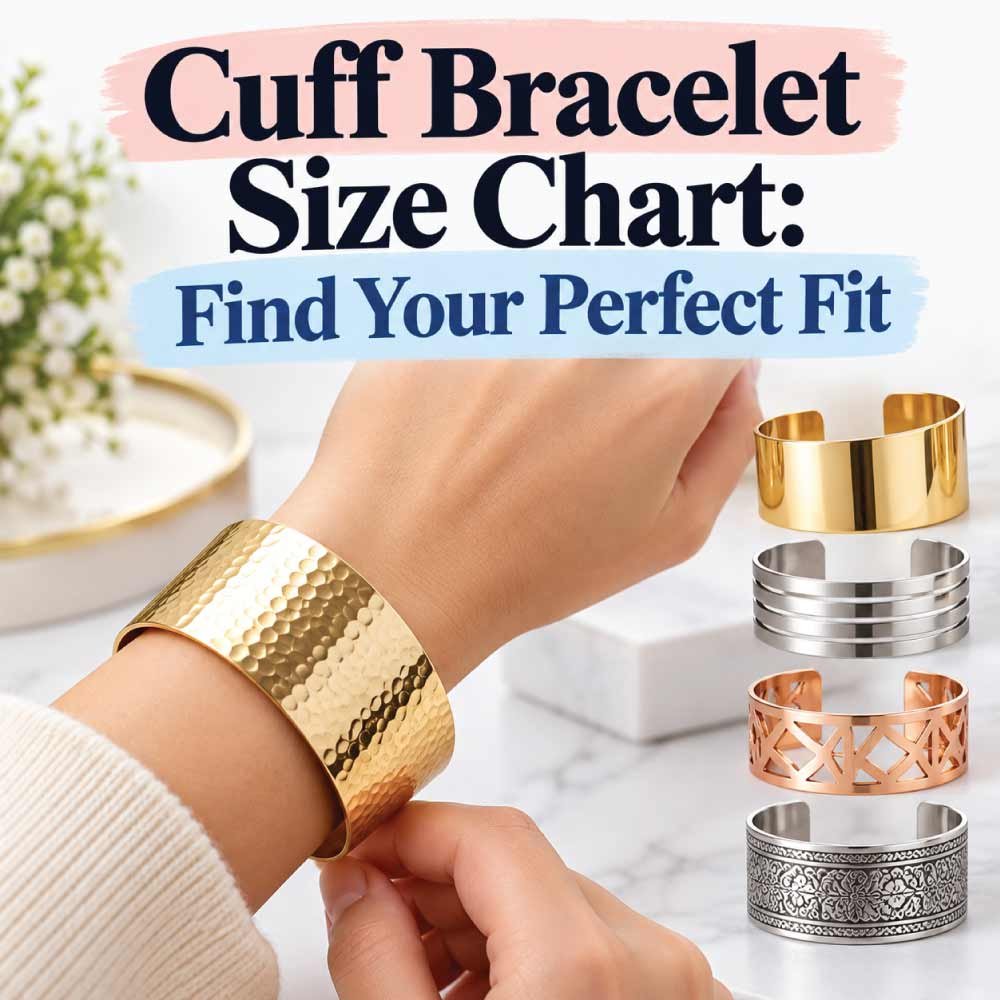
A cuff bracelet can look stylish and feel comfortable only when it fits your wrist properly. Unlike a closed bangle or standard bracelet, a cuff has an opening that allows it to slide onto the wrist, so wrist circumference, bracelet length, opening size, and fit preference all matter.
A reliable cuff bracelet size chart can help you estimate the right size before buying, but cuff bracelets do not follow one universal sizing standard. Different manufacturers may measure the bracelet differently, and a rigid metal cuff can fit very differently from a flexible or adjustable design.
This guide explains how cuff bracelet sizing works, how to measure your wrist accurately, how to use a size chart, and how to choose between a snug, standard, or relaxed fit. You will also find practical measurement tables, conversion guidance, common mistakes, and answers to frequently asked questions.
Cuff Bracelet Size Chart
The first step in choosing a cuff bracelet is to measure the circumference of your wrist. The table below provides a general wrist-size reference for selecting a cuff bracelet. Because designs vary, always compare your measurement with the individual product’s sizing information when available.
| Wrist Circumference | Wrist Size | Typical Fit Category | General Cuff Recommendation |
|---|---|---|---|
| 5.0–5.5 in | 12.7–14.0 cm | Extra Small | Small or adjustable cuff |
| 5.5–6.0 in | 14.0–15.2 cm | Small | Small cuff |
| 6.0–6.5 in | 15.2–16.5 cm | Medium | Medium cuff |
| 6.5–7.0 in | 16.5–17.8 cm | Large | Large or adjustable cuff |
| 7.0–7.5 in | 17.8–19.1 cm | Extra Large | Large or extended cuff |
| 7.5–8.0 in | 19.1–20.3 cm | XX-Large | Extended or adjustable cuff |
| 8.0+ in | 20.3+ cm | Extended | Extra-large or custom cuff |
These categories are general sizing references rather than universal industry standards. A cuff’s internal diameter and opening can affect the actual fit just as much as wrist circumference.
For example, someone with a 6.5-inch wrist may wear a medium-sized cuff from one manufacturer but require a large cuff from another. The construction, thickness, shape, and opening of the cuff all influence the result.
What Is a Cuff Bracelet?
A cuff bracelet is a type of wrist jewelry designed with an opening rather than a completely closed circular shape. The opening allows the bracelet to be placed around the wrist without passing over the hand in the same way a closed bangle does.
Cuffs may be made from:
- Sterling silver
- Gold or gold-plated metals
- Stainless steel
- Brass
- Leather
- Wood
- Beaded materials
- Mixed materials
Some cuffs are rigid, while others are slightly flexible or adjustable.
The main advantage of a cuff is its open construction. This can make it easier to put on and remove, particularly when compared with rigid bracelets that must fit over the widest part of the hand.
However, the open design also creates an important sizing consideration: the cuff should not be judged by wrist circumference alone.
How Cuff Bracelet Sizing Works
Cuff bracelet sizing can be confusing because jewelry sellers may provide several different measurements.
The most common measurements include:
- Wrist circumference: The distance around your wrist.
- Cuff length: The length of the bracelet material from one end to the other.
- Cuff width: The visible width of the bracelet on the wrist.
- Opening width: The gap between the two open ends.
- Inside diameter: The approximate distance across the inside of a curved cuff.
- Overall diameter: The outside measurement across the bracelet.
- Thickness: The depth of the bracelet material.
Among these, wrist circumference is usually the best starting measurement, but the opening and internal dimensions are especially important for rigid cuffs.
A wide cuff may also need more careful sizing than a narrow cuff because its shape can restrict movement more noticeably.
How to Measure Your Wrist for a Cuff Bracelet
Measuring your wrist takes less than a minute if you have a flexible measuring tape. If you do not have one, you can use a strip of paper or string and measure it afterward with a ruler.
Method 1: Flexible Measuring Tape
Wrap a soft measuring tape around your wrist where you intend to wear the cuff.
Keep the tape:
- Snug against the skin
- Comfortable rather than tight
- Level around the wrist
- Free from twisting
- Positioned at the natural bracelet-wearing area
Read the measurement where the tape meets itself.
Do not pull the tape tightly. A measurement that compresses your wrist can produce a cuff that feels too restrictive.
Method 2: String or Paper Strip
If you do not have a measuring tape:
- Wrap a thin strip of paper or non-stretch string around your wrist.
- Mark the point where the ends meet.
- Lay the strip flat.
- Measure the marked length with a ruler.
- Record the result in inches or centimeters.
This method works well, provided the paper or string is not stretched.
Where Should You Measure?
Measure around the part of your wrist where you expect the cuff to sit.
For many people, this is slightly above the wrist joint. If you plan to wear a particularly wide cuff, you may want to measure at several nearby positions because the wrist does not have exactly the same circumference everywhere.
Wrist Measurement Conversion Chart
If a bracelet seller provides measurements in centimeters but you measured in inches, use a conversion reference like the one below.
| Wrist Measurement (inches) | Approx. Wrist Measurement (cm) | General Size |
|---|---|---|
| 5.0 in | 12.7 cm | Extra Small |
| 5.5 in | 14.0 cm | Small |
| 6.0 in | 15.2 cm | Small |
| 6.5 in | 16.5 cm | Medium |
| 7.0 in | 17.8 cm | Large |
| 7.5 in | 19.1 cm | Extra Large |
| 8.0 in | 20.3 cm | XX-Large |
The conversion is based on 1 inch = 2.54 centimeters.
Do not assume that converting the measurement automatically determines your bracelet size. It only puts your wrist measurement into the unit used by the seller.
Choosing the Right Cuff Bracelet Fit
Your wrist measurement is only part of the decision. The ideal cuff fit depends on how you want the bracelet to feel and how much movement you prefer.
Snug Fit
A snug cuff sits relatively close to the wrist without causing pressure or discomfort.
This style may work well if you:
- Prefer a secure feel
- Want limited movement
- Wear the cuff during normal daily activities
- Prefer a streamlined appearance
A cuff should never feel painful, numb, or excessively tight.
Standard or Comfortable Fit
A comfortable everyday fit allows some natural movement while remaining secure on the wrist.
For many wearers, this is the most practical choice because the bracelet can move slightly without constantly sliding toward the hand.
Relaxed Fit
A relaxed cuff allows more movement around the wrist.
This may suit someone who prefers:
- A looser jewelry style
- More visible movement
- Layering with other bracelets
- A larger statement cuff
However, an excessively loose cuff can catch on clothing, rotate unpredictably, or become easier to lose.
Cuff Bracelet Opening Size Matters
One of the biggest differences between cuffs and closed bracelets is the opening.
A cuff can have the correct overall size but still be uncomfortable if the opening is too narrow for your hand or too wide for the intended fit.
When a seller provides an opening measurement, check it carefully.
Small Opening
A smaller opening may create a more secure fit once the cuff is on the wrist, but it can make putting the bracelet on and removing it more difficult.
Medium Opening
A moderate opening provides a balance between accessibility and security. This is often a practical choice for everyday wear.
Large Opening
A larger opening can make the cuff easier to put on, but it may also allow greater movement or make the bracelet feel less secure.
The right opening depends on the cuff’s shape, material, and whether the manufacturer allows the piece to be adjusted.
Cuff Bracelet vs. Bangle: What Is the Difference?
Cuff bracelets and bangles are often confused because both are worn around the wrist, but their sizing systems are different.
| Feature | Cuff Bracelet | Bangle |
|---|---|---|
| Design | Open-ended | Usually closed |
| Main sizing concern | Wrist and opening | Wrist and hand clearance |
| Easy to put on | Usually yes | Depends on design |
| Adjustability | Some designs allow it | Usually limited |
| Opening | Present | Usually absent |
| Fit movement | Can vary considerably | Usually slides around wrist |
| Measurement approach | Wrist circumference plus cuff dimensions | Wrist/hand measurement and internal diameter |
A closed bangle generally needs enough internal space to pass over the hand. A cuff does not have that same requirement because of its opening.
That is why you should not automatically use a bangle size chart to select a cuff bracelet.
How to Choose a Cuff Bracelet Width
Width affects both appearance and comfort.
Narrow Cuffs
Narrow cuffs are often lightweight-looking and easy to combine with other jewelry. They may also allow more natural wrist movement.
Medium-Width Cuffs
Medium cuffs offer a balance between visibility and everyday practicality. They can work well as standalone jewelry or as part of a layered look.
Wide Cuffs
Wide cuffs create a stronger statement and cover more of the wrist.
Because they occupy more surface area, they can feel different from narrow cuffs even when both have the same circumference. A wide cuff may need a little more attention to its curvature and placement.
When shopping for a wide cuff, look beyond the basic size label and examine the actual width, internal dimensions, and opening.
Also Read:
Adjustable Cuff Bracelets
Adjustable cuffs are designed to accommodate a range of wrist sizes. They can be particularly useful when the wearer is between standard sizes.
However, “adjustable” does not mean unlimited.
Before adjusting a cuff, check the manufacturer’s instructions. Repeatedly bending a rigid metal bracelet back and forth can potentially weaken or damage the material, especially if the design was not intended for frequent adjustment.
If adjustment is permitted, make small changes rather than repeatedly opening and closing the cuff.
An adjustable cuff can be a good option when:
- Your wrist falls between standard sizes.
- You are buying a gift and do not know the exact wrist measurement.
- You prefer to change the fit.
- You want additional flexibility when layering bracelets.
How to Check Cuff Bracelet Fit
After putting on a cuff, check several things rather than judging the fit by appearance alone.
A properly fitting cuff should:
- Feel comfortable during normal wrist movement.
- Avoid excessive pressure.
- Stay reasonably secure.
- Allow normal circulation.
- Not pinch the skin.
- Not slide excessively toward the hand.
- Not rotate uncontrollably.
- Have an opening appropriate for the design.
Move your wrist naturally and observe the bracelet.
If the cuff leaves significant pressure marks, feels painful, or restricts movement, it may be too tight. If it constantly moves far up and down your wrist or feels like it could fall off, it may be too loose.
Also Read:
Common Cuff Bracelet Sizing Mistakes
Even a carefully measured wrist can lead to a poor purchase if the bracelet’s dimensions are misunderstood.
Using Only the Size Label
Terms such as Small, Medium, and Large are not necessarily standardized across jewelry brands.
Always prioritize the manufacturer’s actual measurements when they are provided.
Measuring Too Tightly
Pulling the tape tightly around your wrist produces a smaller measurement than your natural wrist size.
The tape should be snug but not compressing the skin.
Ignoring the Opening
A cuff’s opening can dramatically affect how easy it is to put on and how securely it stays in place.
Assuming All Cuffs Are Adjustable
Some cuffs are designed to be adjusted, while others are rigid and should not be bent.
Do not assume a metal cuff can safely be reshaped.
Confusing Circumference With Diameter
Circumference is the distance around the wrist. Diameter is the distance across a circular shape.
They are not interchangeable.
If a seller lists an inside diameter, do not compare that number directly with your wrist circumference.
Ignoring Bracelet Width
A wide cuff and a narrow cuff can feel completely different despite having similar basic measurements.
Always consider width when selecting a statement bracelet.
Also Read:
How to Buy a Cuff Bracelet Online
Shopping online makes accurate sizing especially important because you cannot physically try the bracelet before purchasing.
Before ordering, look for the seller’s:
- Wrist-size range
- Cuff length
- Internal diameter, if listed
- Opening width
- Bracelet width
- Material
- Adjustment instructions
- Size-specific product notes
If a product page gives only “Small,” “Medium,” or “Large” without measurements, the information is less useful than a chart containing actual dimensions.
When possible, compare your measured wrist circumference with the seller’s size chart, rather than relying on the size name alone.
How to Measure an Existing Cuff Bracelet
If you already own a cuff that fits well, you can use it as an additional reference when shopping for another design.
Measure:
- The inside width across the cuff.
- The opening between the ends.
- The overall length of the bracelet.
- The width of the bracelet band.
- Any adjustable range specified by the manufacturer.
A flexible measuring tape can be useful for following the curve of the cuff.
Keep in mind that two cuffs with identical measurements may still feel different because of their material, thickness, curvature, and shape.
Tips for Finding the Best Cuff Bracelet Size
For the most reliable result, use a combination of wrist measurement and product dimensions.
- Measure your wrist twice to reduce measurement errors.
- Use the same unit as the seller whenever possible.
- Check the manufacturer’s size chart before ordering.
- Look for opening dimensions when available.
- Consider whether you prefer a snug or relaxed fit.
- Pay attention to cuff width and thickness.
- Do not assume a size label is universal.
- Avoid forcing a rigid cuff onto your wrist.
- Follow the manufacturer’s instructions for adjustable designs.
- Check return or exchange policies before purchasing an uncertain size.
If your measurement falls directly between two available sizes, examine the product design before choosing. An adjustable cuff may offer more flexibility, while a rigid cuff may require closer attention to the manufacturer’s recommended range.
Cuff Bracelet Sizing for Gifts
Buying a cuff bracelet as a gift can be easier than buying a closed bangle because many cuff designs accommodate a range of wrist sizes.
If you know the recipient’s wrist measurement, use it.
If you do not, consider an adjustable design and avoid choosing based solely on an assumed “average” wrist size. People have different wrist proportions, and bracelet preferences also vary.
A gift cuff should ideally have enough adjustability to accommodate the wearer without requiring aggressive bending.
If the bracelet is expensive or made from a delicate material, a manufacturer’s sizing recommendation is especially important.
Frequently Asked Questions
How do I know what cuff bracelet size I need?
Measure your wrist circumference with a flexible measuring tape or paper strip, then compare that measurement with the manufacturer’s cuff bracelet size chart. Also check the cuff’s opening, width, and internal dimensions because size labels vary between brands.
Should a cuff bracelet be tight or loose?
A cuff should feel secure but comfortable. It should not pinch, cause pain, or restrict normal wrist movement. A slightly relaxed fit may be appropriate if you prefer movement, while a closer fit can feel more secure for everyday wear.
What is the average cuff bracelet size?
There is no single universal cuff bracelet size because wrist dimensions and manufacturer sizing systems vary. Many adult cuffs are offered across small, medium, large, and adjustable ranges. Your own wrist measurement is more useful than relying on an assumed average.
Can I adjust a cuff bracelet myself?
Only adjust a cuff if the manufacturer indicates that it is designed for adjustment. Some materials and rigid designs can be damaged by repeated bending. Follow the product’s instructions rather than forcing the bracelet into a new shape.
How much space should a cuff bracelet have?
The appropriate space depends on the cuff’s design and your preferred fit. It should remain comfortable and reasonably secure without causing pressure. The opening should also be practical for putting the bracelet on and taking it off.
Is cuff bracelet size the same as bangle size?
No. A cuff has an opening, while a traditional bangle is generally closed. A bangle often needs enough internal diameter to pass over the hand, whereas a cuff primarily requires consideration of wrist circumference, opening, curvature, and overall dimensions.
What if my wrist measurement is between two sizes?
Check whether the cuff is adjustable and review its actual dimensions. For a rigid cuff, follow the manufacturer’s recommended wrist range. For an adjustable design, choose the option that provides enough range without requiring excessive bending.
How should a wide cuff fit?
A wide cuff should remain comfortable across the wrist without creating excessive pressure at its edges. Because wide designs cover more of the wrist, pay particular attention to their internal shape, opening, and width rather than relying only on a Small, Medium, or Large label.
Final Thoughts
Finding the right cuff bracelet size starts with an accurate wrist circumference measurement, but that is only one part of the process. The cuff’s opening, width, internal dimensions, curvature, material, and adjustability can all influence how it feels when worn.
Use the cuff bracelet size chart as a starting point, then compare your measurement with the specific manufacturer’s dimensions. For the best result, choose a fit that feels secure without being restrictive and always follow the manufacturer’s instructions for adjustable or rigid designs.
A few minutes spent measuring your wrist can make online jewelry shopping much easier and help you select a cuff that looks good, feels comfortable, and stays securely in place.
