
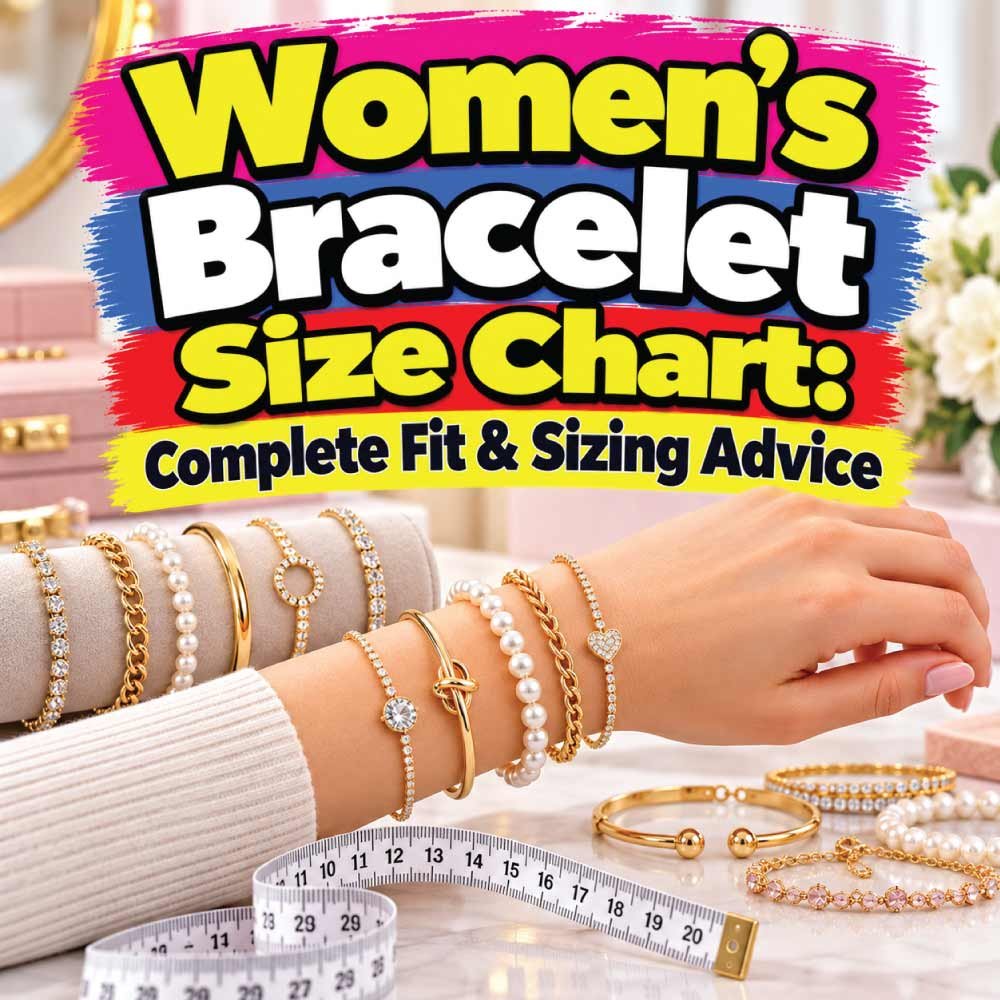
A bracelet can look perfect in a product photo and still feel uncomfortable when it arrives if the size is wrong. Unlike rings, bracelets need enough room to move naturally around the wrist without being so loose that they slide excessively.
This Women’s Bracelet Size Chart explains common bracelet sizes, how to measure your wrist accurately, how much extra room to add, and how sizing changes between different bracelet styles. Whether you are buying a chain bracelet, bangle, cuff, charm bracelet, or adjustable design, the right measurement makes choosing a comfortable fit much easier.
Because bracelet sizing can vary between manufacturers and styles, your wrist measurement should always be the starting point. Use the chart as a practical guide, then check the individual product’s sizing information before ordering.
Women’s Bracelet Size Chart
Women’s bracelets are commonly offered in sizes ranging from small designs for narrow wrists to larger sizes for wider wrists. However, there is no single universal women’s bracelet size standard, so measurements are more useful than labels such as small, medium, or large.
The chart below provides general guidance for bracelet selection.
| Wrist Circumference | Recommended Bracelet Length | Approx. Wrist Size | Typical Fit |
|---|---|---|---|
| 5.5 in | 6.0–6.25 in | 14.0 cm | Snug |
| 5.75 in | 6.25–6.5 in | 14.6 cm | Comfortable |
| 6.0 in | 6.5–6.75 in | 15.2 cm | Comfortable |
| 6.25 in | 6.75–7.0 in | 15.9 cm | Comfortable |
| 6.5 in | 7.0–7.25 in | 16.5 cm | Comfortable |
| 6.75 in | 7.25–7.5 in | 17.1 cm | Comfortable |
| 7.0 in | 7.5–7.75 in | 17.8 cm | Comfortable |
| 7.25 in | 7.75–8.0 in | 18.4 cm | Comfortable |
| 7.5 in | 8.0–8.25 in | 19.1 cm | Relaxed |
| 7.75 in | 8.25–8.5 in | 19.7 cm | Relaxed |
These ranges are general sizing guidance rather than a universal standard. The appropriate bracelet length depends on the bracelet’s construction, clasp, thickness, charms, and the amount of movement you prefer.
For example, someone with a 6.5-inch wrist might prefer a 7-inch bracelet for a relatively close fit or a longer bracelet for a looser, more relaxed style.
How to Measure Your Wrist for a Bracelet
Measuring your wrist is the most reliable way to choose a bracelet size. You do not need specialized equipment. A flexible measuring tape is ideal, but a strip of paper or string can also work.
Method 1: Use a Flexible Measuring Tape
Wrap the measuring tape around the part of your wrist where you normally wear a bracelet.
Keep the tape comfortably against your skin. It should not be pulled tightly or left with a large gap.
Record the circumference where the end of the tape meets the measurement scale.
Your result is your actual wrist circumference, not your final bracelet size.
Method 2: Use String or Paper
If you do not have a flexible tape measure:
- Wrap a narrow strip of paper or non-stretch string around your wrist.
- Mark the point where the ends meet.
- Lay the paper or string flat.
- Measure the marked length with a ruler.
- Record the measurement in inches or centimeters.
Avoid using elastic or stretchy material because it can produce an inaccurate result.
Where Should You Measure Your Wrist?
Measure around the wrist at the location where the bracelet will sit.
For most traditional bracelets, this is slightly above the wrist joint. If you plan to wear a cuff or bangle higher on the arm, measure at that specific location instead.
This matters because your wrist may not have the same circumference at every point.
Wrist Measurement vs. Bracelet Length
One of the most common bracelet-sizing mistakes is treating wrist circumference and bracelet length as the same measurement.
They are different.
Wrist circumference tells you how large your wrist is. Bracelet length tells you how long the bracelet itself is.
A bracelet normally needs additional length beyond your wrist circumference so that it can close properly and move comfortably.
For example, if your wrist measures 6.5 inches, a bracelet measuring exactly 6.5 inches may fit extremely closely and may not provide enough room for comfortable movement.
A bracelet around 7 to 7.25 inches may be more appropriate for a conventional comfortable fit, depending on the style.
How Much Extra Room Should a Bracelet Have?
The amount of additional room you need depends mainly on the fit you prefer.
Snug Bracelet Fit
A snug bracelet stays relatively close to your wrist with limited movement.
A small amount of extra length is usually appropriate when you want a neat, close-fitting appearance.
This style can work well for:
- Simple chain bracelets
- Minimalist jewelry
- Thin bracelets
- Layered bracelet combinations
However, the bracelet should never feel restrictive or interfere with normal wrist movement.
Comfortable or Classic Fit
A comfortable fit provides some room between your wrist and the bracelet.
This is often the easiest choice for everyday wear because the bracelet can move naturally without feeling excessively loose.
For many standard bracelet designs, adding roughly 0.5 to 0.75 inch to the wrist circumference is a useful starting point.
The exact amount depends on the bracelet design.
Loose Bracelet Fit
A loose bracelet has more movement around the wrist and creates a relaxed appearance.
You may prefer a looser fit for:
- Charm bracelets
- Larger chain designs
- Fashion bracelets
- Stacking several bracelets
- Relaxed or oversized styling
Keep in mind that excessive looseness can cause a bracelet to slide over the hand or catch on clothing and other objects.
Women’s Bracelet Size by Fit Preference
Choosing a bracelet length becomes easier when you first decide how you want it to feel.
| Wrist Circumference | Snug Fit | Comfortable Fit | Loose Fit |
|---|---|---|---|
| 5.5 in | 5.75–6.0 in | 6.0–6.25 in | 6.25–6.5 in |
| 6.0 in | 6.25–6.5 in | 6.5–6.75 in | 6.75–7.0 in |
| 6.5 in | 6.75–7.0 in | 7.0–7.25 in | 7.25–7.5 in |
| 7.0 in | 7.25–7.5 in | 7.5–7.75 in | 7.75–8.0 in |
| 7.5 in | 7.75–8.0 in | 8.0–8.25 in | 8.25–8.5 in |
These values are practical starting points. A rigid bangle, thick bracelet, charm bracelet, and flexible chain bracelet can require different sizing even when worn on the same wrist.
Women’s Bracelet Size in Inches and Centimeters
Bracelet measurements may be displayed in either inches or centimeters, depending on the retailer and country.
| Inches | Centimeters | Inches | Centimeters |
|---|---|---|---|
| 5.5 in | 14.0 cm | 7.0 in | 17.8 cm |
| 5.75 in | 14.6 cm | 7.25 in | 18.4 cm |
| 6.0 in | 15.2 cm | 7.5 in | 19.1 cm |
| 6.25 in | 15.9 cm | 7.75 in | 19.7 cm |
| 6.5 in | 16.5 cm | 8.0 in | 20.3 cm |
| 6.75 in | 17.1 cm | 8.25 in | 21.0 cm |
When converting measurements, remember that 1 inch equals 2.54 centimeters. A small conversion difference can matter when selecting jewelry, so use the exact measurement whenever possible rather than rounding too early.
How Bracelet Type Affects Sizing
Not every bracelet should be selected in exactly the same way. The construction and opening mechanism can significantly affect the fit.
Chain Bracelets
Chain bracelets are flexible and generally easy to size because they can follow the shape of the wrist.
A chain bracelet with a clasp is typically selected according to wrist circumference plus the desired amount of wearing room.
If the bracelet includes a substantial pendant or charm, additional movement may be desirable.
Charm Bracelets
Charm bracelets often need more consideration because the charms occupy space and add weight.
A very tight charm bracelet can become uncomfortable as charms gather around the wrist.
A slightly more relaxed fit often gives the charms room to move and allows the bracelet to sit naturally.
Bangle Bracelets
Bangles are different from flexible bracelets because they usually have a rigid or semi-rigid circular shape.
For a bangle, hand size can be as important as wrist size. The bangle needs to pass over the widest part of your hand before resting around your wrist.
This means a wrist measurement alone may not be enough.
Cuff Bracelets
Cuffs may be open on one side and can sometimes offer more flexibility than rigid bangles.
However, you should not assume that every cuff is adjustable. Some are made from rigid materials and are designed for a particular wrist range.
Always check the product’s stated internal dimensions or size range.
Beaded Bracelets
Beaded bracelets may be made with elastic, stretch cord, wire, or a clasp.
Stretch bracelets can have a different sizing approach because the bracelet may expand when worn. Even so, excessive stretching is not ideal for comfort or durability.
For a non-stretch beaded bracelet, use the same basic principle of measuring the wrist and adding appropriate wearing room.
Tennis and Link Bracelets
Tennis and link bracelets typically use a clasp and are commonly worn with some movement.
The number and design of links can affect the final fit. Some link bracelets can be professionally adjusted by removing or adding links, while others offer limited adjustment.
Also Read:
How to Choose the Right Women’s Bracelet Size
Once you know your wrist measurement, consider more than the number alone.
Consider Your Preferred Fit
Ask yourself whether you want the bracelet to:
- Sit close to your wrist
- Move slightly during normal activity
- Hang loosely for a relaxed look
- Fit alongside other bracelets
If you are unsure, a moderate or comfortable fit is generally a practical starting point.
Consider Bracelet Thickness
A thick bracelet can feel tighter than a thin bracelet of the same measured length.
Wide designs also occupy more space across the wrist. When comparing two styles, do not assume identical measurements will feel identical.
Consider Charms and Decorative Elements
Large charms, beads, pendants, and other decorative components can change how a bracelet hangs.
A bracelet that contains several charms may need more room than a simple chain.
Check the Manufacturer’s Size Guide
Individual brands can use different sizing systems.
Before purchasing, compare your measurement with the retailer’s own chart. If the product page provides a specific recommendation, use that information alongside your wrist measurement.
Also Read:
How to Measure for a Bangle
Bangle sizing deserves special attention because the bracelet must usually pass over your hand.
Measure Your Hand
Bring your fingers and thumb together as though you are putting on a bangle.
Measure around the widest part of your hand.
The measurement should account for the point that the bangle must pass over. A bangle that fits your wrist perfectly may still be impossible to put on if its opening is too small.
Check the Bangle Diameter
Rigid bangles are often described using an inside diameter rather than bracelet length.
A larger internal diameter creates more room, while a smaller diameter produces a closer fit.
Because hand shape varies considerably, compare your measurements with the seller’s specific bangle chart rather than relying only on a generic women’s bracelet size chart.
Also Read:
Common Bracelet Sizing Mistakes
Even a carefully measured wrist can result in a poor fit if the measurement is used incorrectly.
Mistake 1: Measuring Too Tightly
Pulling the tape firmly against the skin can make your wrist appear smaller than it actually is.
Keep the tape comfortable and natural.
Mistake 2: Ordering the Exact Wrist Measurement
A bracelet that exactly matches your wrist circumference may be too tight, particularly when the bracelet has a clasp or rigid construction.
Remember that wrist size and bracelet length are not interchangeable.
Mistake 3: Ignoring Bracelet Style
A 7-inch flexible chain and a 7-inch rigid bracelet can feel very different.
Always consider the bracelet’s construction.
Mistake 4: Measuring Over Clothing
For accurate jewelry sizing, measure directly around your wrist rather than over a sleeve.
Mistake 5: Using an Old Measurement
Your measurement can vary slightly depending on where and how you measure.
If you are ordering an important or expensive bracelet, measure again before purchasing.
Mistake 6: Forgetting the Clasp
The listed bracelet length may not always represent the way you expect the bracelet to fit once the clasp and other components are considered.
If the product description provides detailed dimensions, review them carefully.
What Is the Average Women’s Bracelet Size?
There is no single bracelet size that fits all women.
Many women’s bracelet collections commonly include lengths around 6.5 to 7.5 inches, but this should not be interpreted as a universal standard or as proof that one size will fit most people perfectly.
Wrist circumference varies naturally between individuals, and bracelet preferences also differ.
For online shopping, your own wrist measurement is much more useful than choosing a size based on an assumed average.
If you are purchasing a gift and cannot measure the recipient’s wrist, an adjustable bracelet can reduce the risk of selecting an unsuitable fixed length.
Women’s Bracelet Size Guide for Gifts
Buying a bracelet for someone else presents a different challenge because you may not know their wrist measurement.
If you cannot measure the recipient directly, consider:
- Choosing an adjustable bracelet
- Selecting a design with an extension chain
- Checking whether the bracelet can be resized
- Comparing the recipient’s existing bracelet with the seller’s measurements
- Asking someone close to the recipient for their approximate wrist size
Avoid guessing based solely on height, age, or clothing size. These characteristics do not reliably determine wrist circumference.
An adjustable bracelet is particularly useful when the recipient’s exact measurement is unknown.
Adjustable Bracelets vs. Fixed-Size Bracelets
Adjustable bracelets can be easier to fit because their effective length can be changed after purchase.
Advantages of Adjustable Bracelets
- Easier to fit different wrist sizes
- Useful for gifts
- Convenient for changing the preferred fit
- Helpful when wrist measurement is uncertain
- Can accommodate some variation in wearing preference
Limitations of Adjustable Bracelets
- Adjustment hardware may affect appearance
- Extension chains can move around the wrist
- Not every adjustable mechanism provides the same range
- Some designs are only adjustable within a limited size range
Fixed-size bracelets can provide a cleaner appearance and more predictable fit, but accurate measurement becomes more important.
How to Tell If Your Bracelet Fits Correctly
After putting on the bracelet, check both comfort and movement.
A well-fitting bracelet should generally:
- Allow natural wrist movement
- Avoid pinching the skin
- Stay securely on the wrist
- Have enough room for comfortable movement
- Not slide excessively over the hand
- Feel comfortable during normal daily activities
If the bracelet leaves deep pressure marks, feels restrictive, or interferes with movement, it is probably too tight.
If it repeatedly slides over your hand or feels as though it could easily come off, it may be too loose.
What to Do If Your Bracelet Is Too Tight
If a bracelet is too tight, do not force it closed or continue wearing it if it causes discomfort.
Depending on the bracelet, possible solutions include:
- Using an extension chain
- Moving to a larger size
- Removing or replacing a clasp component where appropriate
- Having a professional jeweler resize it
- Choosing an adjustable version
Do not attempt to bend rigid metal jewelry without knowing how the material and construction will respond. Some designs can be damaged by improper adjustment.
What to Do If Your Bracelet Is Too Loose
A loose bracelet may sometimes be adjusted rather than replaced.
Possible solutions include:
- Using a shorter extension setting
- Removing links when the design permits
- Choosing a smaller size
- Using the bracelet’s adjustable mechanism
- Having the bracelet professionally resized
For valuable jewelry, professional resizing is often preferable to experimenting with the bracelet yourself.
Bracelet Size Tips for Comfortable Everyday Wear
Small measurement details can make a noticeable difference when choosing jewelry online.
Keep these tips in mind:
- Measure twice if you are uncertain about your result.
- Use a flexible tape or non-stretch paper strip for the wrist.
- Record your measurement in both inches and centimeters if useful.
- Decide whether you prefer snug, comfortable, or loose wear.
- Check the bracelet’s construction before choosing a size.
- Pay special attention to bangles, because hand size affects whether they can be put on.
- Review the seller’s specific sizing chart before ordering.
- Consider an adjustable design when buying a gift.
- For expensive jewelry, confirm the exact sizing and resizing policy before purchase.
Frequently Asked Questions About Women’s Bracelet Sizes
What is the most common women’s bracelet size?
Women’s bracelets are commonly sold in several lengths, often including sizes around 6.5 to 7.5 inches. However, there is no universal standard size. Measuring the actual wrist and adding the desired wearing room is more reliable than choosing an assumed average.
How do I know what bracelet size I need?
Measure the circumference of your wrist with a flexible measuring tape or paper strip. Then add enough length for your preferred fit. For many standard bracelets, approximately 0.5 to 0.75 inch of additional length is a useful starting point, but the ideal amount depends on the design.
Is a 7-inch bracelet good for a woman?
A 7-inch bracelet can fit many women, but it is not automatically the correct size. Someone with a 6.25-inch wrist may experience a different fit from someone with a 6.75-inch wrist. Always compare the bracelet length with the wearer’s actual wrist measurement.
Should a bracelet be tight or loose?
A bracelet should be comfortable rather than restrictive. A snug fit minimizes movement, while a looser fit allows more movement around the wrist. Your preferred style, bracelet design, and daily activities should determine how much additional room you choose.
How much bigger should a bracelet be than your wrist?
For many conventional bracelets, adding around 0.5 to 0.75 inch to your wrist circumference can provide a comfortable starting point. You may want less room for a snug fit or more for a loose style. Always consider the bracelet’s construction.
Are bracelet sizes the same for every brand?
No. Bracelet sizing can vary between brands, manufacturers, and styles. A labeled small, medium, or large size does not necessarily represent the same measurement everywhere. When possible, compare your wrist measurement with the specific product’s sizing information.
How do I measure my wrist without a tape measure?
Use a strip of paper or non-stretch string. Wrap it around your wrist, mark where the ends meet, then lay it flat and measure the marked length with a ruler. Avoid stretchy materials because they can distort the measurement.
How do I size a bangle?
A bangle usually requires consideration of your hand as well as your wrist because it must pass over the widest part of your hand. Measure around your hand with your fingers and thumb together, then compare that measurement with the bangle manufacturer’s size information.
What bracelet size should I buy as a gift?
If you do not know the recipient’s wrist measurement, an adjustable bracelet is usually easier to fit than a fixed-size design. You can also discreetly measure an existing bracelet or ask someone close to the recipient for sizing information.
Final Thoughts on Women’s Bracelet Sizing
Finding the right bracelet size starts with one simple measurement: your wrist circumference. From there, consider how closely you want the bracelet to fit, how the bracelet is constructed, and whether it needs additional room for charms, movement, or layering.
The most important point is that wrist size is not the same as bracelet size. A bracelet generally needs some additional length to provide a comfortable fit, while bangles require special attention to hand size.
Use this Women’s Bracelet Size Chart as a practical starting point, but always check the individual manufacturer’s measurements before ordering. When your measurement falls between sizes, choose according to your preferred fit and the bracelet’s design. Taking a few minutes to measure correctly can make online jewelry shopping much easier and help you find a bracelet that looks good and feels comfortable.
