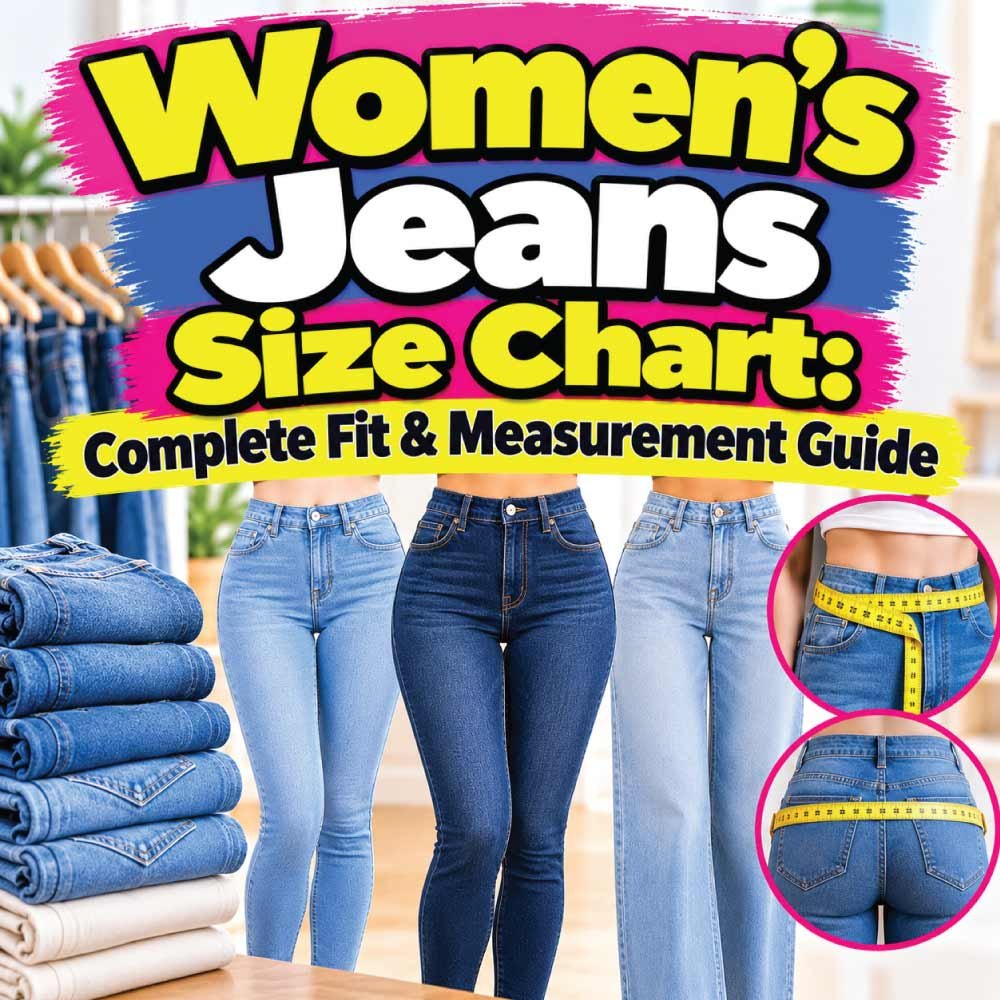
Finding the right pair of jeans can be surprisingly difficult because women’s jeans sizes are not completely standardized. A size 8 in one brand may fit differently from a size 8 in another, while stretch denim, rise, cut, and fabric composition can also change how jeans feel on the body.
A women’s jeans size chart makes the process easier by comparing common waist, hip, and inseam measurements with jean sizes. However, the most reliable way to choose jeans is to measure your body and compare those measurements with the specific brand’s size guide.
This guide explains women’s jeans sizes, waist and hip measurements, inseam lengths, US, UK, and EU conversions, common jean fits, and how to choose the right size when shopping online.
Women’s Jeans Size Chart
Women’s jeans are commonly labeled using US numerical sizes, although some brands use waist measurements in inches, letter sizes, or different international sizing systems.
The chart below provides a general women’s jeans size guide. Measurements are approximate because sizing varies between brands and styles.
| US Jeans Size | Waist (in) | Hips (in) | Waist (cm) | Hips (cm) |
|---|---|---|---|---|
| 00 | 24–25 | 34–35 | 61–64 | 86–89 |
| 0 | 25–26 | 35–36 | 64–66 | 89–91 |
| 2 | 26–27 | 36–37 | 66–69 | 91–94 |
| 4 | 27–28 | 37–38 | 69–71 | 94–97 |
| 6 | 28–29 | 38–39 | 71–74 | 97–99 |
| 8 | 29–30 | 39–40 | 74–76 | 99–102 |
| 10 | 30–31 | 40–41 | 76–79 | 102–104 |
| 12 | 31–33 | 41–43 | 79–84 | 104–109 |
| 14 | 33–35 | 43–45 | 84–89 | 109–114 |
| 16 | 35–37 | 45–47 | 89–94 | 114–119 |
| 18 | 37–39 | 47–49 | 94–99 | 119–124 |
| 20 | 39–41 | 49–51 | 99–104 | 124–130 |
| 22 | 41–43 | 51–53 | 104–109 | 130–135 |
| 24 | 43–45 | 53–55 | 109–114 | 135–140 |
These figures should be treated as a general reference rather than a universal standard. Individual manufacturers can use different measurements for the same labeled size.
For the best result, always compare your measurements with the retailer’s or manufacturer’s own size chart before ordering.
How Women’s Jeans Sizes Work
Women’s jeans can be sized in several different ways. Understanding the labeling system helps you avoid confusing a numerical clothing size with an actual body measurement.
Numerical Jeans Sizes
Numerical sizing includes labels such as 0, 2, 4, 6, 8, 10, 12, and 14. These numbers are commonly used for women’s jeans in the United States.
The number itself does not directly represent your waist measurement. For example, a size 8 does not mean an 8-inch waist. It is simply a standardized-style clothing label used by a particular brand or sizing system.
Because brands interpret numerical sizing differently, the measurements associated with a size can vary.
Waist-Inch Sizing
Some jeans are labeled using waist measurements, such as W26, W28, W30, or W32.
The number generally refers to the intended waist measurement in inches, although the actual garment measurement may differ because of:
- Denim stretch
- Rise
- Cut
- Fabric construction
- Intended fit
- Brand sizing practices
A W28 jean is therefore generally designed around a 28-inch waist, but it should not automatically be assumed to fit every person with exactly that waist measurement.
Letter Sizes
Some women’s jeans use labels such as XS, S, M, L, XL, and XXL. These are especially common in stretchy denim, jeggings, pull-on jeans, and casual clothing.
Letter sizing is less precise than numerical or waist-inch sizing, so body measurements and the manufacturer’s chart become particularly important.
How to Measure for Women’s Jeans
Taking accurate measurements is one of the easiest ways to improve your chances of getting the right jeans size.
You generally need three measurements:
- Waist
- Hips
- Inseam
Use a flexible measuring tape and keep it level around your body. Avoid pulling the tape too tightly.
Measure Your Waist
To measure your waist:
- Stand naturally without sucking in your stomach.
- Find the narrowest area of your natural waist.
- Wrap the measuring tape around your waist.
- Keep the tape horizontal and comfortably snug.
- Record the measurement in inches or centimeters.
Do not intentionally tighten the tape to obtain a smaller measurement. Jeans need enough room for comfortable movement.
It is also important to understand that natural waist measurement and jeans waistband measurement are not always the same. High-rise jeans sit closer to the natural waist, while low-rise jeans sit lower on the body.
Measure Your Hips
Your hip measurement is particularly important when choosing women’s jeans because two people with the same waist measurement can have very different hip proportions.
To measure your hips:
- Stand with your feet together.
- Place the tape around the fullest part of your hips and seat.
- Make sure the tape remains level.
- Keep it comfortably snug without compressing the body.
- Record the measurement.
If your waist and hip measurements fall into different size categories, look at the jean’s cut and the manufacturer’s fit recommendations rather than automatically choosing one measurement.
Measure Your Inseam
The inseam determines how long the jeans are from the crotch area to the bottom hem.
A practical method is to measure a pair of jeans that already fits you well:
- Lay the jeans flat.
- Smooth out wrinkles.
- Measure from the crotch seam to the bottom of the inside leg.
- Record the length in inches.
You can also have another person measure your body from the crotch to the point where you want the jeans to end.
Common women’s jeans inseams include approximately 27, 29, 31, and 33 inches, although brands offer many additional lengths.
Women’s Jeans Size Conversion Chart
International jeans sizing can be confusing because the United States, United Kingdom, European Union, and other markets use different systems.
The following chart gives a general conversion reference rather than a guaranteed one-to-one conversion.
| US Size | UK Size | EU Size | Approx. Waist (in) |
|---|---|---|---|
| 0 | 4 | 32 | 25–26 |
| 2 | 6 | 34 | 26–27 |
| 4 | 8 | 36 | 27–28 |
| 6 | 10 | 38 | 28–29 |
| 8 | 12 | 40 | 29–30 |
| 10 | 14 | 42 | 30–31 |
| 12 | 16 | 44 | 31–33 |
| 14 | 18 | 46 | 33–35 |
| 16 | 20 | 48 | 35–37 |
| 18 | 22 | 50 | 37–39 |
| 20 | 24 | 52 | 39–41 |
| 22 | 26 | 54 | 41–43 |
| 24 | 28 | 56 | 43–45 |
International conversion charts can differ between brands and markets. When buying from an overseas retailer, use its own size chart whenever one is available.
Women’s Jeans Size Chart by Waist Measurement
If you already know your waist measurement, waist-based sizing can provide a useful starting point.
| Waist (in) | Approx. Waist (cm) | Common Jeans Size Range |
|---|---|---|
| 24 | 61 | 00–0 |
| 25 | 64 | 0 |
| 26 | 66 | 2 |
| 27 | 69 | 2–4 |
| 28 | 71 | 4–6 |
| 29 | 74 | 6–8 |
| 30 | 76 | 8–10 |
| 31 | 79 | 10–12 |
| 32 | 81 | 12 |
| 33 | 84 | 12–14 |
| 34 | 86 | 14 |
| 36 | 91 | 16 |
| 38 | 97 | 18 |
| 40 | 102 | 20 |
| 42 | 107 | 22 |
| 44 | 112 | 24 |
The phrase “size 30 jeans” can therefore mean different things depending on how a retailer labels its products. Check whether the number refers to an inch-based waist size or a numerical clothing size.
Women’s Jeans Length and Inseam Guide
Getting the waist right is only part of finding a good fit. Jeans that are too long or too short can change the appearance and comfort of an otherwise well-fitting pair.
| Inseam | General Length | Common Use |
|---|---|---|
| 25–27 in | Short | Cropped or petite fits |
| 28–30 in | Regular-short | Ankle and everyday fits |
| 31–32 in | Regular | Full-length jeans |
| 33–34 in | Long | Taller proportions |
| 35+ in | Extra long | Very tall proportions |
These categories are only general guidelines. Your ideal inseam depends on your height, leg proportions, preferred footwear, and the style of jeans.
For example, a 29-inch inseam may look full-length on one person and cropped on another.
How Jean Rise Affects Fit
The rise is the distance from the crotch seam to the top of the waistband. It strongly influences where the jeans sit on your body.
High-Rise Jeans
High-rise jeans sit higher on the waist and often reach close to or above the natural waist.
They can provide:
- More waist coverage
- A higher waistband position
- A different body silhouette
- Useful coverage when sitting or bending
Because they sit higher, waist placement is especially important when measuring for high-rise jeans.
Mid-Rise Jeans
Mid-rise jeans sit between high-rise and low-rise styles. They are a common choice for everyday wear because they provide moderate coverage without sitting as high as high-rise denim.
Low-Rise Jeans
Low-rise jeans sit lower on the body, closer to the hips.
A person may have a different measurement at the low-rise waistband position than at the natural waist. This is one reason a pair of jeans with the same labeled waist size can feel different depending on its rise.
Also Read:
Women’s Jeans Fits and Cuts
The labeled size tells you how large the jeans are intended to be, but the fit or cut determines how the denim is shaped around your legs and hips.
Skinny Jeans
Skinny jeans are designed to fit closely from the hips through the legs and ankles. Stretch denim is commonly used to make close-fitting styles more comfortable.
Slim Jeans
Slim jeans provide a relatively close fit without being as tight through the entire leg as skinny jeans.
Straight-Leg Jeans
Straight-leg jeans maintain a relatively consistent leg shape from the upper leg toward the hem. They offer a classic alternative to tighter cuts.
Bootcut Jeans
Bootcut jeans are generally closer through the upper leg and gradually widen toward the hem. They are designed to accommodate footwear such as boots.
Wide-Leg Jeans
Wide-leg jeans have a noticeably broader leg opening and provide more room through the leg.
Mom Jeans
Mom jeans typically feature a relaxed fit, often with a higher rise and roomier hip and thigh area. Exact construction varies considerably by brand.
Boyfriend Jeans
Boyfriend jeans generally have a relaxed, casual silhouette. Depending on the design, they may have a looser seat, thigh, or leg.
Also Read:
How to Choose the Right Women’s Jeans Size
Your measurements give you a starting point, but several additional factors affect the final choice.
Consider the Fabric
Check the fabric composition before selecting a size.
Jeans containing elastane or other stretch fibers may feel different from rigid denim. Stretch denim can provide more flexibility, while rigid denim tends to hold its original shape more firmly.
However, stretch does not mean you should automatically size down. The intended fit and the brand’s recommendations matter more than the presence of stretch alone.
Consider Your Largest Measurement
If your waist and hip measurements fall into different size categories, do not focus only on the waist.
For many jean styles, especially fitted designs, the hips and seat need sufficient room for comfortable movement.
You may then choose a style with a different cut, stretch fabric, or tailoring option rather than forcing yourself into a smaller size.
Consider the Rise
A size that works well in high-rise jeans may not feel identical in low-rise jeans because the waistband sits at a different location.
When comparing two pairs, consider:
- Waist measurement
- Rise
- Hip measurement
- Thigh width
- Inseam
- Leg opening
Also Read:
What to Do If You Are Between Jeans Sizes
Being between two sizes is common. It does not necessarily mean that your body is difficult to fit.
First, check whether the jeans are designed to be fitted, relaxed, or oversized. Then examine the fabric and size chart.
If the garment is rigid and closely fitted, choosing the larger size may provide more comfort. If the denim contains stretch and the design is intended to fit closely, the smaller size may sometimes work better.
However, do not rely on a universal rule such as always sizing up or always sizing down. The best choice depends on the specific jeans.
If possible, compare the garment’s actual measurements with a pair of jeans you already own and like.
Common Women’s Jeans Sizing Mistakes
Several mistakes can make jeans seem like the wrong size when the real problem is the measuring or sizing method.
Using Only Your Waist Measurement
Your waist is important, but jeans also need to accommodate your hips, seat, thighs, and rise.
A waist-only measurement can lead to a poor fit around the lower body.
Assuming Every Brand Uses the Same Size
A size 10 is not guaranteed to have the same measurements across different manufacturers.
Always check the specific size chart when shopping online.
Ignoring the Rise
Two jeans with similar waist measurements can feel completely different if one is high-rise and the other is low-rise.
Choosing Jeans Only by Height
Height does not determine jean size. It mainly helps with selecting an appropriate inseam.
Two people of the same height can have very different waist and hip measurements.
Measuring Over Bulky Clothing
For more useful results, measure over lightweight clothing or close to the body rather than over thick garments.
Pulling the Tape Too Tightly
A tightly pulled measuring tape can produce measurements that are smaller than your natural body measurements.
Keep the tape snug but comfortable.
How Women’s Jeans Should Fit
The correct fit is not simply the smallest size you can put on. Jeans should allow comfortable movement while maintaining the intended shape.
A well-fitting pair should generally:
- Sit securely without excessive pressure.
- Allow comfortable sitting and walking.
- Avoid severe pulling around the hips.
- Avoid excessive gaping at the waistband.
- Have enough room through the seat and thighs for the intended cut.
- Reach the desired point on the ankle or shoe.
- Match the intended silhouette of the style.
For skinny or slim jeans, some fabric tension may be normal. Excessive horizontal pulling or uncomfortable pressure, however, can indicate that the jeans are too small or that the cut is not suitable for your proportions.
Women’s Jeans Size Chart for Online Shopping
Shopping online makes accurate sizing even more important because you cannot try the jeans on before ordering.
Before purchasing, collect these details:
- Your waist measurement
- Your hip measurement
- Your preferred inseam
- Your usual size in the retailer
- The jeans’ rise
- The fabric composition
- The brand’s specific size chart
It can also help to measure a pair of jeans you already own. Compare its waistband, rise, inseam, and overall construction with the product measurements provided by the retailer.
Read the product description carefully because terms such as relaxed fit, slim fit, stretch, rigid denim, cropped, ankle length, high rise, and low rise describe characteristics that can significantly affect how the jeans fit.
Frequently Asked Questions About Women’s Jeans Sizes
What is the most accurate way to determine women’s jeans size?
Measure your waist and hips with a flexible measuring tape, then compare those measurements with the specific brand’s women’s jeans size chart. For length, measure your preferred inseam. Brand sizing is more reliable than assuming your usual numerical size will fit everywhere.
Is a size 8 the same in every jeans brand?
No. Women’s jeans sizing is not completely standardized between brands. A size 8 from one manufacturer can have different waist, hip, rise, or leg measurements from another. Always check the brand’s measurement chart when purchasing a new style.
How do I know what size jeans I wear?
Measure your waist and hips, identify your preferred inseam, and compare the results with the manufacturer’s size chart. Your measurements may correspond to different labeled sizes depending on the brand, cut, rise, and fabric.
What does W28 mean in women’s jeans?
W28 generally indicates a jeans size intended for approximately a 28-inch waist. However, the actual fit can vary because of denim stretch, rise, cut, and brand-specific sizing. Check the manufacturer’s measurements before buying.
Should women’s jeans fit tight or loose?
The answer depends on the style. Skinny jeans are designed to fit closely, while boyfriend and wide-leg styles are intentionally roomier. Regardless of the style, jeans should allow comfortable movement and should not cause excessive pressure or pulling.
How do I choose jeans if my waist and hips are different sizes?
Use both measurements rather than choosing based only on your waist. Look for a cut that accommodates your larger measurement, consider stretch denim when appropriate, and check whether the brand offers different fits or lengths.
Does jeans size depend on height?
Height primarily affects the inseam or jeans length, not the waist size. A person’s waist and hip measurements determine the body fit, while height and leg proportions help determine whether a short, regular, long, or extra-long inseam is appropriate.
Are women’s jeans sizes measured in inches?
Some jeans use inch-based waist sizing such as W26 or W30, while others use numerical sizes such as 4, 8, or 12. Some products also use XS through XXL. The labeling method depends on the brand and product.
What is the difference between waist size and jeans size?
Waist size is a body or garment measurement, while a numerical jeans size is a clothing label. A numerical size does not directly equal the number of inches around your waist, which is why measurement charts are useful.
Final Tips for Finding the Right Jeans Size
A women’s jeans size chart is an excellent starting point, but it should not be treated as a universal sizing standard. Your waist, hips, inseam, rise, jean cut, and fabric all influence the final fit.
For the most accurate result:
- Measure your waist and hips carefully.
- Determine your preferred inseam.
- Check the specific brand’s size chart.
- Pay attention to rise and fit.
- Consider whether the denim is rigid or stretchy.
- Compare garment measurements with a pair you already own.
- Do not assume the same numerical size will fit every brand.
- Prioritize comfort and the intended silhouette rather than choosing a size based only on its label.
Once you know your basic measurements, shopping becomes much easier. Instead of relying entirely on a size number, you can evaluate jeans based on actual measurements and construction. That approach gives you a much better chance of finding a pair that fits comfortably and looks the way you expect.
Conclusion
The best way to use a women’s jeans size chart is as a measurement guide rather than an absolute sizing rule. Start with your waist, hip, and inseam measurements, then compare them with the specific manufacturer’s chart.
Remember that rise, fabric stretch, cut, and brand sizing can all change how the same labeled size fits. Taking a few minutes to measure yourself and check the product details can make online jeans shopping much more predictable and help you choose a comfortable, well-fitting pair.
