
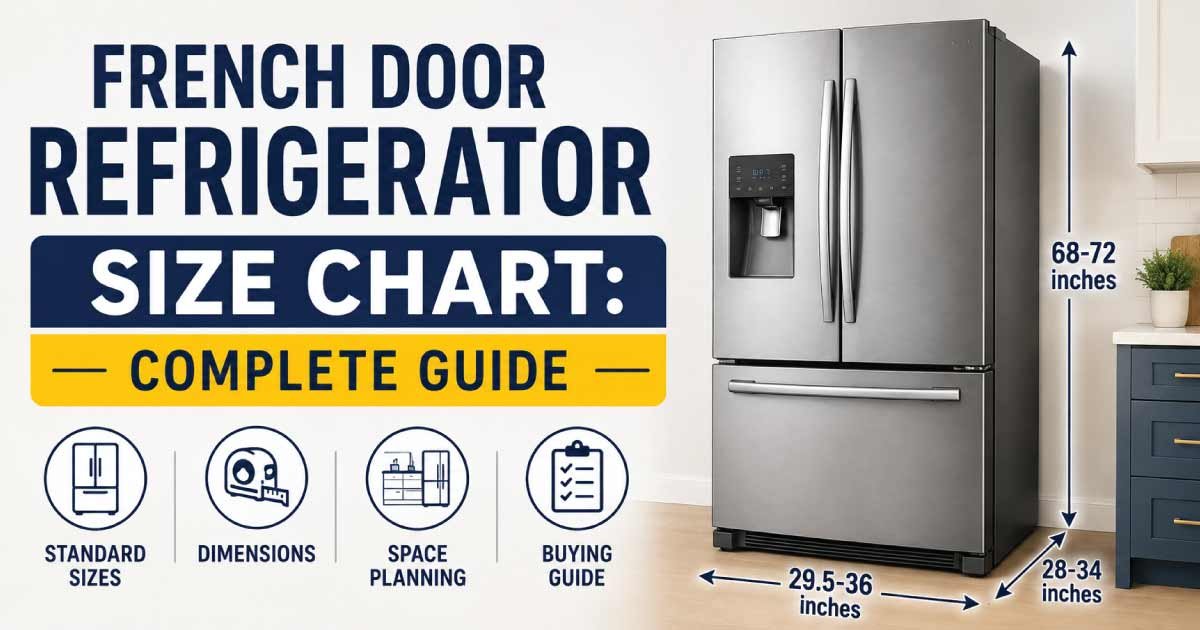
Choosing the right refrigerator is about more than finding a model with enough storage. A French door refrigerator must also fit comfortably into your kitchen, leave enough room for the doors and drawers to open, and provide adequate ventilation. Understanding French door refrigerator dimensions before shopping can help you avoid installation problems and choose a model that matches your household’s needs.
French door refrigerators are popular because they combine wide fresh-food storage with convenient freezer drawers. However, sizes vary considerably between compact, standard, and large-capacity models. The most important measurements are width, depth, height, and capacity, but clearance around the refrigerator matters just as much.
This guide explains typical French door refrigerator sizes, how to measure your available space, what capacity you need, and how to choose the right refrigerator for your kitchen.
What Is a French Door Refrigerator?
A French door refrigerator typically has two refrigerator doors positioned side by side at the top and one or more freezer drawers underneath. This configuration provides easy access to fresh food while allowing wide shelves that can accommodate large dishes, trays, and containers.
Unlike traditional top-freezer refrigerators, French door models usually have a larger fresh-food compartment and a pull-out freezer section.
Common Features of French Door Refrigerators
Depending on the model, a French door refrigerator may include:
- Two upper refrigerator doors
- One or two bottom freezer drawers
- Adjustable glass shelves
- Door bins
- Humidity-controlled crisper drawers
- Ice maker
- Internal or external water dispenser
- Temperature-controlled drawers
- Smart refrigerator features
- Adjustable storage compartments
The combination of wide refrigerator storage and bottom freezer access makes this style particularly useful for families and larger households.
Typical French Door Refrigerator Dimensions
French door refrigerators are available in several sizes, but most full-size models fall within a relatively predictable range.
A typical full-size French door refrigerator is approximately 30–36 inches wide, 67–70 inches high, and 29–36 inches deep. Capacity commonly ranges from around 20 to more than 30 cubic feet.
The exact dimensions vary by manufacturer and model, so the manufacturer’s specification sheet should always be checked before purchasing.
Standard French Door Refrigerator Dimensions
| Dimension | Typical Range | Common Size |
|---|---|---|
| Width | 30–36 inches | 36 inches |
| Height | 67–70 inches | 68–70 inches |
| Depth | 29–36 inches | 32–34 inches |
| Capacity | 20–30+ cu. ft. | 22–28 cu. ft. |
| Door Clearance | Varies by model | Check manufacturer |
| Freezer Location | Bottom | Bottom |
Measurements are general ranges and can vary by refrigerator model.
Why Dimensions Vary
Two refrigerators with the same advertised capacity can have noticeably different exterior dimensions. Manufacturers use different cabinet designs, insulation thicknesses, door configurations, and storage layouts.
For this reason, refrigerator capacity alone should never be used to determine whether a refrigerator will fit your kitchen.
French Door Refrigerator Size Chart by Capacity
Capacity is one of the easiest ways to compare refrigerators, but it should be considered alongside physical dimensions.
Smaller French door refrigerators are useful for apartments and compact kitchens, while larger models provide substantially more storage for families.
| Refrigerator Capacity | Approx. Width | Approx. Height | Approx. Depth | Best For |
|---|---|---|---|---|
| 18–20 cu. ft. | 29–33 in. | 67–70 in. | 29–34 in. | Small households |
| 21–23 cu. ft. | 30–34 in. | 67–70 in. | 30–35 in. | Couples |
| 24–26 cu. ft. | 33–36 in. | 68–70 in. | 30–36 in. | Small families |
| 27–29 cu. ft. | 35–36 in. | 68–71 in. | 32–36 in. | Larger families |
| 30+ cu. ft. | 36+ in. | 69–72 in. | 34–37+ in. | Large households |
These figures are general planning ranges rather than exact manufacturer specifications.
French Door Refrigerator Width
Width is often the first measurement homeowners consider because refrigerator cabinets are commonly designed around a specific opening.
Most full-size French door refrigerators are approximately 33 to 36 inches wide, although narrower models are available.
30-Inch French Door Refrigerators
A 30-inch French door refrigerator can be a good option when kitchen space is limited. These models generally have less interior storage than wider refrigerators but can still provide the convenience of French doors and a bottom freezer.
They may work particularly well in:
- Apartments
- Condos
- Small kitchens
- Narrow kitchen layouts
- Older homes with smaller openings
Always check the actual cabinet width because a refrigerator marketed as a “30-inch model” may not measure exactly 30 inches.
33-Inch French Door Refrigerators
A 33-inch refrigerator offers a useful middle ground between compact and full-size designs. It can provide more storage than many 30-inch models without requiring the full opening of a 36-inch refrigerator.
This size is worth considering when your kitchen opening is too narrow for a standard 36-inch model.
36-Inch French Door Refrigerators
The 36-inch refrigerator is one of the most common choices for larger kitchens. It provides a wide interior compartment and generally offers more capacity.
However, a 36-inch model can require more than 36 inches of usable space once installation clearances and door movement are considered.
French Door Refrigerator Height
Height can become a major installation issue when cabinets or countertops surround the refrigerator opening.
Most standard French door refrigerators are approximately 67–70 inches tall, but larger models can exceed 70 inches.
Measure Cabinet Clearance Carefully
Before purchasing, measure from the floor to the lowest point of the cabinet or obstruction above the refrigerator.
Check:
- Floor-to-cabinet height
- Refrigerator height with hinges
- Height-adjustable feet
- Top ventilation requirements
- Installation clearance
- Door hinge movement
A refrigerator may fit based on its cabinet height but fail to fit because the hinge assembly extends higher.
French Door Refrigerator Depth
Depth is especially important because many French door refrigerators extend beyond standard kitchen countertops.
Standard-depth refrigerators commonly measure approximately 30–36 inches deep, depending on the model and whether handles are included in the manufacturer’s measurement.
Standard Depth vs. Counter Depth
One of the most important choices is whether to buy a standard-depth or counter-depth French door refrigerator.
| Feature | Standard Depth | Counter Depth |
|---|---|---|
| Cabinet Depth | Deeper | Shallower |
| Interior Capacity | Usually larger | Usually smaller |
| Appearance | Projects farther | More flush with cabinets |
| Storage | More | Less |
| Kitchen Space | Uses more floor space | Uses less floor space |
| Best For | Maximum storage | Streamlined appearance |
Counter-depth models are designed to sit more closely with surrounding cabinetry. They can make a kitchen look cleaner and provide more walking space in front of the refrigerator.
How to Measure for a French Door Refrigerator
Accurate measurements should be taken before shopping. Do not measure only the old refrigerator.
Measure the Width
Use a tape measure to determine the width of the opening at:
- The top
- The middle
- The bottom
If the measurements differ, use the narrowest measurement when determining whether a refrigerator will fit.
Measure the Height
Measure from the finished floor to the lowest obstruction above the refrigerator.
Check both sides because cabinets may not be perfectly level.
Measure the Depth
Measure from the back wall to the front edge of the surrounding cabinets or countertop.
Then determine how far the refrigerator is allowed to project into the kitchen.
Remember that handles can add several inches to the total front-to-back dimension.
Why Installation Clearance Matters
A refrigerator should not simply be squeezed into an opening that matches its exterior dimensions.
Manufacturers may require clearance around the cabinet for proper operation, ventilation, door movement, and servicing.
Side Clearance
Side clearance may be needed so the doors can open properly. This is particularly important for French door refrigerators because the doors need to swing outward before shelves and drawers can be accessed fully.
Top Clearance
Some models require space above the refrigerator. Check the installation instructions to determine the manufacturer’s recommended clearance.
Rear Clearance
Space behind the refrigerator may be required for:
- Air circulation
- Power connections
- Water connections
- Compressor operation
- Cleaning
- Maintenance
Always follow the installation requirements for the specific refrigerator.
How Much Refrigerator Capacity Do You Need?
The right refrigerator capacity depends on household size, shopping habits, cooking frequency, and available kitchen space.
A common planning guideline is to allow roughly 4–6 cubic feet of refrigerator capacity per person, although individual needs vary considerably.
For One or Two People
A refrigerator around 18–22 cubic feet may provide sufficient storage for a couple or individual who shops frequently.
If you buy fresh food in bulk or prepare meals in advance, you may benefit from a larger refrigerator.
For Three or Four People
A capacity of approximately 22–26 cubic feet is often a practical range for a small family.
This provides more room for fresh produce, dairy products, beverages, leftovers, and frozen foods.
For Five or More People
Larger households may prefer 26–30+ cubic feet.
A larger refrigerator can reduce overcrowding and make it easier to organize weekly groceries.
However, choosing the largest possible model is not always better. More capacity also means a larger appliance and potentially higher energy use.
Discover More:
French Door Refrigerator Sizes for Different Kitchens
Kitchen layout should influence your refrigerator choice just as much as household size.
Small Kitchen
For a small kitchen, consider:
- 30–33 inch width
- Counter-depth construction
- Approximately 18–23 cubic feet
- Compact door swing requirements
- Smaller freezer configuration
A narrower refrigerator can preserve valuable countertop and walking space.
Medium Kitchen
A medium-sized kitchen can often accommodate:
- 33–36 inch width
- Approximately 22–27 cubic feet
- Standard or counter depth
- Larger freezer drawers
This range provides a good balance between storage and physical size.
Large Kitchen
A spacious kitchen may accommodate:
- 36-inch or wider refrigerators
- 27–30+ cubic feet
- Standard-depth construction
- Larger freezer capacity
- Additional temperature-controlled compartments
Before selecting an extra-large refrigerator, verify that it can enter the home and pass through all required doorways.
French Door Refrigerator Door Clearance
Door clearance is frequently overlooked during refrigerator shopping.
Even when the refrigerator cabinet fits perfectly into the opening, the doors may not open far enough to access interior shelves and drawers.
Things to Check
Measure or confirm:
- Door swing area
- Adjacent wall clearance
- Cabinet clearance
- Island clearance
- Handle clearance
- Drawer extension
- Nearby appliances
This is especially important if the refrigerator is positioned next to a wall.
Some models are designed with hinges that allow the doors to open effectively in tighter spaces, but specifications vary.
French Door Refrigerator Size vs. Capacity
A larger exterior refrigerator does not always provide storage in exactly the way you expect.
Two models with similar external dimensions may have different usable interior capacities because of differences in insulation, shelving, ice makers, drawers, and internal components.
What to Compare
When comparing refrigerators, look at:
- Total cubic-foot capacity
- Refrigerator compartment capacity
- Freezer capacity
- Shelf configuration
- Door storage
- Crisper space
- Drawer arrangement
- Ice maker location
If fresh food is your priority, a model with a larger refrigerator compartment may be more useful than one that dedicates more space to the freezer.
Discover More:
Counter-Depth French Door Refrigerator Sizes
Counter-depth refrigerators are increasingly popular for modern kitchen layouts because they reduce how far the appliance projects beyond surrounding cabinets.
Typical counter-depth French door refrigerators may be approximately:
- 30–36 inches wide
- 68–70 inches high
- 24–30 inches deep for the cabinet, depending on the design
The exact measurement can be greater when doors and handles are included.
Advantages of Counter Depth
Counter-depth models can provide:
- A more integrated appearance
- More open walking space
- Easier access around kitchen islands
- Reduced visual bulk
- Better alignment with cabinetry
The primary trade-off is that they often provide less total storage than similarly wide standard-depth models.
Standard-Depth French Door Refrigerator Sizes
Standard-depth models generally extend farther into the kitchen but offer greater interior capacity.
They are a strong choice when:
- Storage capacity is the priority
- Kitchen floor space is generous
- The refrigerator is not directly beside an island
- You regularly store large quantities of food
- You want a larger freezer compartment
Before choosing one, consider the refrigerator’s total depth with doors and handles.
How to Choose the Right French Door Refrigerator Size
Choosing the right model becomes easier when you consider your kitchen and household together.
Step 1: Measure Your Opening
Record the exact width, height, and depth.
Step 2: Check Clearance Requirements
Look at the installation requirements for the refrigerator models you’re considering.
Step 3: Determine Your Storage Needs
Think about how much food you normally keep at home.
Step 4: Choose Standard or Counter Depth
Decide whether maximum storage or a more streamlined kitchen appearance is more important.
Step 5: Check Door and Drawer Movement
Make sure the doors and freezer drawers can open without hitting walls, cabinets, islands, or other appliances.
Step 6: Measure Your Entry Route
Measure hallways, exterior doors, interior doors, stairs, and tight corners between the delivery point and kitchen.
Discover More:
Common French Door Refrigerator Size Mistakes
Even a carefully selected refrigerator can create problems if measurements are incomplete.
Mistake 1: Measuring Only the Old Refrigerator
Your existing refrigerator may be significantly smaller or shaped differently.
Measure the available opening rather than copying the old appliance’s dimensions.
Mistake 2: Ignoring Door Handles
Manufacturer dimensions may be listed with or without handles.
Always determine what the published measurement includes.
Mistake 3: Forgetting Door Swing
The refrigerator may fit into the opening but still have insufficient space for the doors to operate properly.
Mistake 4: Ignoring Delivery Access
A refrigerator that fits your kitchen may not fit through the front door, hallway, elevator, or staircase.
Mistake 5: Choosing Capacity Before Measuring
It is tempting to start by selecting the largest refrigerator available. However, dimensions should be established first.
Tips for Maximizing French Door Refrigerator Space
Once you have the correct refrigerator size, organization can help you make better use of the available capacity.
Organize the Refrigerator Compartment
Keep frequently used items at easy-to-reach levels and group similar foods together.
For example:
- Dairy products together
- Fruits and vegetables in crisper drawers
- Drinks in designated door storage
- Leftovers in one organized area
- Condiments together
Use the Freezer Efficiently
Avoid packing the freezer so tightly that air cannot circulate. Organize frozen food by category and use containers or bins where appropriate.
A well-organized freezer can make a moderately sized refrigerator feel much more practical.
French Door Refrigerator Dimensions Checklist
Before purchasing, use this checklist:
- Measure opening width
- Measure opening height
- Measure available depth
- Check manufacturer clearance requirements
- Confirm door swing clearance
- Check freezer drawer clearance
- Measure nearby walls and cabinets
- Check kitchen island clearance
- Measure delivery doorways
- Check stairways and hallways
- Compare total capacity
- Compare refrigerator and freezer capacity
- Confirm water and electrical connections
- Check whether dimensions include handles
Frequently Asked Questions About French Door Refrigerator Sizes
What is the standard size of a French door refrigerator?
Most full-size French door refrigerators are approximately 30–36 inches wide, 67–70 inches high, and 29–36 inches deep. However, dimensions vary by model, so always check the manufacturer’s specifications before purchasing.
How wide is a 36-inch French door refrigerator?
A refrigerator marketed as 36 inches wide may not measure exactly 36 inches. Actual cabinet dimensions can be slightly narrower or different depending on the manufacturer. Always use the exact listed product dimensions when planning installation.
What refrigerator size is best for a family of four?
A French door refrigerator around 22–26 cubic feet can be a practical starting range for a family of four. Larger capacity may be preferable if the household shops in bulk, stores many beverages, or prepares meals in advance.
Are counter-depth refrigerators smaller?
Counter-depth refrigerators are generally shallower than standard-depth models. They may have less total capacity, although width and height can remain similar. Their main advantage is a more streamlined appearance and reduced projection into the kitchen.
How much clearance does a French door refrigerator need?
The required clearance varies by model. Manufacturers may specify different amounts for the sides, top, and rear. Door-opening requirements can also be greater than the basic cabinet clearance, so consult the specific installation guide.
Can a French door refrigerator fit in a 36-inch opening?
Some models can fit in a 36-inch opening, but the exact refrigerator width and required clearance must be checked. Do not assume that a refrigerator labeled “36-inch” will automatically fit a 36-inch space.
Final Thoughts on French Door Refrigerator Sizes
Finding the right French door refrigerator size requires more than comparing cubic-foot capacity. Width, height, depth, door clearance, freezer drawer movement, ventilation, and delivery access all affect whether a refrigerator will work in your kitchen.
For many households, a refrigerator between 22 and 28 cubic feet provides a useful balance between storage and size. Smaller kitchens may benefit from a 30–33-inch counter-depth model, while larger kitchens can often accommodate 36-inch models with greater capacity.
The safest approach is to measure your kitchen opening first, check the manufacturer’s installation requirements, and then compare refrigerator capacity and features. Taking a few extra measurements before purchasing can prevent expensive installation and delivery problems while helping you choose a refrigerator that fits your kitchen and your lifestyle.
