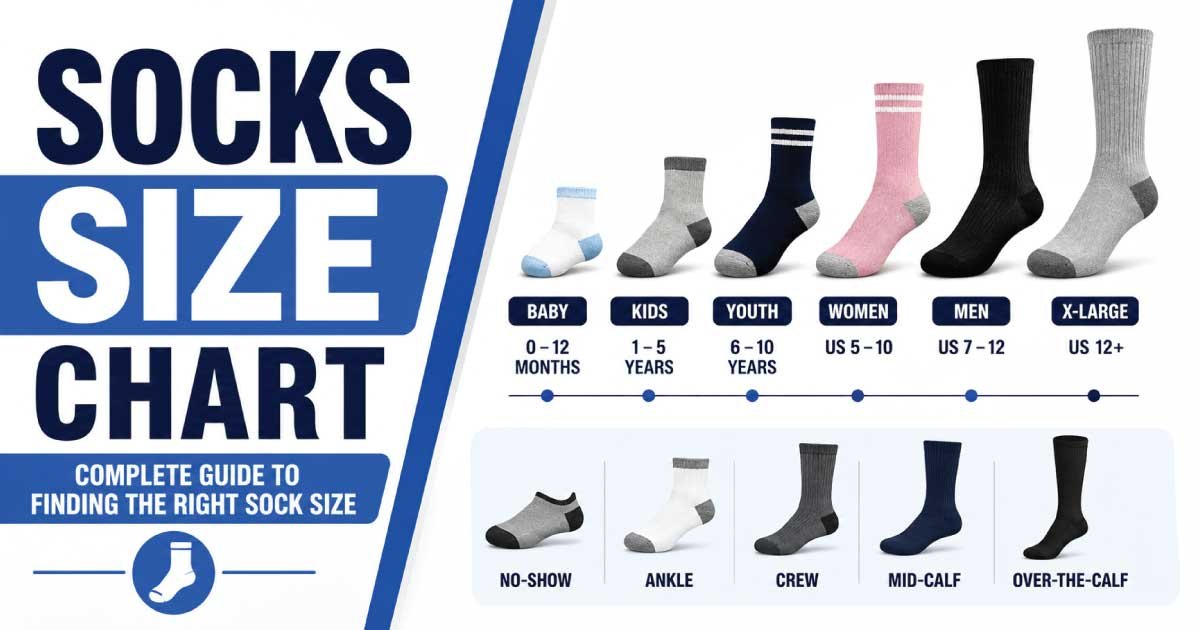
Finding the right sock size is important for comfort, support, and a proper fit inside your shoes. Socks that are too small can feel tight around the toes, heel, and ankle, while socks that are too large may bunch up, slide down, or create uncomfortable folds.
Unlike shoes, socks are often sold using ranges rather than one exact size. A single sock size may fit several foot sizes because socks are made from stretchy materials such as cotton, wool, polyester, nylon, and spandex.
This Socks Size Chart explains standard sock sizes for men, women, children, babies, and different footwear types. You’ll also learn how to measure your feet, understand sock size numbers, convert US sizes to UK and EU sizes, and choose the right socks for your foot length.
What Is a Sock Size Chart?
A sock size chart is a measurement guide that connects a person’s foot length or shoe size with the recommended sock size.
Sock manufacturers commonly use:
- Small (S)
- Medium (M)
- Large (L)
- Extra Large (XL)
- Numeric sock sizes
- US shoe sizes
- UK shoe sizes
- EU shoe sizes
Because socks stretch, their sizing ranges are usually broader than shoe sizing.
For example, a medium sock may accommodate several adjacent shoe sizes. However, the exact range depends on the manufacturer and sock type.
How Are Socks Sized?
Socks can be sized in several different ways.
Shoe Size
Many socks use shoe size as the primary sizing reference. This is convenient because you can compare the sock’s recommended range with your normal shoe size.
Foot Length
Some manufacturers provide the actual foot length that the sock is designed to fit.
Measuring your foot can be more accurate when you’re between standard sizes.
Numeric Sock Size
Some traditional sock sizing systems use numbers such as 9–11, 10–13, or 13–15.
These numbers can be confusing because they may refer to sock sizing systems rather than directly representing your shoe size.
Always check whether the manufacturer provides a corresponding shoe-size range.
Socks Size Chart for Adults
The following chart provides general adult sock sizing guidelines.
| Sock Size | Men’s US Shoe Size | Women’s US Shoe Size | Approx. Foot Length |
|---|---|---|---|
| Small | 4–7 | 5–8 | 8.5–9.5 in |
| Medium | 7–10 | 8–11 | 9.5–10.5 in |
| Large | 10–13 | 11–14 | 10.5–11.5 in |
| XL | 13–16 | 14–17 | 11.5–12.5 in |
These ranges are general guidelines. Sock sizing varies between manufacturers, materials, and styles.
Men’s Sock Size Chart
Men’s socks are generally sized according to men’s shoe sizes.
| Sock Size | Men’s US Shoe Size | UK Shoe Size | EU Shoe Size |
|---|---|---|---|
| Small | 4–7 | 3–6 | 36–40 |
| Medium | 7–10 | 6–9 | 40–44 |
| Large | 10–13 | 9–12 | 44–47 |
| XL | 13–16 | 12–15 | 47–50 |
Exact conversions can vary slightly between footwear sizing systems and manufacturers.
If your shoe size falls directly between two sock ranges, check the manufacturer’s individual chart before ordering.
Women’s Sock Size Chart
Women’s socks are commonly designed around women’s shoe sizes.
| Sock Size | Women’s US Shoe Size | UK Shoe Size | EU Shoe Size |
|---|---|---|---|
| Small | 4–7 | 2–5 | 35–38 |
| Medium | 7–10 | 5–8 | 38–42 |
| Large | 10–13 | 8–11 | 42–45 |
| XL | 13–16 | 11–14 | 45–48 |
Women’s sock sizes vary between brands, so these measurements should be used as a general reference.
Unisex Sock Size Chart
Many everyday socks are sold as unisex products.
| Unisex Sock Size | Approx. US Shoe Range | Typical Use |
|---|---|---|
| Small | 4–7 | Smaller adult feet |
| Medium | 7–10 | Average adult range |
| Large | 10–13 | Larger adult feet |
| XL | 13–16 | Extra-large feet |
Unisex socks are often made with stretch fabrics that allow one size to accommodate several foot sizes.
Children’s Sock Size Chart
Children’s feet grow quickly, so their sock size should be checked regularly.
| Children’s Sock Size | Approx. US Shoe Size | Approx. Age Range |
|---|---|---|
| XS | 0–3 | Infant |
| S | 4–7 | Toddler |
| M | 8–12 | Young child |
| L | 13–3 | Older child |
| XL | 4–6 | Youth |
Age ranges are only approximate because children’s foot growth varies considerably.
For children, foot length and current shoe size are generally more useful than age alone.
Baby Sock Size Chart
Baby socks are usually sized by age, foot length, or shoe size.
| Baby Sock Size | Approx. Age | Approx. Foot Length |
|---|---|---|
| Newborn | 0–3 months | 3–3.5 in |
| Small Baby | 3–6 months | 3.5–4 in |
| Medium Baby | 6–12 months | 4–4.5 in |
| Large Baby | 12–18 months | 4.5–5 in |
| Toddler | 18–24 months | 5–5.5 in |
Baby sock sizing varies substantially between brands. Since infants grow quickly, avoid choosing a size based only on age.
How to Measure Your Foot for Socks
Measuring your foot is simple and can help you choose the correct sock size when you’re between sizes.
Step 1: Place Your Foot on Paper
Stand on a sheet of paper while wearing the type of socks you normally use.
Standing is important because your foot expands slightly when bearing weight.
Step 2: Trace Your Foot
Have someone carefully trace around your foot with a pencil.
Keep the pencil perpendicular to the paper rather than angled inward.
Step 3: Measure Foot Length
Measure from the very back of your heel to the tip of your longest toe.
Record the measurement in inches or centimeters.
Step 4: Compare With the Sock Chart
Compare your foot length with the manufacturer’s sock size chart.
If your foot falls between sizes, consider the sock’s material and intended fit.
Also Read: Vanity Table Size Chart: Complete Guide With Dimensions
Foot Length to Sock Size Chart
Foot length can be a useful alternative to shoe size when choosing socks.
| Foot Length | Approx. Sock Size |
|---|---|
| 8–9 in | Small |
| 9–10 in | Small–Medium |
| 10–11 in | Medium–Large |
| 11–12 in | Large–XL |
| 12–13 in | XL |
These ranges are approximate and should not replace a manufacturer’s specific sizing guide.
Socks Size Chart in Centimeters
If you shop internationally, foot measurements in centimeters can make sock sizing easier.
| Foot Length | Approx. Foot Length | General Sock Size |
|---|---|---|
| 20–23 cm | 7.9–9.1 in | Small |
| 23–25 cm | 9.1–9.8 in | Small–Medium |
| 25–27 cm | 9.8–10.6 in | Medium |
| 27–29 cm | 10.6–11.4 in | Large |
| 29–32 cm | 11.4–12.6 in | XL |
These measurements are general because sock sizing systems differ among manufacturers.
How Should Socks Fit?
A properly fitting sock should feel comfortable without excessive pressure.
The sock should:
- Cover the foot completely
- Fit securely around the heel
- Keep the toe area comfortable
- Stay in place during movement
- Avoid excessive bunching
- Avoid tight compression unless specifically designed for compression
- Sit comfortably around the ankle or calf
The heel of the sock should sit near your actual heel rather than sliding toward the arch or ankle.
How Tight Should Socks Be?
Everyday socks should generally feel secure but not uncomfortably tight.
A sock that is too tight may leave deep marks around the ankle or calf. A sock that is too loose may slide down and bunch inside the shoe.
The correct amount of stretch depends on the sock design.
For example:
- Athletic socks may have a secure fit.
- Dress socks are often thinner and more fitted.
- Wool socks may have a roomier construction.
- Compression socks are intentionally tighter.
- Casual socks generally have moderate stretch.
Sock Size vs. Shoe Size
Sock sizes and shoe sizes are related but they are not the same thing.
A shoe size represents the footwear designed to fit your foot, while a sock size represents the range of foot dimensions that the sock can accommodate.
For example, a sock labeled 10–13 may be designed to fit people whose shoe sizes fall within a particular range.
Always look at the conversion information provided by the sock manufacturer.
US, UK, and EU Sock Size Conversion
International shoe sizing can make sock shopping confusing.
| US Men’s | US Women’s | UK Approx. | EU Approx. |
|---|---|---|---|
| 6 | 7.5 | 5 | 39 |
| 7 | 8.5 | 6 | 40 |
| 8 | 9.5 | 7 | 41–42 |
| 9 | 10.5 | 8 | 42 |
| 10 | 11.5 | 9 | 43–44 |
| 11 | 12.5 | 10 | 44–45 |
| 12 | 13.5 | 11 | 45–46 |
| 13 | 14.5 | 12 | 46–47 |
| 14 | 15.5 | 13 | 47–48 |
These conversions are approximate and should be used alongside the manufacturer’s sock-size chart.
Also Read: Window Size Chart: Complete Window Guide Size
Sock Size for Different Types of Socks
Not all socks should be selected in exactly the same way.
Dress Socks
Dress socks are usually thin and designed to fit inside formal shoes.
A precise fit helps prevent bunching around the ankle and foot.
Athletic Socks
Athletic socks often use stretch materials and elastic bands to keep the sock securely in place during exercise.
Choose a size that provides a snug but comfortable fit.
Running Socks
Running socks should fit closely enough to prevent excessive movement inside the shoe.
Loose socks can create folds that may become uncomfortable during longer activities.
Wool Socks
Wool socks can be thicker than cotton or synthetic socks.
When wearing them with shoes or boots, make sure there is enough room for the additional sock thickness.
Compression Socks
Compression socks are different from standard socks because they are designed to provide graduated pressure.
Their sizing may depend on measurements such as:
- Shoe size
- Calf circumference
- Ankle circumference
- Leg length
For compression products, follow the manufacturer’s specific measurement instructions.
Sock Size for Boots
Boots often require thicker socks than sneakers or dress shoes.
If you normally wear thick wool or hiking socks, consider the extra space they occupy inside the boot.
A sock that is comfortable with sneakers may feel too thick in a tightly fitted boot.
For hiking boots, the sock should provide enough cushioning while keeping your heel stable.
Sock Size for Sneakers
Sneakers generally work well with standard cotton or athletic socks.
Choose a sock that fits the foot without excess material around the toes.
The heel should remain properly positioned during walking and exercise.
Sock Size for Different Foot Shapes
Foot shape can affect how socks feel even when the numerical size is correct.
Wide Feet
People with wider feet may prefer socks made with stretchy materials or designs specifically intended for wider feet.
Narrow Feet
A highly elastic sock may provide a better fit because it is less likely to slide or bunch.
High Instep
A sock with good stretch through the upper foot can provide additional comfort.
Long Toes
Focus on foot length rather than shoe size alone if the longest toe extends significantly beyond the others.
What Happens If Socks Are Too Small?
Socks that are too small may cause several problems.
They can:
- Feel tight around the toes
- Pull the heel out of position
- Restrict comfortable movement
- Create pressure around the ankle
- Wear out more quickly
- Become uncomfortable inside shoes
If your toes feel compressed or the sock constantly pulls away from the heel, you may need a larger size.
Also Read: Mirror Size Chart: Standard Mirror Size Guide
What Happens If Socks Are Too Large?
Oversized socks can also cause problems.
They may:
- Bunch inside shoes
- Slide down
- Create wrinkles
- Move around the heel
- Feel uncomfortable during exercise
- Increase friction inside footwear
The best sock should stay in position without requiring constant adjustment.
Does Sock Material Affect Size?
Yes. Material can affect how a sock fits.
Cotton
Cotton socks are comfortable and breathable but may change slightly after washing.
Wool
Wool socks can be thicker and may require more room inside shoes.
Polyester
Polyester provides durability and is commonly used in athletic socks.
Nylon
Nylon adds strength and can improve the sock’s ability to maintain its shape.
Spandex or Elastane
Stretch fibers allow socks to fit a wider range of foot sizes.
Because fabric composition affects stretch, two socks with the same labeled size may feel different.
How to Choose the Right Sock Size When Between Sizes
If your foot falls between two sock sizes, consider the following factors.
Choose the smaller size when:
- You prefer a snug fit
- The sock has plenty of stretch
- The material is lightweight
- The manufacturer recommends sizing down
Choose the larger size when:
- You have wider feet
- You prefer more room
- The socks are thick
- You have longer feet
- The manufacturer recommends sizing up
Always prioritize the individual brand’s size guide.
Common Sock Sizing Mistakes
Choosing Based Only on Age
Age is not an accurate measurement for adult socks and can be unreliable for children’s socks.
Ignoring Foot Length
Shoe sizes differ between brands, so foot length can provide a useful additional reference.
Buying Based on Sock Color or Style
A visually attractive sock is not useful if it does not fit properly.
Ignoring Material
Thick wool socks can fit differently from lightweight synthetic socks.
Forgetting Shrinkage
Some natural-fiber socks may shrink if washed incorrectly.
Using One Chart for Every Brand
Sock sizing is not universally standardized.
Frequently Asked Questions About Sock Sizes
What is the standard sock size chart?
Adult sock sizes are commonly divided into Small, Medium, Large, and Extra Large. The exact shoe-size range varies by manufacturer, but many everyday adult socks use overlapping shoe-size ranges for flexibility.
How do I know what sock size I need?
Start with your normal shoe size and compare it with the sock manufacturer’s size chart. If you’re between sizes, measure your foot from heel to longest toe and compare the foot length with the recommended range.
Is sock size the same as shoe size?
No. Sock sizes are designed to cover a range of shoe or foot sizes. A sock size may correspond to several shoe sizes because the fabric stretches around the foot.
What does sock size 10–13 mean?
A sock labeled 10–13 generally represents a sock designed to fit a particular range of shoe sizes rather than meaning the sock itself is exactly 10 or 13 inches long. Always check the manufacturer’s conversion chart.
What size socks should a man wear?
The correct men’s sock size depends primarily on shoe size and foot length. Many men’s socks are available in Small, Medium, Large, and XL ranges corresponding to different men’s shoe-size groups.
What size socks should a woman wear?
Women’s sock size is generally based on shoe size or foot length. Many brands use Small through XL ranges, but the exact size boundaries vary between manufacturers.
How should socks fit?
Socks should fit smoothly around the foot without excessive pressure, slipping, or bunching. The heel should remain positioned correctly, and the toes should have enough room to move comfortably.
Should socks be tight or loose?
Everyday socks should generally be snug enough to stay in place but loose enough to remain comfortable. They should not leave excessive pressure marks or create folds inside your shoes.
Do socks shrink after washing?
Some socks, particularly those containing natural fibers such as cotton or wool, can shrink if washed or dried at high temperatures. Follow the care instructions to minimize changes in size.
Should I size up for thick socks?
If you’re wearing thick socks with fitted shoes or boots, consider the available footwear space. The sock itself may not require a larger size, but thicker material can make the shoe feel tighter.
Final Thoughts on Socks Sizes
Choosing the correct sock size is important for everyday comfort, athletic performance, and proper footwear fit. Although most socks are stretchy and designed to cover a range of foot sizes, selecting the right size helps prevent slipping, bunching, tightness, and uncomfortable pressure.
The easiest starting point is your shoe size, but measuring your actual foot length can be useful when you’re between sizes or shopping from an unfamiliar brand.
Remember that sock sizing varies according to the manufacturer, material, construction, and intended use. Athletic socks, dress socks, hiking socks, wool socks, compression socks, and children’s socks may all use different sizing systems.
Use this Socks Size Chart as a general reference, then compare your measurements with the specific manufacturer’s size guide before purchasing. A properly fitted pair of socks should stay comfortably in place, provide enough stretch for movement, and work naturally with your shoes.
