
It is important that you select appropriate air conditioner (AC) size so that you can have efficiency and effectiveness in cooling your home. A small unit cannot properly cool a room, it runs constantly without more energy but oversized unit cools entirely too fast with the result that the temperatures, humidity and electricity bill will not be even. Learning about the proper measurement and choice of AC size is a sure guarantee of the comfort, efficiency, and durability of your appliance. This tutorial will take you by the hand on all you should know about measuring and selecting the ideal AC to your space.
Why AC Size Matters
Room comfort, energy use and durability of your system directly depend on the size of your ac. An appropriately sized unit offers good consistency, maintains the best level of humidity, and minimizes the wear and tear. On the other hand, an inappropriate size may cause changes in temperature, over noises, and an increased maintenance fee. The key to the right size is to make sure that you are not spending more than you actually need to.
Understand AC Types
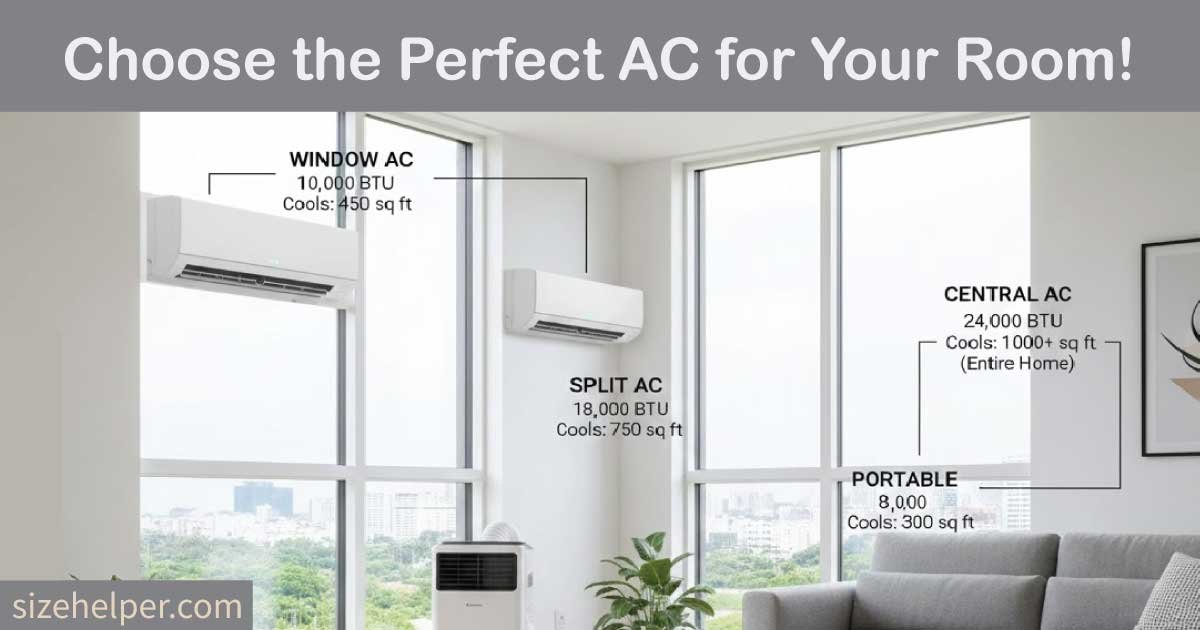
It is essential to know the kinds of air conditioners in the market before deciding the size. The window units are very small, suitable in small rooms and they are easy to install. Split ACs are single devices that can cool and heat and they are also applicable in both the medium and large rooms. Portable ACs are flexible and might not be very efficient. Central AC is made to cool the whole house, but needs a professional installation and ductwork. They all have varying sizing considerations and installation requirements.
Common AC Types and Typical Room Sizes
| AC Type | Ideal Room Size (sq. ft.) | Typical Capacity (BTU/hr) | Notes |
|---|---|---|---|
| Window AC | 100 – 400 | 5,000 – 12,000 | Compact, easy installation |
| Split AC | 250 – 1,500 | 9,000 – 24,000 | Efficient, quiet, flexible placement |
| Portable AC | 100 – 350 | 8,000 – 12,000 | Mobile, temporary solution |
| Central AC | 1,000 – 5,000+ | 24,000 – 60,000+ | Whole-house cooling, professional installation |
Measure Your Room for AC
The correct room measurements come first in the procedure of choosing the correct size of AC. To determine the square footage and volume of the room, measure its length, width and height. Take into account such other factors as ceiling height, the size of windows, exposure to sunlight, and the orientation of the room. Rooms are higher in ceilings or have large windows and may need more powerful AC than a room with the same dimensions.
Square Footage to AC Capacity Estimate
| Room Size (sq. ft.) | Recommended AC Capacity (BTU/hr) |
|---|---|
| 100 – 150 | 5,000 – 6,000 |
| 150 – 250 | 6,000 – 8,000 |
| 250 – 350 | 8,000 – 10,000 |
| 350 – 450 | 10,000 – 12,000 |
| 450 – 550 | 12,000 – 14,000 |
| 550 – 700 | 14,000 – 18,000 |
| 700 – 1,000 | 18,000 – 24,000 |
Calculate AC Capacity (BTUs)
The cooling capability of an AC is measured in BTU or British Thermal Unit. The greater the BTU the stronger the unit. The right capacity depends on the square footage of a room and standard recommendations on BTU. Calculate high ceilings, direct sunshine, occupancy and heat generating equipment. This will guarantee the AC is not overworked by peak heat loads.
Adjust for Room Conditions
BTU calculation adjustments need to be made to different rooms. Rooms that have large windows that open to the sun, have poorly insulated walls, or high ceilings might require an additional 1020 percent capacity. On the other hand, slightly less may be needed in shaded or insulated rooms. Kitchens and media rooms that have heating equipment require more cooling space. With these adjustments in mind, underpowered or overpowered units will be avoided.
Consider AC Types for Room Layout
Room arrangement influences the AC performance. Windows units would be optimal when there is only one exterior wall of the room, whereas split ACs would effectively cool rooms with more or irregular designs. Central AC is more appropriate in case of multi room layout and it needs to be designed to put in proper ductwork to guarantee all rooms are evenly cooled. The portable ACs are effective where the permanent installation is not possible.
AC Type Recommendations Based on Room Layout
| Room Layout | Recommended AC Type | Notes |
|---|---|---|
| Small, single wall | Window or Portable | Compact, easy to install |
| Medium, multiple windows | Split AC | Efficient cooling, quiet operation |
| Large, open floor plan | Split AC or Central AC | Even cooling, higher capacity |
| Multi-room house | Central AC | Whole-house temperature control |
Energy Efficiency Considerations
Energy efficiency will be an essential factor towards minimizing electricity bills and environmental effects. Find an Energy Star model and verify Seasonal Energy Efficiency Ratio (SEER). Large ACs can work fast but would turn on and off very often, wasting energy. ACs that are properly sized will last longer and maintain constant temperature with lower consumption of energy. An efficient operation is also energy saving which increases the unit life.
Noise Levels and Comfort
Noise may affect comfort especially in bedrooms or study rooms. Front loading split ACs are normally quiet as compared to window units. In selecting the size, make sure that the size of the unit matches its power with air in the unit and noise. Big units can give more noise when overworked in small units. Adequate size of AC will guarantee that the cooling is effective and the surrounding is serene.
Installation and Clearance
Good installation influences life and performance. It is believed that window and split ACs need air circulation clearance along their sides and rear, which is usually 6 to 12 inches. Central AC should have properly designed ducts to evenly distribute air. Unproper installation may decrease the performance and overload the system. Never forget to plan proper spacing around the unit and do as the manufacturer wants.
Recommended Clearance for AC Installation
| AC Type | Side Clearance (inches) | Rear Clearance (inches) | Front Clearance (inches) |
|---|---|---|---|
| Window AC | 6 – 12 | 6 – 12 | 0 – 6 |
| Split AC Indoor | 0 | 0 | 6 – 12 |
| Split AC Outdoor | 12 – 24 | 12 – 24 | 0 – 6 |
| Central AC | N/A | N/A | N/A |
Common Mistakes to Avoid
Most individuals fail in the choice of AC size. Xenophonian is usually done resulting in brief cooling periods and moisture issues. Undersizing would result in excessive operation, increased power bills and inadequate cooling. The disregard of room aspects like sunlight, appliances or ceiling height can lead to poor performance. These problems are avoided by measuring properly, calculating BTU, and laying out design, which will result in optimal cooling.
Mini List: Factors to Consider When Selecting AC Size
Selecting an AC: in the selection you have to keep in mind: room square foot, ceiling height, occupancy, sun exposure, window quantity, quality of insulation used, appliances in the room that produce heat and the level of comfort that you require. A combination of these elements will guarantee an ideal sizing of the AC in your area.
Maintenance and Long-Term Efficiency
Routine maintenance enhances performance of the AC and increases its life. Change or wash filters, check refrigerant and clean coils, to remain efficient. ACs of the correct size wear and tear less, and thus, they may be frequently repaired. Having your AC the same size as the room ensures you are able to maintain the AC easily and maintain cooling power over a period of time as well.
Conclusion
The appropriate size of AC is important to the comfort, energy conservation and reliability in the long-run. Perfect cooling all year round can be achieved by measuring your room, calculating BTU specifications, layout and sun exposure, and the proper type of AC that can be purchased. Some of the common mistakes to avoid include over sizing, under sizing and not considering room factors. Properly designed AC system will add more comfort, will save on energy expenses, and will be highly reliable with regard to performance hence making your home a cool, cozy, and energy-efficient haven. Proper planning guarantees your AC to match the daily requirements and infrequent peak temperature providing the perfect indoor comfort over the next few years.
📚 Bookshelf Size Guide helps you choose the perfect shelves for small and large rooms. With detailed charts and practical tips, you can plan your space efficiently and avoid costly mistakes. Read the full post to find the ideal bookshelf size that fits your home perfectly!
