
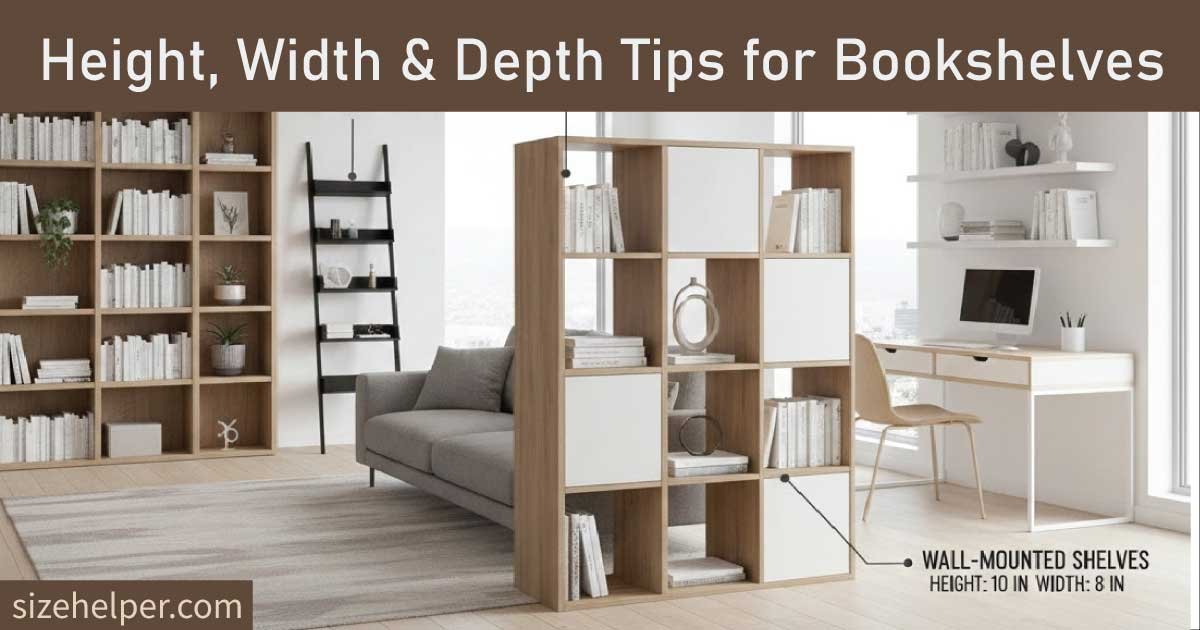
The bookshelves are beyond being mere storage facilities as they are also practical furniture that can beautify a room by improving its appearance, organization, and circulation. Select the proper bookshelf size will be important to both the small and the big rooms so that the books and the other items, the decoration, and the space are not over- crowded on the shelf. An oversized bookshelf will take up too much space in a room and make it feel claustrophobic, where as the bookshelf that is too small can result in disorganized clutter and a lack of storage space. Knowledge in the size, design and placement will guarantee the practicality and appeal of a bookshelf set up in any given room.
Why Bookshelf Size Matters
A bookshelf size also influences the level of functionality and the room atmosphere. A tall, narrow bookshelf can also be used in small spaces to save up on floor space and storage is not limited. Oversized bookshelves may balance the wall space and add focal points in large rooms but when not proportioned they may become overwhelming to the room. Bookshelves of the correct size enable an organized storage system, easy accessibility and harmonious design of rooms, which makes them an important part of the interior planning.
Understand Different Bookshelf Types
Bookshelves are available in different types and they are considered differently in terms of sizing. Free standing bookshelves are available in a variety of heights and widths and provide flexibility of positions. Wall mounted shelves help in saving space and are effective in small rooms. Bookshelves in the form of ladders are not only beautiful but also functional at the same time, and modular units can be tailored to fit any area. Built-in bookshelves are more permanent and they would need careful calculation but are able to be as useful as possible. The selection of the type to be used is dependent on the size of your room, storage requirements and design preferences.
Table: Common Bookshelf Types and Standard Dimensions
| Bookshelf Type | Height (inches) | Width (inches) | Depth (inches) | Notes |
|---|---|---|---|---|
| Freestanding | 36 – 84 | 24 – 36 | 10 – 14 | Flexible placement, standard option |
| Wall-mounted | 12 – 48 | 24 – 72 | 6 – 12 | Saves floor space, decorative storage |
| Ladder-style | 48 – 84 | 18 – 36 | 10 – 12 | Stylish, ideal for light storage |
| Modular | 36 – 96 | 24 – 48 | 10 – 14 | Customizable, expandable |
| Built-in | 72 – 120 | Varies | 12 – 14 | Permanent, maximizes storage |
Measure Your Room
Take measurements before buying a bookshelf of the wall or floor space available. Take into consideration height, width and depth and clearages of walking paths and other furniture. The vertical storage of small rooms can be particularly effective than the wide unit, with the large rooms having the capacity to carry broader or more bookshelves. Accurate measurement has the advantage of avoiding the overcrowding of your bookshelf and having your bookshelf fit well without causing disturbance in moving.
Recommended Clearance Around Bookshelves
| Room Size | Clearance in Front (inches) | Clearance on Sides (inches) |
|---|---|---|
| Small room | 24 – 30 | 6 – 12 |
| Medium room | 30 – 36 | 6 – 18 |
| Large room | 36 – 48 | 12 – 24 |
Determine Bookshelf Height
The height of bookshelf must correspond to storage requirements and room ratio. Small rooms may have tall bookshelves that do not occupy any floor space but can still offer a lot of storage and are only accessible with the help of a step stool. Tall bookshelves in large rooms may make a dramatic focal point, whereas the medium-height units may be used as functional partitions. Keep the visual balance with other pieces of furniture when choosing the height of ceiling.
Understand Bookshelf Width and Depth
The size of a shelf and its depth is what defines the space available to store books and other items and influences their accessibility. General bookshelves have standard depths of 1014 inches, and units of greater depth may be required to place over-sized books or decor objects. The width will be changed with the available wall space and storage requirements. Slim shelves are limited in space requirement in small rooms, but broad shelves in large rooms allow more space of display and storage.
Recommended Bookshelf Dimensions Based on Room Size
| Room Size | Recommended Height (inches) | Width (inches) | Depth (inches) |
|---|---|---|---|
| Small | 36 – 72 | 24 – 30 | 10 – 12 |
| Medium | 48 – 84 | 24 – 36 | 12 – 14 |
| Large | 60 – 96 | 36 – 48 | 12 – 14 |
Shelf Spacing Considerations
Shelf spacing influences the kind of things that you will be able to store. In the case of ordinary books, shelves are spaced 10 to 12 inches aside. Bigger book or ornamental objects can take 12-15 inches of space. Modifiable shelves are versatile to store other sizes of objects and you can always tailor your storage as your collection or decor changes.
Bookshelf Material and Durability
Selection of material influences on the weight bearing and durability. Solid wood shelves are strong and long lasting whereas the engineered wood or MDF is cheap and easy to carry. The metal bookshelves are robust and contemporary and can be heavier to relocate. Glass shelves have a classy appearance but are not as useful with heavy books. The material will have an effect on the maximum width and depth of shelves that will be safely supported.
Table: Bookshelf Material Comparisons
| Material | Durability | Weight Capacity | Ideal Use |
|---|---|---|---|
| Solid Wood | High | High | Long-term storage, heavy books |
| MDF / Engineered | Medium | Medium | Budget-friendly, lightweight |
| Metal | High | High | Industrial or modern aesthetics |
| Glass | Low-Medium | Low | Decorative, light items only |
Common Mistakes to Avoid
Some of the most common errors when picking out bookshelves are to pick out units that are too deep or tall as compared to the room, crowding shelves, or not clearing off the walls. Excessive storage needs can cause extremely large units, which will take up much space in a room whereas insufficient storage can result in a shortage of space. These pitfalls can be avoided by proper planning, measurements, and consideration of the items to be intended.
Mini List: Key Factors for Choosing the Right Bookshelf
In choosing a bookshelf, one should keep in mind the following: the size of the room, the ceiling height, the space available on the wall, the type of items that will be stored in the shelf, shelf depth, material durability, style and design, and flexibility (adjustable shelves). A balance between these aspects will guarantee not only efficient but also beautiful storage.
Matching Bookshelves to Room Layout
Bookshelves are to be used in addition to the layout of the room and other furniture. There are small rooms with narrow vertical units or wall-mounted shelves that save floor space. Large rooms may use wide or built-in units as divisions or focuses to the room. Book shelfs should be placed in areas with natural light to increase their readability, and to display the objects of the decoration, but it should not be exposed to direct sunlight to avoid fading.
Styling and Organization Tips
You need to organize and style the bookshelf once you have the appropriate size of the bookshelf. Organize books according to category, color or size as an aesthetic appeal. Combine decorative objects, such as greenery, photo frames, or paintings, to avoid a homogenous appearance. Keep shelves open to create a balance and avoid clutter. Modifiable shelves enable you to modify the book shelf arrangement (as your library expands or alters).
Conclusion
The size of the bookshelf has to be chosen correctly to maximize storage, comfort, and appearance enhancements of the room. It is also possible to select the units that will fit in a small room and a big room by measuring your room, knowing the height, width, and depth of your bookshelf, taking into account the space between shelves, and finding the right materials. Be careful of the pitfalls like overcrowding, mismatched dimensions or not considering the wall clearance. Not only will a well thought-out bookshelf allow you to store the books and other decorations, but also be part of the overall design and harmony of your space. With proper planning, your bookshelf can be a useful and beautiful part of your home that not only helps you to be more organized but also to be more comfortable over the years.
💺 Chair Dimensions are key to creating comfortable seating at home. Learn the ideal measurements for height, width, and depth to suit any space. With practical tips and detailed charts, this guide helps you choose chairs that provide perfect support. Read the full post for complete guidance!
