
Choosing a dishwasher isn’t just about picking a model that looks sleek in your kitchen. The size of a dishwasher significantly affects efficiency, convenience, and overall kitchen functionality. A unit that’s too small may require multiple washes, while an oversized dishwasher can waste water, energy, and space. This guide explores standard and compact dishwasher sizes, capacity considerations, installation tips, and energy efficiency, helping you select the right dishwasher for your home.
Why Dishwasher Size Matters
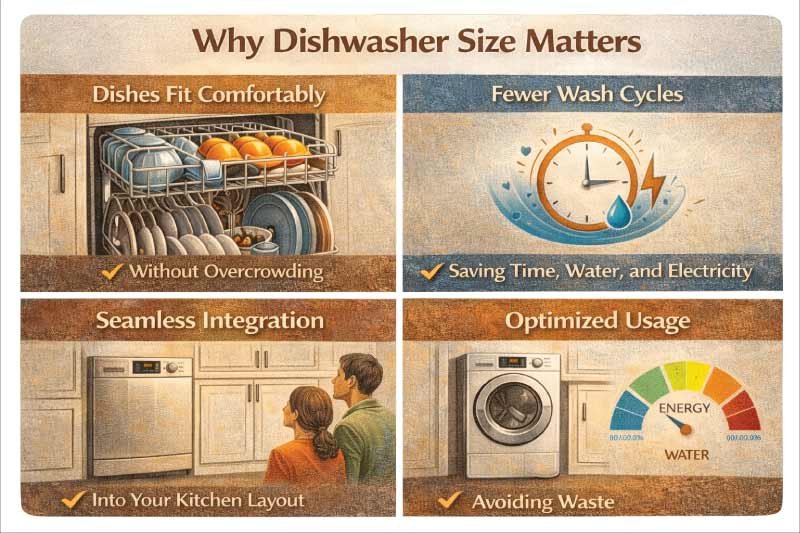
Choosing the right dishwasher size is crucial for both efficiency and convenience. A properly sized dishwasher ensures optimal cleaning, reduces energy and water consumption, and fits seamlessly into your kitchen. Understanding how size impacts performance helps you select a model that meets your household’s needs.
-
Dishes fit comfortably without overcrowding.
-
Fewer wash cycles are needed, saving time, water, and electricity.
-
Appliances integrate seamlessly into your kitchen layout.
-
Energy and water usage remain optimized, avoiding waste.
Household size, kitchen space, and frequency of use are key factors to consider when choosing the right dishwasher size.
Standard Dishwasher Sizes
Choosing the right dishwasher size is essential for kitchen efficiency and convenience. Standard dishwasher dimensions—width, height, and depth—ensure a proper fit under counters and seamless integration with cabinetry. Understanding the different types helps you select a model that matches your household size, kitchen layout, and daily dishwashing needs.
Standard Dishwasher Dimensions
| Type | Width | Height | Depth | Ideal Use Case |
|---|---|---|---|---|
| Full-Size | 24 inches | 34 inches | 24 inches | Families, daily full loads |
| Compact | 18 inches | 32–34 inches | 22–24 inches | Apartments, singles, couples |
| Slimline | 21 inches | 34 inches | 22–24 inches | Small kitchens, limited space |
| Drawer Dishwashers | 24 inches/drawer | 16–18 inches/drawer | 22–24 inches | Flexible, space-saving |
| Countertop Dishwashers | 18 inches | 17–20 inches | 20–22 inches | Single households, small spaces |
| Portable Dishwashers | 18–24 inches | 34 inches | 24 inches | Rental homes, temporary installations |
Types of Dishwashers and Their Size Implications
Choosing the right dishwasher involves understanding how size affects capacity, placement, and efficiency. Dishwashers vary from full-sized built-in units to compact countertop models, each designed for specific household needs. Proper sizing ensures effective cleaning, convenient installation, and optimal use of kitchen space, while preventing energy waste or overcrowding.
1. Built-in Dishwashers
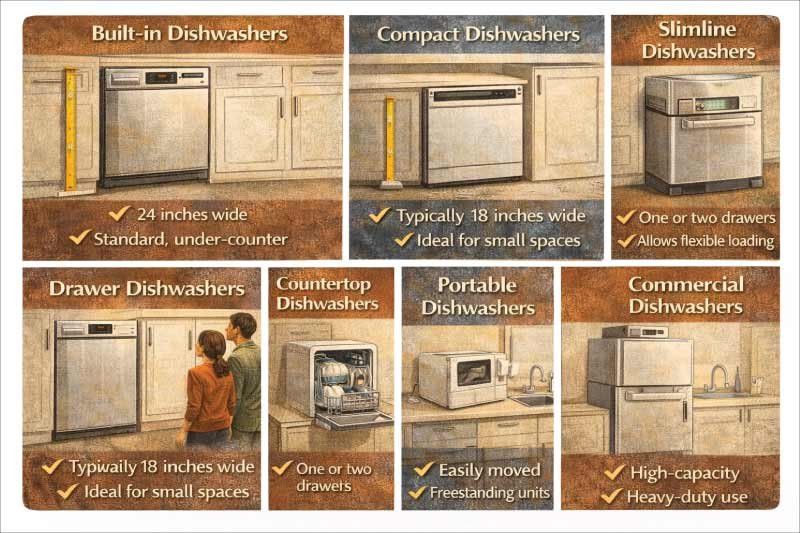
Built-in dishwashers are the most common type, typically 24 inches wide, designed to fit seamlessly under countertops. They offer large capacity, ideal for families, and integrate smoothly with cabinetry. Permanent installation ensures stability and minimal noise, making them a long-term, space-efficient solution for kitchens with adequate under-counter space.
2. Compact Dishwashers
Compact dishwashers are usually 18 inches wide and suited for singles, couples, or small kitchens. They may be freestanding or counter-top models, providing flexibility in placement. Although they offer limited capacity, they efficiently handle smaller loads and save space, making them perfect for apartments or kitchens with restricted under-counter dimensions.
3. Slimline Dishwashers
Slimline dishwashers measure around 21 inches wide, slightly larger than compact models. They are ideal for small households needing moderate cleaning capacity without occupying too much space. Slimline units often include flexible racks and adjustable settings, balancing efficiency with compact design, offering a practical solution where standard-size units may be too large.
4. Drawer Dishwashers
Drawer dishwashers feature one or two pull-out drawers for loading dishes. They provide half-load options, making them energy and water-efficient for smaller loads. Space-saving and ergonomic, they can be installed under counters or in kitchen islands. While more expensive, they allow flexible loading, quiet operation, and are ideal for modern, minimalist kitchens.
5. Countertop Dishwashers
Countertop dishwashers are extremely compact, designed to sit on kitchen counters. With limited capacity, they are best for single occupants, couples, or office kitchens. Installation is simple, often connecting directly to the sink faucet. Their small footprint saves floor space and offers a convenient option where under-counter space is unavailable.
6. Portable Dishwashers
Portable dishwashers are freestanding units on wheels, easily rolled into place and connected to a faucet when needed. They require no permanent installation and are perfect for renters or kitchens lacking built-in space. Despite limited capacity compared to built-in models, they provide full dishwasher functionality and can be stored when not in use.
7. Commercial Dishwashers
Commercial dishwashers are high-capacity machines designed for restaurants, catering, or large households. They often require specialized electrical and plumbing connections, handling heavy-duty loads efficiently. These units offer rapid washing cycles and durable construction, but their large size makes them unsuitable for standard residential kitchens, requiring careful planning for space and installation requirements.
Also Read:
Measuring Your Space
Before buying a dishwasher, measuring your kitchen space accurately is essential. Proper measurements prevent installation issues, ensure smooth operation, and maintain kitchen workflow. Taking precise dimensions and checking clearances helps you select a model that fits perfectly, avoids obstructions, and aligns with existing plumbing and electrical setups.
-
Width, depth, height of the installation space.
-
Door swing clearance—most dishwasher doors open outward; ensure nothing blocks them.
-
Proximity to plumbing and electrical connections.
Recommended Dishwasher Dimensions by Kitchen Type
Selecting the right dishwasher for your kitchen depends on both space and usage needs. Recommended dimensions vary by kitchen type, from compact apartments to large kitchens. Matching width, height, and depth ensures efficient installation, optimal performance, and convenience while accommodating household size and available space.
| Kitchen Type | Recommended Width | Height | Depth | Notes |
|---|---|---|---|---|
| Small apartment | 18–21 inches | 32–34 in | 22–24 in | Compact or slimline units recommended |
| Standard kitchen | 24 inches | 34 in | 24 in | Fits standard cabinetry |
| Large kitchen | 24–30 inches | 34–36 in | 24–26 in | Consider high-capacity or commercial unit |
| Flexible space | Drawer models | 16–18 in per drawer | 22–24 in | Half-load flexibility |
Dishwasher Capacity
Understanding dishwasher capacity helps match your appliance to your household’s cleaning needs. Measured in place settings, capacity determines how many dishes can be washed efficiently in one cycle. Choosing the right size prevents overcrowding, reduces energy and water waste, and ensures that every load comes out spotless.
Full-size dishwashers: 12–16 place settings
Compact dishwashers: 6–8 place settings
Slimline dishwashers: 8–10 place settings
Drawer dishwashers: 6–8 per drawer
Recommended Dishwasher Capacity by Household Size
Choosing a dishwasher with the right capacity ensures efficient cleaning and avoids multiple loads. Household size determines the ideal type and number of place settings, from compact units for singles or couples to full-size or commercial models for larger families, supporting daily use and larger meal preparations.
| Household Size | Dishwasher Type | Place Settings | Notes |
|---|---|---|---|
| 1–2 people | Compact / Countertop | 6–8 | Suitable for limited daily loads |
| 3–4 people | Full-size Built-in | 12–14 | Handles everyday family dishes |
| 5+ people | Full-size / Commercial | 14–16+ | Frequent use, larger meal prep |
Also Read:
Energy Efficiency and Water Usage
Dishwasher size plays a key role in energy and water efficiency. Selecting the right size ensures optimal performance while minimizing waste, lowering utility bills, and supporting eco-friendly practices. Proper load management and choosing energy-efficient models help maintain effective cleaning without unnecessary consumption of resources.
Tips for optimizing efficiency:
-
Run full loads whenever possible.
-
Use eco or half-load modes for smaller loads.
-
Choose Energy Star-rated models to save electricity and water.
Average Energy and Water Use by Dishwasher Type
Dishwasher type influences both energy consumption and water usage. Understanding average yearly use helps households choose a model that balances performance with efficiency. From full-size units for families to compact or countertop models for singles, selecting the right type can reduce utility costs and environmental impact.
| Dishwasher Type | Energy Use (kWh/Year) | Water Use (Gallons/Year) | Notes |
|---|---|---|---|
| Full-size | 270–320 | 3000–4000 | Standard family use |
| Compact | 200–250 | 2000–2500 | Small household or apartments |
| Slimline | 230–280 | 2500–3000 | Moderate use |
| Drawer Dishwashers | 220–270 | 2200–2800 | Flexible half-load options |
| Countertop | 150–200 | 1500–2000 | Single or light use |
Depth Considerations
Dishwasher depth affects both visual alignment and everyday usability in your kitchen. Choosing the correct depth ensures the appliance sits flush with cabinetry, provides adequate interior space, and allows doors to open smoothly. Proper depth selection prevents clearance issues and maintains a clean, well-organized kitchen layout.
-
Standard (24 inches): Fits most countertops.
-
Shallow (22–23 inches): Useful for islands or tight spaces.
-
Extra-deep (25–26 inches): Allows for larger internal capacity.
Always check how the dishwasher door aligns with adjacent cabinets and appliances to avoid interference.
Also Read:
Dishwasher Height and Kitchen Counter Compatibility
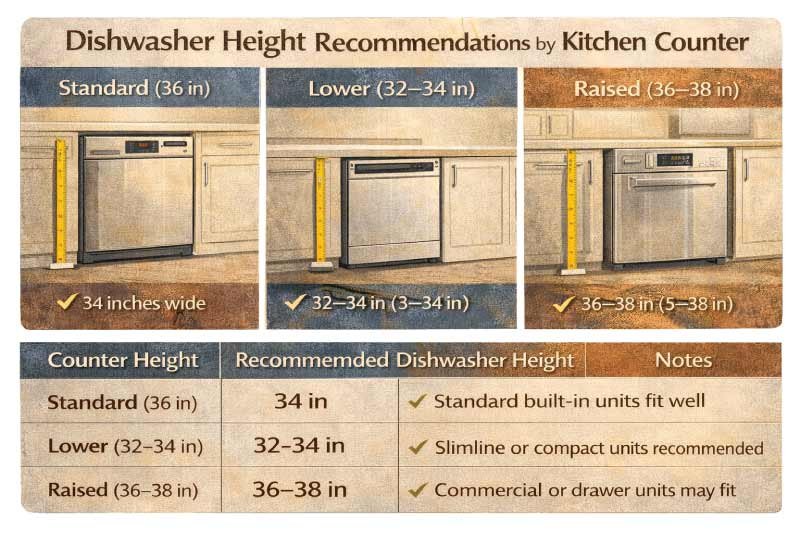
Dishwasher height plays a crucial role in proper installation and seamless kitchen design. Most standard models are built to fit under 34-inch counters, but variations in flooring or cabinetry may require adjustable-height dishwashers. Ensuring correct height compatibility prevents installation issues and maintains a clean, integrated kitchen appearance.
Dishwasher Height Recommendations by Kitchen Counter
Dishwasher height must align with your kitchen counter to ensure proper installation and comfortable use. Matching appliance height to counter dimensions prevents gaps, improves stability, and supports smooth operation. Understanding standard and non-standard counter heights helps you choose a dishwasher that integrates seamlessly into your kitchen design.
| Counter Height | Recommended Dishwasher Height | Notes |
|---|---|---|
| Standard (36 in) | 34 in | Standard built-in units fit well |
| Lower (32–34 in) | 32–34 in | Slimline or compact units recommended |
| Raised counters | 36–38 in | Commercial or drawer units may fit |
Special Considerations for Installation
Installation requirements vary depending on dishwasher type and kitchen layout. Understanding these differences helps avoid costly modifications and ensures smooth operation. Considering installation style, space availability, and utility access allows you to select a dishwasher that fits your kitchen seamlessly while meeting practical, functional, and long-term usage needs.
-
Built-in units: Permanent, integrated into cabinetry.
-
Portable units: Flexible placement, ideal for rentals.
-
Drawer units: Require specialized cabinet space, allow half-loads.
-
Countertop units: No permanent installation, suitable for limited space.
Always consider door clearance, plumbing, and electrical requirements.
Installation Considerations by Dishwasher Type
Dishwasher installation requirements vary by type and can significantly affect cost and convenience. From permanent built-in models to portable and countertop units, understanding space needs, hookups, and modifications helps ensure a smooth installation. Evaluating pros and cons in advance prevents unexpected challenges and supports long-term satisfaction.
| Dishwasher Type | Installation Requirements | Pros | Cons |
|---|---|---|---|
| Built-in | Permanent under-counter, plumbing/electric hookups | High capacity, sleek design | Requires cabinet space |
| Compact | Countertop or under-counter | Space-saving, suitable for singles | Limited capacity |
| Drawer | Cabinet modifications needed | Flexible half-loads | Expensive, special installation |
| Portable | No permanent installation, water hookup | Easy to move, no construction | Slower, smaller capacity |
| Countertop | Countertop space, faucet hookup | Ideal for apartments | Very limited capacity |
| Commercial | High power, water pressure, space needed | Heavy-duty, rapid cleaning | Expensive, requires special setup |
Also Read:
Pros and Cons of Different Sizes
Dishwasher size influences convenience, efficiency, and overall cost. Each size category offers unique advantages and limitations depending on household needs and available space. Understanding the pros and cons of different dishwasher sizes helps you make an informed choice that balances capacity, flexibility, installation requirements, and long-term operating efficiency.
-
Full-size Dishwashers
-
Pros: Large capacity, fewer cycles
-
Cons: Uses more water if underfilled, higher cost
-
-
Compact Dishwashers
-
Pros: Saves space, ideal for small households
-
Cons: Limited capacity
-
-
Drawer Dishwashers
-
Pros: Flexible loading, ergonomic
-
Cons: Expensive, requires specialized installation
-
-
Portable Dishwashers
-
Pros: Easy to move, no permanent installation
-
Cons: Slower cycles, limited capacity
-
Also Read:
Final Thoughts
Choosing the right dishwasher size requires balancing household needs, kitchen space, and energy efficiency. Measure your space accurately, consider capacity, and choose a type that fits your lifestyle. Whether you opt for compact, full-size, or drawer models, the right dishwasher size ensures convenience, efficiency, and long-lasting performance.
By using the tables and guidelines above, you can confidently select a dishwasher that complements your kitchen and meets your household needs.
FAQs:
What are standard dishwasher sizes?
Standard dishwashers typically measure 24 inches wide, 24 inches deep, and 35 inches tall. These units fit most kitchen cabinetry, offering a capacity of 12–16 place settings. Compact or slimline models may be smaller, ideal for apartments or small kitchens without compromising cleaning performance.
How to choose dishwasher size?
Choose a dishwasher size based on your kitchen space, household needs, and load frequency. Standard 24-inch models suit most families, while compact 18–22 inch units work for smaller kitchens or couples. Measure your cabinet opening carefully and ensure the unit fits plumbing and electrical connections for seamless installation.
Do they make 22 inch dishwashers?
Yes, 22-inch dishwashers are available as slimline models. These are ideal for small kitchens or apartments where a standard 24-inch unit won’t fit. While they hold fewer dishes, modern 22-inch dishwashers still provide efficient cleaning and energy-saving features suitable for one to two people.
What size space is needed for a dishwasher?
Most dishwashers require a cabinet opening approximately 24 inches wide, 24 inches deep, and 35 inches high. Compact or slimline models may need slightly less space, around 18–22 inches wide. Always leave a few inches for ventilation and proper installation, ensuring plumbing and electrical access is available.
How big is a full-size dishwasher?
A full-size dishwasher generally measures 24 inches wide, 24 inches deep, and 35 inches tall. It can hold 12–16 place settings, making it suitable for families or frequent entertainers. Full-size dishwashers fit standard kitchen cabinetry and provide optimal cleaning capacity without occupying extra space.
Do they make 20 inch dishwashers?
Yes, 20-inch dishwashers exist as compact units, perfect for small kitchens, apartments, or minimal usage. They typically hold fewer dishes than standard models but maintain efficient cleaning. These units are ideal for singles or couples who need space-saving appliances without compromising performance.

I am Engineer Hassan, a professional engineer with over 15 years of experience in measurements, design accuracy, and furniture, appliance, and home product sizing. Through Size Helper, I provide research-based guides and trending 2026 home design ideas for living rooms, bedrooms, sofas, wall décor, fashion, and sports—helping users make confident, informed decisions. Every guide is written with real expertise, verified data, and a commitment to quality, usability, and style.