
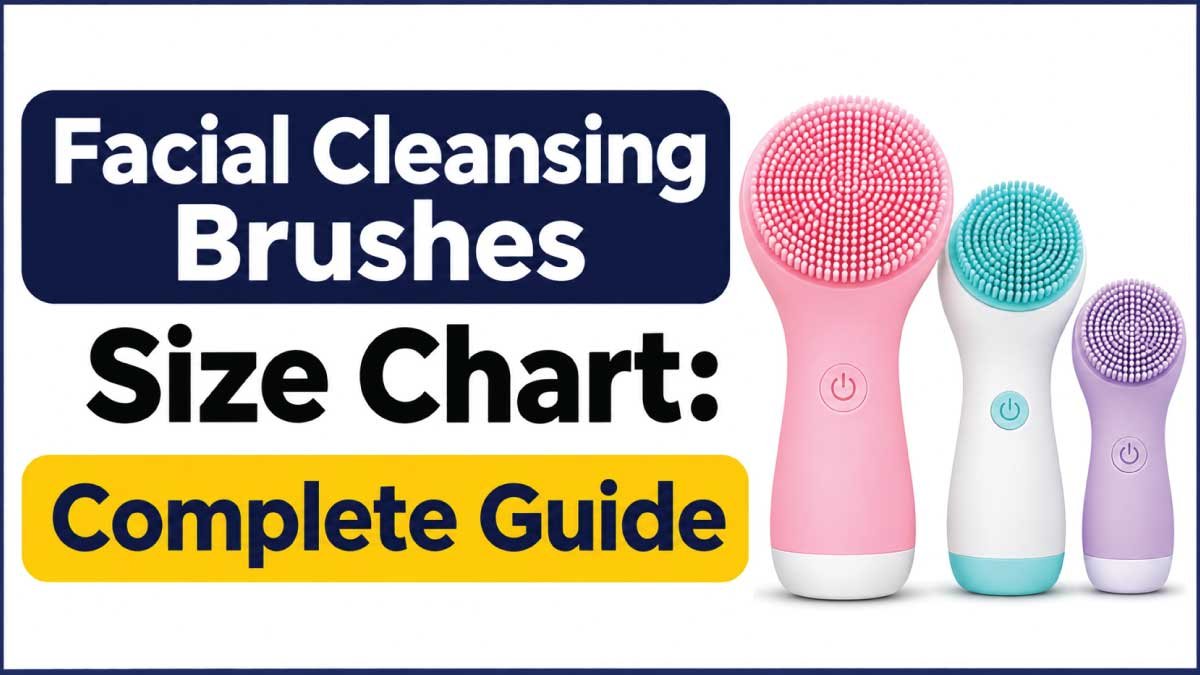
Choosing the right facial cleansing brush involves more than selecting a color or design. The brush head diameter, overall length, bristle softness, and contact surface can all affect how comfortably the device fits into your skincare routine. A brush that is too large may be difficult to use around the nose, while a compact head may require more time to clean larger facial areas.
This facial cleansing brushes size chart explains common brush dimensions, head sizes, materials, and design types. Whether you prefer a manual silicone brush or an electric facial cleansing device, this guide will help you compare sizes and choose a suitable option.
Because facial cleansing brushes are not manufactured according to one universal sizing standard, the measurements below are practical estimates. Actual dimensions vary by manufacturer, model, and attachment type.
Facial Cleansing Brushes Size Chart
Facial cleansing brushes come in several sizes, from small travel-friendly designs to larger electric devices. The most important measurements include the overall brush length, head diameter, contact surface, and thickness.
The following chart provides approximate dimensions for common facial cleansing brush categories.
| Brush Size Category | Overall Length | Brush Head Width | Best For |
|---|---|---|---|
| Mini / Travel | 2–2.75 in (5.1–7 cm) | 1.5–2 in (3.8–5.1 cm) | Travel and detail cleaning |
| Small | 2.5–3.25 in (6.4–8.3 cm) | 1.75–2.25 in (4.4–5.7 cm) | Smaller facial areas |
| Medium | 2.75–4 in (7–10.2 cm) | 2–3 in (5.1–7.6 cm) | Everyday facial cleansing |
| Large | 3.5–4.5 in (8.9–11.4 cm) | 2.5–3.25 in (6.4–8.3 cm) | Wider facial contact |
| Electric Handheld | 4–6 in (10.2–15.2 cm) | 1.75–3 in (4.4–7.6 cm) | Powered cleansing |
| Detail Brush | 2–3 in (5.1–7.6 cm) | 1–1.75 in (2.5–4.4 cm) | Nose and targeted areas |
These categories describe general product dimensions rather than official industry sizes. Some silicone cleansing brushes are wider and flatter, while electric models may have a narrow handle and a detachable circular head.
Facial Cleansing Brush Head Size Chart
The brush head is the part that makes direct contact with your face. Its diameter determines the approximate cleaning area covered with each movement.
Smaller brush heads are easier to position around the nose and chin. Larger heads can cover broader areas, such as the cheeks and forehead.
| Brush Head Size | Diameter in Inches | Diameter in Millimeters | Typical Application |
|---|---|---|---|
| Extra Small | 0.75–1 in | 19–25 mm | Detail cleaning |
| Small | 1–1.5 in | 25–38 mm | Nose and chin |
| Medium | 1.5–1.75 in | 38–44 mm | General facial cleansing |
| Standard | 1.75–2 in | 44–51 mm | Everyday use |
| Large | 2–2.25 in | 51–57 mm | Wider contact area |
| Extra Large | 2.25–2.5 in | 57–64 mm | Broad facial coverage |
A head measuring approximately 1.75–2 inches is a common practical size for full-face cleansing devices. However, some compact electric brushes use smaller heads, and silicone models may have oval or irregular contact surfaces.
How to Choose the Right Brush Head Diameter
Consider the following points when comparing brush head sizes:
- Small heads: Useful for reaching around the nose, chin, and other narrow areas.
- Medium heads: Offer a balance between coverage and maneuverability.
- Large heads: Cover more surface area but may be less convenient around facial contours.
- Oval heads: Can provide a longer contact surface for cheeks and forehead.
- Round heads: Common in interchangeable electric cleansing devices.
A larger brush head does not automatically provide better cleansing. Comfort, material, pressure, and suitable usage are equally important.
Facial Cleansing Brush Size by Type
Different facial cleansing brush designs have different dimensions and cleaning surfaces. Understanding these differences makes it easier to compare products.
1. Silicone Facial Cleansing Brushes
Silicone cleansing brushes feature soft raised points or flexible nubs instead of traditional fiber bristles. They are commonly designed as compact handheld pads or rechargeable electric devices.
| Silicone Brush Type | Approximate Dimensions | Common Use |
|---|---|---|
| Mini Silicone Brush | 2–2.75 in long | Travel and targeted cleansing |
| Standard Silicone Pad | 2.75–4 in long | Everyday facial cleansing |
| Wide Silicone Pad | 3–4 in wide | Cheeks and forehead |
| Electric Silicone Brush | 4–6 in long | Powered facial cleansing |
| Oval Silicone Brush | 2–3.5 in long | Facial contours and detail areas |
Silicone brushes are available in different softness levels and nub patterns. Some have finer points for gentle contact, while others feature larger raised sections.
2. Bristle Facial Cleansing Brushes
Traditional facial cleansing brushes use fine synthetic fibers arranged in a circular or oval head. Their head dimensions vary according to the device and intended application.
| Bristle Brush Type | Approximate Head Diameter | Common Application |
|---|---|---|
| Fine Bristle | 1–1.25 in | Gentle surface cleansing |
| Small Bristle | 1.25–1.5 in | Targeted cleansing |
| Medium Bristle | 1.5–1.75 in | General facial cleansing |
| Standard Bristle | 1.75–2 in | Everyday cleansing |
| Large Bristle | 2–2.25 in | Wider facial areas |
Bristle thickness and softness also matter. For example, some manufacturers offer fine fibers around 0.055 mm in diameter and firmer fibers around 0.075 mm. These measurements describe individual fiber thickness, not the overall brush head size.
3. Electric Facial Cleansing Brushes
Electric facial cleansing brushes include a motor or vibration mechanism inside the handle. Many models feature replaceable brush heads or adjustable intensity settings.
| Electric Brush Component | Approximate Size |
|---|---|
| Overall Device Length | 4–6 in (10.2–15.2 cm) |
| Brush Head Diameter | 1.5–2 in (38–51 mm) |
| Handle Width | 0.75–1.25 in (1.9–3.2 cm) |
| Brush Head Height | 0.5–0.8 in (1.3–2 cm) |
| Compact Travel Model | 3–4.5 in (7.6–11.4 cm) |
Actual electric device dimensions can differ considerably. For example, some commercial models have brush heads measuring approximately 47–48 mm in diameter.
4. Manual Facial Cleansing Brushes
Manual brushes do not require batteries or charging. They are usually made from silicone, plastic, or soft synthetic bristles.
| Manual Brush Type | Approximate Length | Approximate Width |
|---|---|---|
| Mini Manual Brush | 2–2.75 in | 1.5–2 in |
| Standard Handheld Brush | 2.75–4 in | 2–3 in |
| Flat Silicone Brush | 2.75–3.5 in | 2.25–3 in |
| Handled Bristle Brush | 3–5 in | 1.5–2.5 in |
Manual brushes are often lightweight and easy to store. Their simple construction also makes them convenient for people who do not want to maintain an electronic device.
Facial Cleansing Brush Size Conversion Chart
Manufacturers may list brush dimensions in inches or millimeters. Use this conversion chart to compare measurements between different brands.
| Inches | Millimeters | Centimeters |
|---|---|---|
| 0.5 in | 12.7 mm | 1.27 cm |
| 0.75 in | 19.05 mm | 1.91 cm |
| 1 in | 25.4 mm | 2.54 cm |
| 1.25 in | 31.75 mm | 3.18 cm |
| 1.5 in | 38.1 mm | 3.81 cm |
| 1.75 in | 44.45 mm | 4.45 cm |
| 2 in | 50.8 mm | 5.08 cm |
| 2.25 in | 57.15 mm | 5.72 cm |
| 2.5 in | 63.5 mm | 6.35 cm |
| 3 in | 76.2 mm | 7.62 cm |
| 4 in | 101.6 mm | 10.16 cm |
| 5 in | 127 mm | 12.7 cm |
| 6 in | 152.4 mm | 15.24 cm |
For accurate comparisons, check whether the listed measurement refers to the brush head, the entire device, or only its contact surface.
Facial Cleansing Brush Size by Facial Area
Not every part of the face has the same shape or available cleaning space. A brush that feels comfortable on the cheeks may be difficult to position around the nose.
The following guide explains which brush designs are generally convenient for different facial areas.
| Facial Area | Suggested Brush Design | Reason |
|---|---|---|
| Forehead | Medium or large head | Covers a broad surface |
| Cheeks | Medium or standard head | Comfortable everyday coverage |
| Nose | Small or detail head | Easier access around contours |
| Chin | Small or medium head | Provides better control |
| Jawline | Medium head | Follows the facial outline |
| Around the Nose | Compact or narrow head | Helps reach smaller spaces |
These recommendations describe handling and coverage, not a requirement to use a separate brush for every facial area. A single medium-sized brush may be sufficient for many users.
Choosing a Brush for Smaller Facial Areas
If you want a brush that is easy to maneuver around the nose and chin, consider a compact head or an oval-shaped design. Avoid forcing a large, rigid brush into narrow areas.
Choosing a Brush for Larger Facial Areas
A medium or standard head can make it easier to move across the cheeks and forehead. However, use gentle movements rather than pressing harder to cover more surface area.
Facial Cleansing Brush Bristle Size Chart
Bristle dimensions influence the texture and feel of a traditional cleansing brush. Some manufacturers identify their brush fibers by diameter, while others use descriptions such as soft, sensitive, or deep cleansing.
| Bristle Category | Approximate Fiber Diameter | General Characteristics |
|---|---|---|
| Ultra-Fine | 0.03–0.05 mm | Very fine fibers |
| Fine | 0.055 mm | Soft, closely arranged fibers |
| Medium | 0.06–0.07 mm | Moderate fiber thickness |
| Firm | 0.075 mm | Thicker fibers |
| Extra Firm | 0.08–0.10 mm | Firmer texture |
These are illustrative product categories, not universal classifications. A brush’s actual feel also depends on fiber length, density, flexibility, and arrangement.
Bristle Length and Density
Apart from fiber diameter, consider the length and number of bristles.
- Short bristles: May create a compact contact surface.
- Long bristles: Can bend more easily but may feel different during use.
- High-density bristles: Provide a closely packed cleaning surface.
- Low-density bristles: Have more space between individual fibers.
A soft, flexible brush is generally a more cautious starting point than a firm brush, especially if you are unfamiliar with facial cleansing devices.
Also Read:
How to Choose the Right Facial Cleansing Brush Size
The best facial cleansing brush is one that feels comfortable in your hand and is easy to control. Before buying one, compare its measurements and construction.
1. Consider Your Preferred Brush Type
Decide whether you prefer silicone, synthetic bristles, or an electric device. Silicone brushes generally have a molded contact surface, while bristle models use individual fibers. Electric models may offer interchangeable attachments and adjustable settings.
2. Check the Brush Head Diameter
Look for a head size that suits your preferred cleaning areas. A medium head offers a practical balance for general use, while a smaller head may be easier to maneuver around facial contours.
3. Check the Overall Length
The overall length affects how comfortably you can hold the brush. A compact model may be easier to pack for travel, while a longer electric device may provide a more traditional handle grip.
4. Compare Brush Softness
Do not select a brush based on size alone. Consider the softness of its bristles or silicone contact points. A gentler design may be more appropriate for delicate or easily irritated skin.
5. Consider Handle Thickness
A handle that is too thick or too narrow can be uncomfortable to hold. If possible, compare the grip width and shape before purchasing.
6. Check Replacement Head Availability
Some electric facial cleansing brushes require model-specific replacement heads. Check compatibility and availability before buying the device.
7. Read the Manufacturer’s Instructions
Follow the manufacturer’s guidance for cleaning, charging, waterproof use, and replacement schedules. Not every electric brush is suitable for use in the shower.
Also Read:
How to Measure a Facial Cleansing Brush
Measuring a facial cleansing brush is straightforward. You only need a ruler or measuring tape.
Step 1: Measure the Overall Length
Place the brush on a flat surface and measure from the bottom of the handle or base to the highest point of the brush head.
Step 2: Measure the Brush Head Width
For a round brush, measure straight across the widest part of the head. For an oval brush, record both its longest and shortest dimensions.
Step 3: Measure the Brush Head Height
Measure from the base of the attachment to the top of the bristles or silicone surface.
Step 4: Measure the Handle Width
Measure across the widest part of the handle. This measurement helps you compare grip comfort between different models.
Step 5: Record the Contact Surface
For a bristle brush, measure the diameter of the bristle-covered area rather than the entire plastic attachment. For a silicone brush, measure the area covered by the raised silicone points.
Recording these measurements separately makes it easier to compare different facial cleansing brushes.
Common Facial Cleansing Brush Size Mistakes
Choosing the wrong brush can make your skincare routine less comfortable. Avoid these common mistakes when comparing products.
Choosing the Largest Brush Head
A larger head is not necessarily better. It may cover more surface area, but a compact head can be easier to control around the nose and chin.
Ignoring the Overall Device Length
Some buyers compare only the brush head and overlook the handle. A device that is difficult to grip may be inconvenient during regular use.
Confusing Bristle Diameter With Head Diameter
These are two different measurements. A 0.055 mm bristle specification refers to the thickness of an individual fiber, not the width of the complete brush head.
Assuming All Replacement Heads Are Compatible
Replacement attachments are often designed for specific models. Always verify the product number and connection type before ordering a replacement.
Selecting a Firm Brush Without Considering Skin Comfort
A firm brush may feel too harsh for some users. Start with a soft design and follow the manufacturer’s recommended usage instructions.
Ignoring Cleaning and Maintenance
Brushes should be cleaned according to their material and manufacturer instructions. Replaceable bristle heads may need periodic replacement, while damaged silicone attachments should not continue to be used.
Facial Cleansing Brush Care and Replacement Guide
Proper maintenance helps keep a facial cleansing brush clean and in good condition.
| Brush Type | General Maintenance | Replacement Consideration |
|---|---|---|
| Silicone Brush | Rinse and dry after use | Replace if damaged |
| Synthetic Bristle Brush | Rinse thoroughly and air-dry | Follow manufacturer guidance |
| Electric Brush Head | Clean attachment separately as instructed | Check recommended replacement interval |
| Manual Travel Brush | Clean and store dry | Replace when worn or damaged |
| Sponge Attachment | Clean according to material instructions | Replace as recommended |
Some manufacturers recommend replacing detachable bristle heads approximately every three months. However, replacement schedules vary by model and manufacturer. Silicone heads may not have the same routine replacement schedule, but they should be replaced if their surface becomes damaged.
Frequently Asked Questions About Facial Cleansing Brush Sizes
1. What Is the Standard Size of a Facial Cleansing Brush?
There is no universal standard size. Many handheld brushes measure approximately 2.75–4 inches long, while electric devices are often around 4–6 inches long. Brush head diameters commonly fall between 1.5 and 2 inches.
2. What Is the Best Brush Head Size for Everyday Use?
A medium or standard brush head measuring approximately 1.5–2 inches in diameter is a practical option for general facial cleansing. The best choice depends on the device design and your comfort.
3. Are Smaller Facial Cleansing Brushes Better?
Smaller brushes can be easier to control around the nose, chin, and other narrow areas. However, they may take longer to cover larger areas such as the cheeks and forehead.
4. What Size Silicone Facial Brush Should I Buy?
A standard silicone brush measuring approximately 2.75–4 inches long is a practical starting point for many users. Consider the contact surface and handle design as well as the overall length.
5. What Does 0.055 mm Mean on a Facial Brush?
This measurement usually describes the diameter of an individual brush fiber. It does not represent the width of the complete brush head.
6. How Large Are Electric Facial Cleansing Brush Heads?
Electric brush heads commonly measure approximately 1.5–2 inches in diameter, although some models are smaller or larger. Always check the manufacturer’s specifications.
7. Can I Use One Brush Size for My Entire Face?
Yes. Many users can use one appropriately sized brush for their entire face. A medium head is generally easier to maneuver than an oversized attachment.
8. Are Silicone Brushes Better Than Bristle Brushes?
Neither type is automatically better for everyone. Silicone brushes use flexible molded points, while bristle brushes use individual fibers. Your choice should depend on comfort, material, device design, and personal preference.
9. How Often Should I Replace a Facial Cleansing Brush Head?
Follow the manufacturer’s replacement instructions. Some brands recommend replacing detachable bristle heads about every three months. Replace any attachment sooner if it becomes damaged or excessively worn.
10. How Do I Know If a Facial Cleansing Brush Is Too Large?
If the brush is difficult to move around your nose, chin, or jawline, its head may be too large for your preferred use. A smaller or oval attachment may provide better control.
Conclusion
Choosing the right facial cleansing brush size can make your skincare routine more convenient and comfortable. For general use, a medium brush head measuring approximately 1.5–2 inches in diameter is a useful starting point. Smaller heads are convenient for targeted areas, while larger designs can cover broader facial surfaces.
Before purchasing, compare the overall length, head diameter, bristle or silicone design, and handle width. Most importantly, remember that facial cleansing brushes do not follow one universal sizing standard. Always check the manufacturer’s product measurements and usage instructions to find a suitable model.
