Finding the right belt size is easier when you know which measurement to use. A belt that is too short may not reach the buckle comfortably, while one that is too long can leave excessive material around your waist. The challenge is that belt size, waist size, trouser size, and total belt length are not always the same measurement.
This belt size chart explains common belt sizing, how to measure yourself accurately, how to convert between inches and centimeters, and how to choose the right belt for jeans, trousers, suits, or everyday clothing. You will also learn how belt sizing works for men, women, and different belt styles, plus how to handle sizing when shopping online.
Belt Size Chart
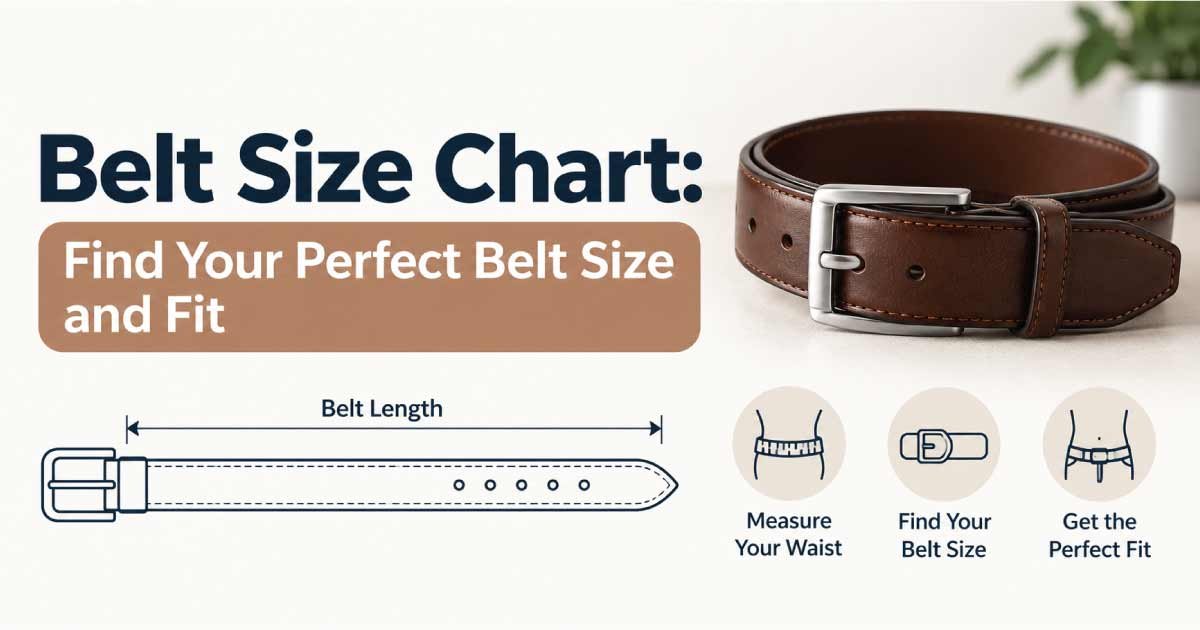
A belt size usually refers to the distance from the buckle’s prong to the middle hole of the belt. This is important because the total length of a belt is normally longer than its labeled size.
The following chart provides a practical starting point for choosing a belt based on waist measurement.
| Belt Size (in) | Belt Size (cm) | Approx. Waist (in) | Approx. Waist (cm) | Common Clothing Size |
|---|---|---|---|---|
| 28 | 71 | 26–27 | 66–69 | XS |
| 30 | 76 | 28–29 | 71–74 | XS–S |
| 32 | 81 | 30–31 | 76–79 | S |
| 34 | 86 | 32–33 | 81–84 | M |
| 36 | 91 | 34–35 | 86–89 | M–L |
| 38 | 97 | 36–37 | 91–94 | L |
| 40 | 102 | 38–39 | 97–99 | L–XL |
| 42 | 107 | 40–41 | 102–104 | XL |
| 44 | 112 | 42–43 | 107–109 | XXL |
| 46 | 117 | 44–45 | 112–114 | XXL–3XL |
| 48 | 122 | 46–47 | 117–119 | 3XL |
These ranges are general guidelines rather than a universal standard. Manufacturers may define belt sizes differently, and some brands label belts by total length instead of buckle-to-middle-hole measurement. Always check the individual brand’s size guide when one is available.
Quick Belt Size Rule
For many conventional belts, a useful starting point is:
Belt size ≈ trouser or waist size + 2 inches
For example, if you normally wear trousers with a 34-inch waist, a 36-inch belt is often a reasonable starting point.
However, your actual belt size can differ depending on where you wear the belt, the thickness of your clothing, and how the manufacturer measures its products.
What Does Belt Size Mean?
One of the most common belt-sizing mistakes is assuming that a 36-inch belt is exactly 36 inches from end to end. In many cases, it is not.
A traditional belt is measured from the point where the buckle attaches to the belt to the center hole. The center hole is generally intended to provide a comfortable adjustment position while leaving additional holes for tightening or loosening.
For example, a belt labeled 36 inches may have a total physical length significantly greater than 36 inches because the measurement does not necessarily include the buckle or the entire strap.
Belt Size vs. Total Belt Length
These terms should not be treated as interchangeable.
| Measurement | What It Usually Means |
|---|---|
| Belt size | Buckle-to-middle-hole measurement |
| Total belt length | Physical length of the belt, often including the strap and sometimes measured differently by the brand |
| Waist size | Measurement around your waist or clothing’s labeled waist |
| Trouser size | Clothing measurement that may not exactly match your actual body measurement |
This distinction becomes particularly important when buying belts online. If a retailer lists total belt length instead of belt size, you should not automatically select the same number as your waist measurement.
How to Measure Your Belt Size
The most reliable way to determine your belt size is to measure yourself rather than relying entirely on your trouser size.
You can use a soft measuring tape, or you can measure a belt that already fits you well.
Method 1: Measure Your Waist
This method is useful when you do not already own a properly fitting belt.
- Put on the type of clothing you normally wear with the belt.
- Wrap a flexible measuring tape around your waist at the position where the belt will sit.
- Keep the tape snug but not tight.
- Record the measurement in inches or centimeters.
- Use the result as a starting point when consulting a belt size chart.
- If the measurement falls between sizes, consider the belt’s adjustment range and your preferred fit.
Do not pull the tape tightly against your body. A belt should hold your clothing comfortably without creating unnecessary pressure.
Method 2: Measure a Belt That Fits
If you already own a belt that feels comfortable, this can be one of the most practical methods.
Lay the belt flat and measure from the buckle attachment point to the hole you normally use. Do not simply measure the entire belt from end to end.
If that measurement is 36 inches, for example, you can look for a replacement belt with a similar buckle-to-hole measurement.
This approach is especially useful when buying a new belt from a different brand and you want to reproduce the fit of an existing belt.
How to Measure a Belt Correctly
When measuring an existing belt, the buckle design matters.
For a traditional buckle with a prong, start at the point where the buckle and leather or strap meet. Measure along the belt to the hole you normally use.
The result is your wearing measurement, which is more useful than the belt’s total length.
Why the Middle Hole Matters
Many belts have five holes, although designs vary. The center hole gives you room to adjust the belt in either direction.
For a five-hole belt:
- The center hole is typically the third hole.
- The holes closer to the buckle provide a tighter fit.
- The holes farther from the buckle provide a looser fit.
A properly selected belt generally allows you to use the middle portion of the adjustment range rather than leaving you at the very first or last hole.
Belt Size Conversion Chart
Belt sizes are commonly listed in inches in the United States and several other markets, while centimeters may be used elsewhere.
Use this conversion chart as a quick reference.
| Belt Size (inches) | Approx. Belt Size (cm) |
|---|---|
| 28 | 71 |
| 30 | 76 |
| 32 | 81 |
| 34 | 86 |
| 36 | 91 |
| 38 | 97 |
| 40 | 102 |
| 42 | 107 |
| 44 | 112 |
| 46 | 117 |
| 48 | 122 |
The centimeter values are rounded conversions from inch measurements. Because manufacturers may use their own sizing systems, the conversion should be treated as a reference rather than a guarantee of fit.
Belt Size Chart for Men
Men’s belts are often sold in even-numbered sizes such as 30, 32, 34, 36, 38, 40, and 42 inches.
A general men’s belt size guide is shown below.
| Trouser Waist (in) | Suggested Belt Size (in) | Suggested Belt Size (cm) |
|---|---|---|
| 28 | 30 | 76 |
| 30 | 32 | 81 |
| 32 | 34 | 86 |
| 34 | 36 | 91 |
| 36 | 38 | 97 |
| 38 | 40 | 102 |
| 40 | 42 | 107 |
| 42 | 44 | 112 |
| 44 | 46 | 117 |
| 46 | 48 | 122 |
This chart follows the common two-inch belt-sizing approach, but it should not replace a manufacturer’s specific sizing information.
A man’s belt size may also change depending on whether the belt is worn around the natural waist, lower on the hips, or over thicker clothing.
Belt Size Chart for Women
Women’s belts can be more difficult to standardize because they are frequently worn in different positions. A belt may sit at the waist, around the hips, over a dress, or around a coat.
| Approx. Waist (in) | Approx. Belt Size (in) | Approx. Belt Size (cm) | General Clothing Range |
|---|---|---|---|
| 24–25 | 26–28 | 66–71 | XS |
| 26–27 | 28–30 | 71–76 | S |
| 28–29 | 30–32 | 76–81 | S–M |
| 30–31 | 32–34 | 81–86 | M |
| 32–33 | 34–36 | 86–91 | M–L |
| 34–35 | 36–38 | 91–97 | L |
| 36–38 | 38–40 | 97–102 | XL |
| 39–41 | 40–42 | 102–107 | XXL |
Women’s clothing sizes vary considerably between brands, so actual body or wearing measurements are more dependable than a clothing-size label.
For fashion belts, especially wide belts worn over dresses or tops, measure at the exact position where you intend to wear the belt.
How to Choose the Right Belt Size
Getting the measurement right is only part of finding a comfortable belt. The intended use and belt style also matter.
Consider Where You Will Wear It
A belt worn with low-rise jeans may require a different measurement from one worn around the natural waist.
Before ordering, decide whether the belt will be used with:
- Jeans
- Casual trousers
- Dress trousers
- Chinos
- Shorts
- Dresses
- Skirts
- Outerwear
Measure at the actual wearing position whenever possible.
Consider Clothing Thickness
A belt worn over a thin shirt may fit differently from one worn through belt loops over several layers.
Winter clothing, heavy denim, thick fabrics, and tucked-in shirts can all affect the required circumference.
If you frequently wear the belt over bulky clothing, allow enough adjustment room rather than selecting a size based only on a bare-waist measurement.
Belt Size for Jeans and Trousers
The belt loops on jeans and trousers can make belt selection relatively straightforward, but your labeled trouser size should still be treated as a starting point.
For example, someone wearing 32-inch trousers may find a 34-inch belt comfortable, while another person may prefer a different size because of body shape, rise, fabric thickness, or personal preference.
A practical approach is:
Measure the waist position through the belt loops → compare the result with the manufacturer’s belt chart → select the belt size that places your preferred hole near the center of the adjustment range.
This method is more reliable than assuming every pair of trousers labeled 32 inches has exactly the same actual circumference.
Dress Belt vs. Casual Belt Sizing
Dress belts and casual belts can use similar sizing principles, but their physical construction is often different.
Dress Belts
Dress belts are commonly narrower and designed for formal trousers. They usually have a cleaner appearance and a buckle that works with relatively small belt loops.
For a formal outfit, focus on:
- Correct buckle-to-hole measurement
- Appropriate belt width for the trousers
- A comfortable fit
- A belt length that does not leave excessive excess strap
Casual Belts
Casual belts may be wider, thicker, or made from materials such as leather, woven fabric, or synthetic materials.
Because construction varies, a casual belt can feel different even when the labeled size is identical to a dress belt.
Always compare the manufacturer’s measurement method when buying online.
Also Read:
How Much Belt Should Be Left After the Buckle?
A properly fitted belt should not leave an excessive amount of strap hanging beyond the buckle.
At the same time, it should not be so short that the end barely reaches the next belt loop.
For a conventional belt, the ideal appearance is usually achieved when the belt fastens around the middle portion of its adjustment range and the remaining strap reaches an appropriate belt loop.
The exact amount of visible excess depends on the belt design, number and placement of loops, buckle shape, and personal style.
If you consistently use the first or last hole, that is a useful sign that another belt size may provide a better fit.
What to Do If You Are Between Belt Sizes
Being between sizes is common.
Suppose your preferred belt measurement is approximately 35 inches and the available options are 34 and 36 inches. In many conventional sizing systems, the 36-inch size may provide more useful adjustment room.
However, do not choose automatically. Check:
- The belt’s hole spacing
- The manufacturer’s measurement method
- Whether the belt is adjustable
- Whether you wear it over thick clothing
- Your preferred level of snugness
For a belt with an adjustable buckle or a track-style mechanism, the sizing approach may be different from a traditional five-hole belt.
Also Read:
Common Belt Sizing Mistakes
A few simple mistakes can result in an uncomfortable or poorly fitting belt.
Using Your Trouser Size as an Exact Measurement
A trouser label is useful, but it does not necessarily represent your exact body circumference. Different brands and cuts can fit differently.
Use your trouser size as a starting point, then verify the belt measurement.
Measuring the Entire Belt
If you measure a belt from one end to the other, you may get a number that does not correspond to its labeled size.
Instead, determine how the manufacturer defines its belt size.
Ignoring the Buckle
A large buckle can affect the effective fit and the way the belt sits around your body. Some manufacturers measure from the buckle’s attachment point, while others may provide total length.
Choosing Based Only on Clothing Size
Labels such as S, M, L, XL, or numerical clothing sizes are not universal. A measurement-based approach is more reliable.
Forgetting How You Wear the Belt
A belt worn around the hips can require a different size from one worn at the natural waist. Always measure at the location where the belt will actually sit.
Also Read:
Belt Width and Fit
Belt size is not the only measurement worth checking. Belt width affects both appearance and compatibility with belt loops.
Common belt widths include approximately 1.25 inches, 1.5 inches, and wider casual styles, although products vary.
A narrow belt is often suitable for dressier clothing, while wider belts are frequently used with jeans and casual trousers.
Before buying, check the belt-loop opening on the clothing. A belt can be the correct length but still be unsuitable if it is too wide to pass comfortably through the loops.
Leather Belt Sizing and Stretch
Leather belts can change slightly with use. Natural leather may soften and develop some flexibility over time.
This does not mean you should deliberately buy a belt that is too small. A properly sized belt should be comfortable when new and should provide enough adjustment range for normal use.
Different leather types, construction methods, thicknesses, and finishes can behave differently, so avoid assuming that every leather belt will stretch by the same amount.
If long-term durability matters, consider the belt’s construction as well as its size.
How to Find Your Belt Size Without a Measuring Tape
You can still estimate your belt size if you do not have a flexible tape.
One option is to use a piece of string, ribbon, or non-stretch material.
Wrap it around your waist at the intended belt position, mark where the ends meet, then lay it flat against a ruler or rigid measuring device.
Another method is to measure a belt that already fits correctly. This is often easier than trying to estimate your body measurement.
Avoid using elastic or stretchy material because it can produce an inaccurate result.
Buying a Belt Online: What to Check
Online shopping makes belt sizing especially important because you cannot test the fit before purchasing.
Before placing an order, look for the seller’s measurement information and determine exactly what its listed size represents.
Check these details:
- Belt size: Is it measured to the center hole?
- Total length: Is the buckle included?
- Hole spacing: How far apart are the adjustment holes?
- Belt width: Will it fit your clothing’s belt loops?
- Adjustment range: How much larger or smaller can it be worn?
- Material: Does the belt have characteristics that may affect flexibility?
- Return policy: Can you exchange the belt if the fit is incorrect?
If the manufacturer’s chart conflicts with a generic belt size chart, follow the manufacturer’s measurement instructions because its labeling system may be different.
Frequently Asked Questions About Belt Sizes
What belt size should I buy for a 32-inch waist?
A 34-inch belt is a common starting point for a 32-inch trouser or waist measurement when the belt follows the conventional waist-plus-two sizing method. However, measuring the actual belt position and checking the manufacturer’s chart gives a more dependable result.
Is belt size the same as waist size?
No. Belt size and waist size are related but are not always identical. Many conventional belts are labeled according to the distance from the buckle attachment point to the middle hole, which is commonly a little larger than the wearer’s trouser waist measurement.
How do I know what belt size I need?
Measure around your body where you will wear the belt, or measure a belt that already fits you correctly from the buckle attachment point to the hole you normally use. Then compare that measurement with the manufacturer’s belt size chart.
Should I buy a belt one size bigger than my pants?
Often, yes. A common rule is to choose a belt approximately two inches larger than your trouser waist size. However, this is only a starting point because brands use different sizing systems and clothing measurements are not always identical to actual body measurements.
What belt size is best for a 34-inch waist?
A 36-inch belt is commonly used for a 34-inch waist when following the conventional sizing approach. For the best fit, measure where the belt will sit and confirm the result against the specific manufacturer’s chart before purchasing.
How long should a belt be?
The total belt length depends on the belt’s labeled size, buckle design, adjustment holes, and manufacturer. Rather than choosing by total length alone, compare the buckle-to-middle-hole measurement or the manufacturer’s stated wearing measurement with your own.
Can I use my jeans size to choose a belt?
You can use your jeans size as a starting point, but it should not be treated as an exact belt measurement. Jeans from different brands and cuts can fit differently. Measuring your actual belt position is usually more accurate.
What if my waist measurement is between two belt sizes?
Check the hole spacing and adjustment range first. In a conventional belt, choosing the next larger size often gives more adjustment room, but the best option depends on the manufacturer’s sizing system and how you prefer the belt to fit.
How should a belt fit?
A belt should hold your trousers or clothing securely without feeling excessively tight. Ideally, you should fasten it near the middle of its adjustment range, leaving room to tighten or loosen it as needed.
Final Belt Size Guide
Choosing the right belt does not have to involve guesswork. The most important step is understanding what the belt’s size actually represents.
For a conventional belt, start by measuring your waist at the position where the belt will sit or measure a belt that already fits you well. Remember that the labeled belt size may refer to the buckle-to-middle-hole distance rather than the total physical length.
Use the belt size chart as a practical reference, but always give priority to the manufacturer’s own measurements. Consider your clothing, belt width, buckle style, adjustment range, and intended use before buying.
With an accurate measurement and a clear understanding of belt sizing, you can choose a belt that looks better, feels more comfortable, and provides the adjustment you need.
