
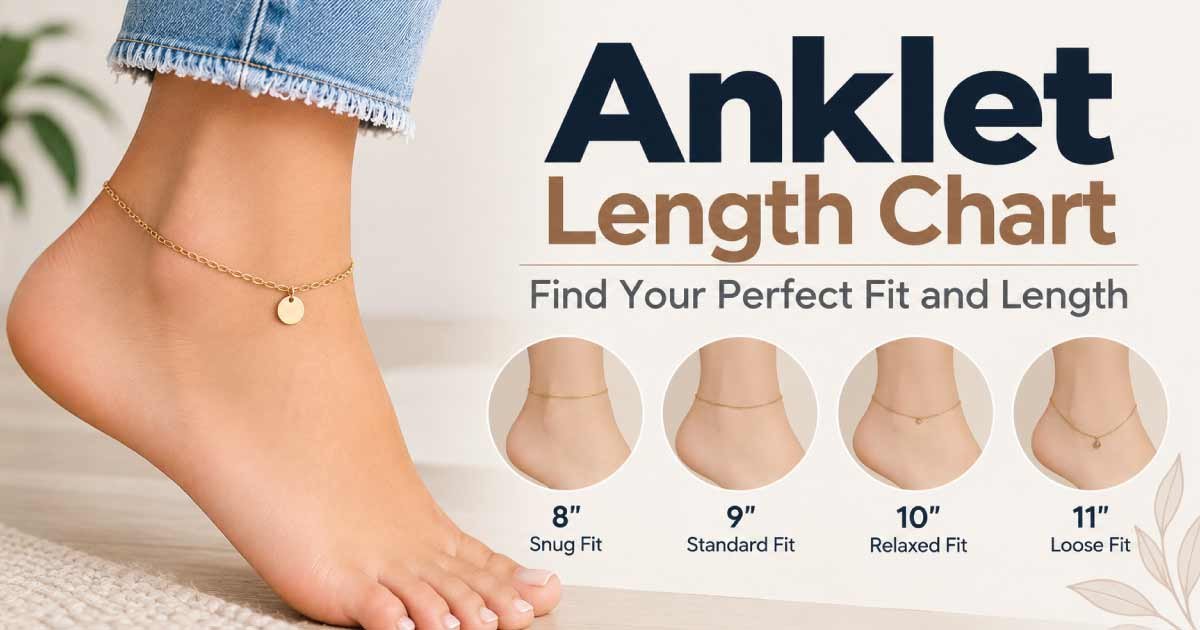
An anklet should feel comfortable, secure, and easy to wear without cutting into your skin or sliding excessively around your ankle. The right length depends on your ankle circumference, preferred fit, anklet style, and the amount of extra room you want.
This anklet length chart provides practical measurements for choosing an anklet, along with simple instructions for measuring your ankle at home. You will also learn how anklet lengths compare, how much room to add for different fits, and how to avoid common sizing mistakes.
Whether you are buying a delicate chain anklet, a beaded design, a charm anklet, or an adjustable style, measuring first can make it much easier to find a comfortable fit.
Anklet Length Chart
Anklet sizes are generally based on the length of the finished anklet rather than the circumference of the ankle itself. To choose a suitable length, first measure your ankle and then add the amount of ease appropriate for the fit you want.
The chart below provides a practical starting point for common adult anklet lengths.
| Anklet Size | Length (inches) | Length (cm) | Typical Fit |
|---|---|---|---|
| XXS | 7 in | 17.8 cm | Very snug |
| XS | 8 in | 20.3 cm | Snug |
| Small | 8.5 in | 21.6 cm | Close fit |
| Medium | 9 in | 22.9 cm | Comfortable |
| Large | 9.5 in | 24.1 cm | Relaxed |
| XL | 10 in | 25.4 cm | Loose |
| XXL | 11 in | 27.9 cm | Extra loose |
These are general sizing guidelines, not universal industry standards. Jewelry manufacturers may use different size labels, and some anklets have adjustable chains that make sizing more flexible.
For many adults, an anklet around 8 to 10 inches (20.3 to 25.4 cm) can be suitable, but your actual ankle measurement is more useful than choosing a size based on a general average.
How to Choose the Right Anklet Length
The simplest method is to measure the circumference of your ankle and then add extra length for comfort.
Your preferred fit makes a significant difference. A person with a 9-inch anklet measurement may want an anklet that is exactly 9 inches for a close fit, while someone who prefers movement may choose 9.5 or 10 inches.
A useful rule is:
Anklet length = ankle circumference + desired extra room
The amount of extra room depends on the style you want.
| Preferred Fit | Add to Ankle Measurement | Result |
|---|---|---|
| Snug | 0–0.25 in | Close-fitting |
| Comfortable | 0.25–0.5 in | Light movement |
| Relaxed | 0.5–0.75 in | More movement |
| Loose | 0.75–1 in or more | Noticeably loose |
For example, if your ankle measures 8.5 inches, a comfortable anklet may be around 8.75 to 9 inches. If you prefer a looser style, you could consider approximately 9.25 to 9.5 inches.
The exact choice also depends on the thickness of the anklet and whether it contains charms, beads, or other decorative elements.
How to Measure Your Ankle for an Anklet
Measuring your ankle correctly is more reliable than guessing your anklet size from shoe size, height, or clothing size.
You only need a flexible measuring tape. If you do not have one, you can use a strip of string, ribbon, or paper and measure it afterward with a ruler.
Method 1: Use a Flexible Measuring Tape
Follow these steps:
- Sit or stand comfortably with your foot in a natural position.
- Wrap the measuring tape around the ankle where you want the anklet to sit.
- Keep the tape snug against the skin without squeezing.
- Make sure the tape remains level around the ankle.
- Read the measurement where the tape overlaps.
- Record the measurement in inches or centimeters.
- Add the desired amount of extra room for your preferred fit.
Do not pull the tape tightly. A measurement that compresses the skin can result in an anklet that feels too restrictive.
Method 2: Use String or Paper
If you do not have a measuring tape:
- Wrap a piece of non-stretch string around your ankle.
- Mark the point where the string meets.
- Remove the string without stretching it.
- Measure the marked length against a ruler.
- Add your preferred amount of ease.
This method works well for home measurements, provided the string does not stretch.
Where Should You Measure?
Measure around the part of your ankle where the anklet will actually sit.
Some people wear anklets immediately above the ankle bone, while others prefer them slightly lower. If you normally wear an anklet in a particular position, measure at that position rather than measuring somewhere else on your leg.
Anklet Size Conversion Chart: Inches to Centimeters
Jewelry websites may list anklet lengths in either inches or centimeters. Converting between the two makes comparison easier when shopping from different retailers.
| Length (inches) | Length (cm) |
|---|---|
| 7 in | 17.8 cm |
| 7.5 in | 19.1 cm |
| 8 in | 20.3 cm |
| 8.5 in | 21.6 cm |
| 9 in | 22.9 cm |
| 9.5 in | 24.1 cm |
| 10 in | 25.4 cm |
| 10.5 in | 26.7 cm |
| 11 in | 27.9 cm |
| 11.5 in | 29.2 cm |
| 12 in | 30.5 cm |
The conversion is based on 1 inch = 2.54 centimeters.
When shopping online, check whether the listed measurement refers to the total anklet length, the wearable length, or the chain length before ordering.
Anklet Length by Fit
Not everyone wants the same amount of movement. Some people prefer an anklet that sits closely around the ankle, while others like it to move slightly when walking.
Snug Anklet Fit
A snug anklet sits close to the ankle with very little additional space.
This style can work well for:
- Minimalist chain anklets
- Simple everyday jewelry
- Anklets without large charms
- People who dislike excess movement
A snug fit should still feel comfortable. It should not pinch, dig into the skin, or interfere with normal movement.
Comfortable or Standard Fit
A comfortable fit adds a small amount of extra length to the measured ankle circumference.
This is often a practical choice for everyday wear because it provides some movement without making the anklet feel excessively loose.
For many people, adding approximately 0.25 to 0.5 inch is a useful starting point, although individual preferences vary.
Loose Anklet Fit
A loose anklet allows more movement around the ankle.
This can create a relaxed appearance and may be preferred with:
- Layered anklets
- Charm anklets
- Beach-inspired jewelry
- Beaded anklets
- Designs intended to move while walking
However, an anklet that is excessively loose can catch on footwear, clothing, or surrounding objects and may be more likely to slip over the heel.
Anklet Length Chart by Ankle Circumference
If you already know your ankle measurement, the following chart can help you estimate a starting anklet length.
| Ankle Circumference | Snug Fit | Comfortable Fit | Relaxed Fit |
|---|---|---|---|
| 7 in / 17.8 cm | 7–7.25 in | 7.25–7.5 in | 7.5–7.75 in |
| 7.5 in / 19.1 cm | 7.5–7.75 in | 7.75–8 in | 8–8.25 in |
| 8 in / 20.3 cm | 8–8.25 in | 8.25–8.5 in | 8.5–8.75 in |
| 8.5 in / 21.6 cm | 8.5–8.75 in | 8.75–9 in | 9–9.25 in |
| 9 in / 22.9 cm | 9–9.25 in | 9.25–9.5 in | 9.5–9.75 in |
| 9.5 in / 24.1 cm | 9.5–9.75 in | 9.75–10 in | 10–10.25 in |
| 10 in / 25.4 cm | 10–10.25 in | 10.25–10.5 in | 10.5–10.75 in |
Use this table as a sizing guide rather than a fixed standard. Anklet construction, clasp size, chain thickness, and the manufacturer’s sizing method can affect the final fit.
How Anklet Style Affects the Best Length
Anklet length is not the only factor that determines fit. The design itself can change how an anklet feels and where it sits.
Chain Anklets
Chain anklets are usually lightweight and flexible. A small difference in length can therefore noticeably change how much the anklet moves around your ankle.
For a simple chain, measure your ankle carefully and add enough room for comfortable movement without allowing the chain to slide excessively.
Beaded Anklets
Beaded anklets can behave differently because beads may have less flexibility than a fine chain.
If the design is relatively rigid or bulky, a small amount of additional room may make it more comfortable.
Charm Anklets
Charms add weight and can affect how an anklet hangs.
A charm anklet may look better with enough space to allow the decorative elements to move naturally. However, excessive length can cause the charms to hang too low.
Adjustable Anklets
Adjustable anklets are particularly useful when you are between standard sizes.
Many designs use an extension chain, allowing the wearer to select from several fastening positions. When buying an adjustable anklet, check the minimum and maximum wearable lengths rather than looking only at the total chain length.
Women’s Anklet Size Guide
There is no single universal women’s anklet size because ankle dimensions vary considerably.
Instead of relying on labels such as small, medium, or large, use your actual ankle circumference.
A general starting point is:
| Anklet Length | General Description |
|---|---|
| 7–8 in | Shorter or snug styles |
| 8–9 in | Common shorter-to-standard range |
| 9–10 in | Standard-to-relaxed range |
| 10–11 in | Loose or larger sizing |
| 11+ in | Extra-long or extended sizing |
These ranges are not intended to define body sizes. They simply describe common finished anklet lengths.
If you are purchasing an anklet as a gift, an adjustable design can be a practical option when the recipient’s ankle measurement is unknown.
Also Read:
Men’s Anklet Size Guide
Men’s anklets are often designed with somewhat larger or heavier styles, but there is no separate universal sizing system for men.
The same basic principle applies:
Measure the ankle first, then add the desired amount of ease.
For thicker leather, rope, beaded, or metal anklets, consider the construction of the piece when choosing a length. A bulky design may require a different fit from a thin chain even when both are intended for the same ankle circumference.
A men’s anklet should allow natural movement while remaining secure enough that it does not constantly slide down the foot.
How Much Extra Room Should an Anklet Have?
The ideal amount of extra room depends on how you want the anklet to feel.
For an everyday anklet, about 0.25 to 0.5 inch of additional length can be a useful starting point after measuring your ankle. A more relaxed fit may require approximately 0.5 to 1 inch or more.
There is no requirement that every anklet follow one exact allowance.
Consider these factors:
- Personal comfort: Do you prefer close-fitting or loose jewelry?
- Anklet thickness: Thick designs can feel tighter than thin chains at the same nominal length.
- Decorations: Charms and beads can influence movement.
- Activity: An anklet for everyday walking may need a secure fit.
- Layering: Multiple anklets may work better with slightly different lengths.
- Clasp design: A large clasp can affect the effective wearable length.
If you are between two sizes, an adjustable anklet can provide more flexibility than a fixed-length design.
Also Read:
Anklet Size vs. Bracelet Size
Anklets and bracelets are measured using similar principles, but their dimensions should not be assumed to be interchangeable.
An ankle is generally larger in circumference than a wrist, so a bracelet size should not automatically be used for an anklet.
The important measurement is the circumference of the actual body part where the jewelry will be worn.
For an anklet:
Measure around the ankle → determine desired ease → choose the finished anklet length.
For a bracelet:
Measure around the wrist → determine desired ease → choose the finished bracelet length.
This distinction is especially important when shopping for jewelry sold in generic small, medium, or large sizes.
Common Anklet Sizing Mistakes
Even a simple measurement can produce a poor fit if it is taken incorrectly.
Measuring Too Tightly
Pulling the tape tightly around the ankle can produce an undersized result. The tape should be snug but not compress the skin.
Using Shoe Size
Shoe size does not provide a reliable way to determine anklet length. Two people with the same shoe size can have different ankle circumferences.
Ignoring the Desired Fit
Knowing your ankle measurement is only the first step. You also need to decide whether you want a snug, comfortable, or loose fit.
Confusing Total Length With Wearable Length
Some manufacturers may describe the full chain length, while others may provide the wearable measurement. Check the product description carefully.
Forgetting the Extension Chain
An anklet with an extension chain may have a wider adjustment range than the main chain length suggests.
Measuring Only Once
If the measurement seems surprising, measure again. Small differences can matter when selecting between closely spaced anklet lengths.
Tips for Buying an Anklet Online
Online shopping removes the opportunity to try the anklet on before purchasing, so careful measurement is especially important.
Before ordering, check:
- The finished anklet length
- Whether measurements are in inches or centimeters
- The manufacturer’s size chart
- Whether an extension chain is included
- The minimum and maximum adjustable lengths
- Whether the listed measurement includes the clasp
- The material and construction
- The retailer’s return or exchange policy
If the product comes in fixed lengths such as 8, 9, or 10 inches, compare those options with your measured ankle circumference rather than choosing based on the size label alone.
When in doubt, an adjustable anklet can reduce the risk of choosing a length that is slightly too short or too long.
Also Read:
How Should an Anklet Fit?
A properly fitted anklet should sit comfortably around the ankle and allow normal movement.
You should generally be able to:
- Walk without the anklet digging into your skin.
- Move your ankle naturally.
- Fit a small amount of space between the jewelry and skin if you prefer a relaxed fit.
- Wear the anklet without constant pulling or pressure.
- Keep the clasp securely fastened.
An anklet that leaves deep marks, feels restrictive, or becomes uncomfortable during normal movement is probably too tight.
An anklet that repeatedly slips toward the heel or catches on shoes may be too loose.
The best fit is therefore a balance between security, comfort, movement, and appearance.
Anklet Length for Layering
If you plan to wear multiple anklets together, using identical lengths is not always necessary.
Layered anklets can look more balanced when they have slightly different lengths. For example, one can sit closer to the ankle while another hangs slightly lower.
You might combine:
- A delicate close-fitting chain
- A medium-length charm anklet
- A slightly longer beaded or decorative anklet
When layering, make sure the pieces do not become so loose that they interfere with footwear or catch on each other.
The thickness and weight of each anklet should also be considered. A heavier design may need a more secure fit than a lightweight chain.
Frequently Asked Questions About Anklet Length
What is the standard anklet length?
There is no single universal standard anklet length. Many adult anklets fall roughly within the 8- to 10-inch range, but the appropriate length depends on the wearer’s ankle circumference and preferred fit. Measuring your ankle is more reliable than choosing a universal size.
How do I know what anklet size I need?
Measure around your ankle where you want the anklet to sit. Keep the tape snug without squeezing the skin. Then add approximately 0.25 to 0.5 inch for a comfortable starting point, or more if you prefer a loose fit.
Is a 9-inch anklet big or small?
A 9-inch anklet is neither inherently big nor small because the correct size depends on the wearer’s ankle circumference and desired fit. For someone with a smaller ankle, it may be loose; for someone with a larger ankle, it may provide a closer fit.
Should an anklet be tight or loose?
An anklet should be comfortable rather than excessively tight or loose. A snug style sits close to the ankle, while a relaxed style allows more movement. Avoid a fit that restricts movement or causes discomfort, and avoid excessive looseness that makes the anklet slip toward the foot.
How much bigger should an anklet be than your ankle?
For many people, adding about 0.25 to 0.5 inch to the ankle circumference provides a useful starting point for a comfortable fit. Your preferred amount can vary depending on the jewelry style, thickness, and desired movement.
Can I use a bracelet size for an anklet?
No. Bracelet and anklet sizes should not be treated as interchangeable. A bracelet is sized around the wrist, while an anklet is sized around the ankle. Always measure the body part where the jewelry will actually be worn.
Are adjustable anklets better?
Adjustable anklets can be convenient because they accommodate a range of ankle circumferences and preferences. They are particularly useful when buying a gift or when you are between fixed sizes. Always check the manufacturer’s minimum and maximum adjustment range.
What should I do if I am between two anklet sizes?
If you are between two fixed sizes, consider your preferred fit. Choose the shorter option for a closer fit and the longer option for additional movement. An adjustable anklet may be the best choice when you want flexibility between sizes.
Final Thoughts on Choosing an Anklet Length
Finding the right anklet size starts with one simple step: measure your ankle accurately. Once you know the circumference, add the amount of room that matches your preferred fit.
For a close fit, add little or no extra length. For everyday comfort, a small amount of additional room is usually a practical starting point. If you prefer noticeable movement, choose a longer length.
Remember that anklet sizing is not completely standardized. Manufacturer measurements, clasp construction, extension chains, beads, charms, and personal preference can all affect the final fit.
Use an anklet length chart as a guide, but let your actual ankle measurement and comfort preference make the final decision. When shopping online, always compare your measurement with the seller’s specific size information before ordering.
