
Choosing the right oven size is one of the most important decisions when designing or upgrading a kitchen. An oven that is too small can limit your cooking options, while an oversized model may waste energy and take up valuable space. This oven size guide explains standard oven dimensions, capacities, and types to help you select the perfect oven for your cooking needs, kitchen layout, and household size.
Why Oven Size Matters
Oven size is an important factor that directly impacts cooking performance, kitchen space utilization, and everyday convenience. Choosing the right oven size ensures even heat distribution, accommodates your cookware, fits seamlessly into your cabinetry, and supports your cooking needs, whether for daily meals or special occasions.
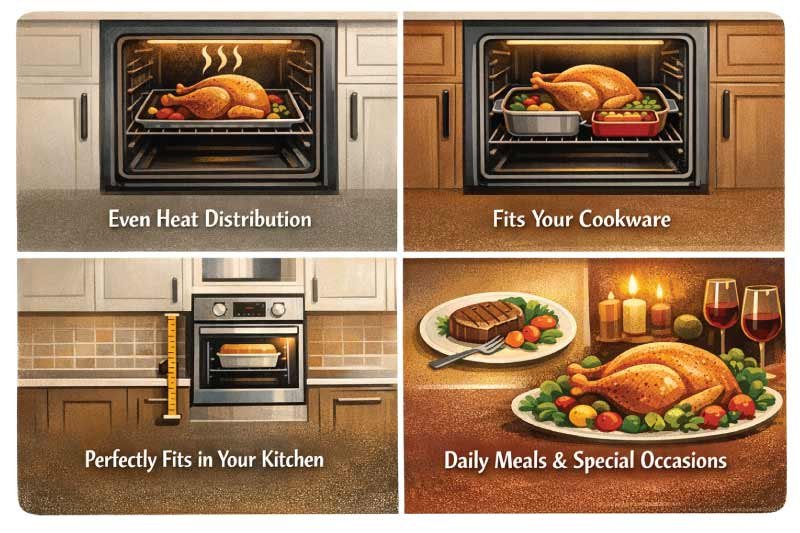
Consistent Cooking Performance: Proper oven size allows even heat distribution for reliable cooking results.
Space & Cabinet Compatibility: Correct sizing ensures a perfect fit within your kitchen cabinetry and layout.
Energy Efficiency: Right-sized ovens consume less energy compared to oversized or undersized models.
Capacity for Daily Needs: Choosing the correct size helps you cook comfortably for individuals, families, or large gatherings.
Understanding Oven Dimensions vs Capacity
Understanding both oven dimensions and capacity is essential for selecting a model that fits your kitchen and meets your cooking needs. While external dimensions affect installation and clearance, internal capacity determines how much food you can prepare at once. Balancing the two ensures convenience, efficiency, and proper fit.
-
Dimensions refer to the oven’s width, height, and depth, which determine whether it fits into your kitchen space.
-
Capacity, measured in cubic feet, indicates how much food the oven can hold.
Both factors must be considered together to make the right choice.
Standard Oven Widths Explained
Oven width is a crucial factor in kitchen planning, ensuring a proper fit and optimal functionality. Choosing the right width helps maintain workflow, accommodates your cooking needs, and integrates seamlessly with cabinets and countertops. Understanding standard sizes simplifies selection and avoids installation issues.
Common Oven Width Options
-
24 inches – Compact kitchens and apartments
-
27 inches – Medium kitchens with moderate cooking needs
-
30 inches – Most common size for residential kitchens
-
36 inches – Large or professional-style kitchens
A 30-inch oven is the most popular choice because it balances capacity and compatibility with standard cabinetry.
Standard Oven Widths and Uses
Oven width plays a key role in kitchen planning and cooking efficiency. Selecting the right width ensures the appliance fits your space while meeting your cooking needs. The table below outlines standard oven widths, their typical capacities, and the households or situations they are best suited for.
| Oven Width | Typical Capacity (cu. ft.) | Best For |
|---|---|---|
| 24 inches | 2.0 – 3.0 | Small kitchens, singles, apartments |
| 27 inches | 3.0 – 4.0 | Medium households, limited space |
| 30 inches | 4.5 – 6.0 | Families, frequent cooking |
| 36 inches | 6.0 – 9.0 | Large families, professional cooking |
Oven Height Considerations
Oven height affects both usability and kitchen design. Proper height ensures comfortable access, safe operation, and smooth integration with cabinetry. Considering your cooking habits and kitchen layout helps prevent strain and allows for efficient use, whether you choose a single or double oven.
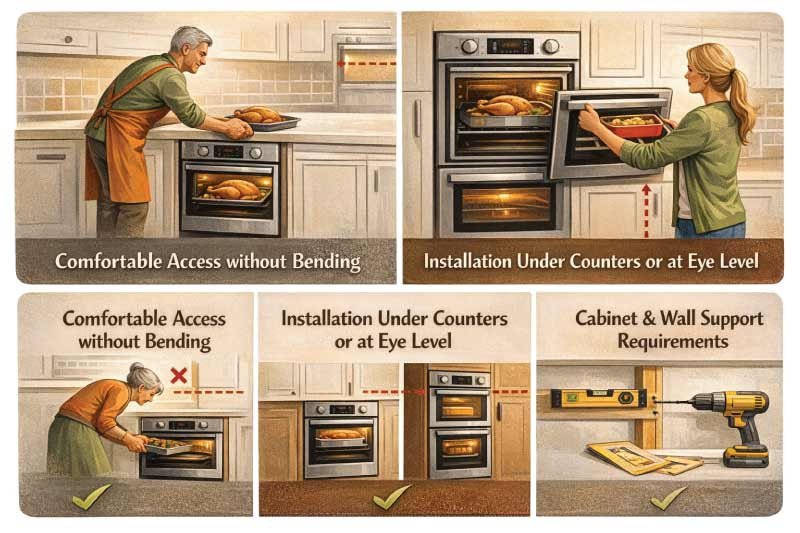
When considering height, also account for:
-
Comfortable access without bending
-
Installation under counters or at eye level
-
Cabinet and wall support requirements
Oven Depth and Door Clearance
Oven depth typically ranges from 24 to 27 inches, not including the handle. Door clearance is often overlooked but essential. The oven door needs enough space to open fully without blocking walkways or hitting cabinets.
Always allow extra clearance in front of the oven, especially in narrow kitchens.
Internal Oven Capacity Explained
Internal oven capacity is a key factor in selecting the right appliance for your cooking needs. Measured in cubic feet, it dictates how much food can be prepared at once. Understanding capacity ensures you choose an oven that matches your household size, cooking habits, and entertaining requirements.
-
Smaller capacities are suitable for simple meals
-
Medium capacities handle multiple dishes
-
Large capacities support roasting, baking, and entertaining
Also Read:
Oven Capacity Guide
Oven capacity directly affects what and how much you can cook at once. Choosing the right size ensures efficient cooking, prevents overcrowding, and matches your household’s meal preparation needs. The table below breaks down oven capacities, their cooking abilities, and which households or occasions they are best suited for.
| Capacity (cu. ft.) | Cooking Ability | Ideal For |
|---|---|---|
| 2.0 – 3.0 | Small trays, single dishes | Singles, couples |
| 3.1 – 4.5 | Multiple racks, basic baking | Small families |
| 4.6 – 6.0 | Large meals, roasting | Medium to large families |
| 6.1+ | Multiple large dishes | Entertaining, professionals |
Single vs Double Ovens
Choosing between a single and double oven depends on your cooking style, household size, and kitchen space. Single ovens suit everyday cooking and smaller kitchens, while double ovens provide flexibility for multiple dishes and large meals. Understanding your needs helps ensure efficiency, convenience, and optimal use of space.
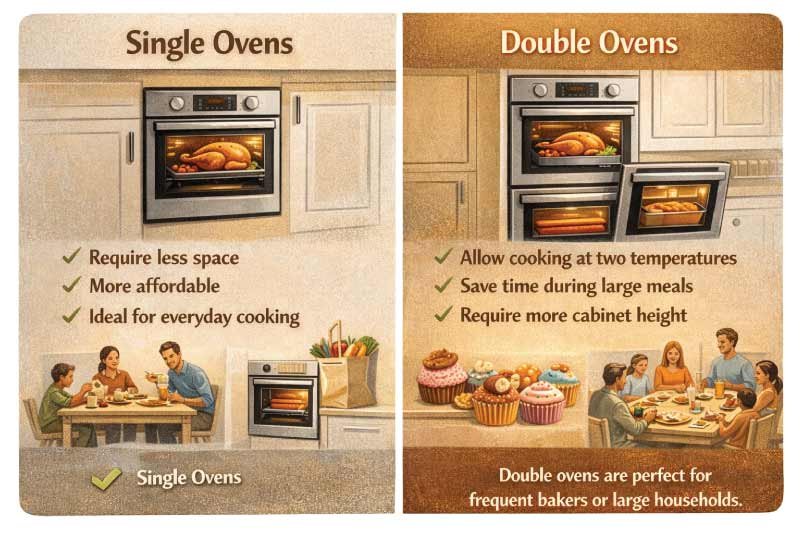
Single Ovens
-
Require less space
-
More affordable
-
Ideal for everyday cooking
Double Ovens
-
Allow cooking at two temperatures
-
Save time during large meals
-
Require more cabinet height
Double ovens are perfect for frequent bakers or large households.
Also Read:
Built-In Ovens vs Freestanding Ranges
Oven installation type affects both size selection and kitchen design. Built-in ovens offer a sleek, integrated appearance and allow for customized placement, while freestanding ranges combine cooktop and oven in one unit for convenience. Understanding the differences ensures your kitchen remains functional, stylish, and suited to your cooking needs.
-
Built-in ovens fit into wall cabinets and offer a seamless look.
-
Freestanding ranges combine a cooktop and oven and typically measure 30 inches wide.
Built-in models provide flexibility in placement, while ranges are easier to install.
Compact and Small Oven Options
Compact and small ovens are perfect for limited spaces, offering convenience without sacrificing essential cooking functions. They suit households with lighter cooking needs or those looking for a secondary oven. Choosing the right compact model ensures efficiency, versatility, and modern features, even in tight kitchen layouts.
They are ideal for:
-
Apartments
-
Studio kitchens
-
Secondary or backup ovens
Despite their size, modern compact ovens often include advanced features.
Large and Professional-Style Ovens
Large and professional-style ovens are built for high-volume cooking and advanced performance, making them ideal for enthusiastic home chefs. Their size and power support multiple dishes at once, but they demand careful planning. Understanding their space, utility, and ventilation needs ensures they function safely and efficiently in your kitchen.
However, they require:
-
More space
-
Higher electrical or gas capacity
-
Strong ventilation systems
Oven Size for Different Household Types
Household size directly influences how much cooking space you need and how often the oven is used. Selecting an oven that matches your household type helps prevent energy waste, overcrowded cooking, and unnecessary expense, while ensuring daily meals and special occasions are handled comfortably. The right oven ensures efficiency, convenience, and proper meal preparation for your family.
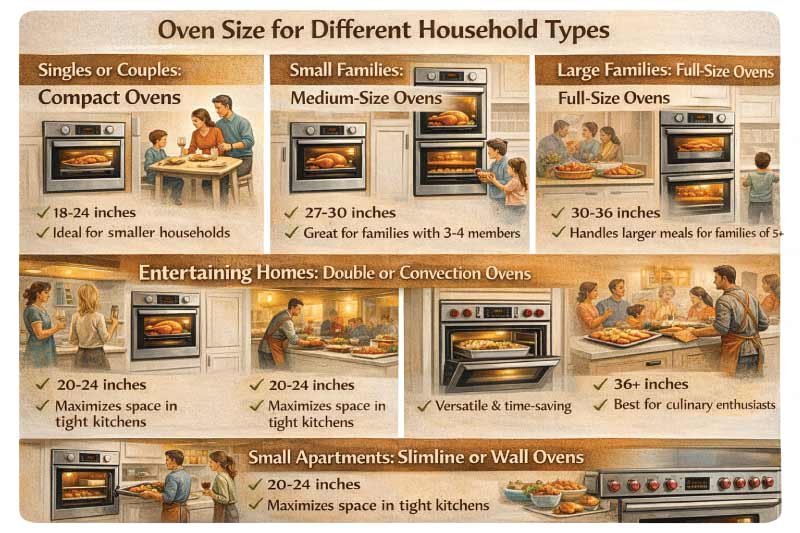
1. Singles or Couples: Compact Ovens
For individuals or couples, compact ovens between 18–24 inches are ideal. They save kitchen space, consume less energy, and are perfect for simple meals or occasional entertaining. A smaller capacity oven prevents wasted energy and allows for efficient cooking without overcrowding the interior.
2. Small Families: Medium-Size Ovens
Small families of three to four members benefit from 27–30 inch ovens. These provide enough space for daily meals and weekend gatherings. Medium-capacity ovens offer flexibility, accommodating multiple dishes simultaneously, which saves cooking time and ensures meals are prepared efficiently for the whole family.
3. Large Families: Full-Size Ovens
Households with five or more members require 30–36 inch ovens. These large-capacity ovens can handle multiple trays and bigger dishes, ideal for large meals and celebrations. They reduce the need for sequential cooking and ensure everyone’s portion is prepared at once, improving convenience and mealtime efficiency.
4. Entertaining Homes: Double or Convection Ovens
Families or hosts who frequently entertain benefit from double or convection ovens. These ovens allow simultaneous cooking of appetizers and main dishes at different temperatures. They save time, offer precise heat distribution, and are perfect for parties, holiday feasts, or any household that prioritizes hosting and large meal preparation.
5. Small Apartments: Slimline or Wall Ovens
In compact apartments, slimline or wall ovens between 20–24 inches maximize space without compromising functionality. They fit smaller kitchen layouts while still offering sufficient capacity for everyday meals. Wall-mounted models also free counter space and allow ergonomic access, ideal for singles or couples with limited cooking needs.
6. Busy Families: Multi-Function Ovens
Busy households with children or variable schedules benefit from multi-function ovens. Features like self-cleaning, steam, and convection options provide convenience and speed. Multi-function ovens help prepare diverse meals quickly and efficiently, keeping up with busy routines while reducing energy consumption and kitchen clutter.
7. Gourmet or Hobby Cooks: Extra-Large or Professional Ovens
For households where cooking is a hobby or gourmet meals are frequent, extra-large ovens above 36 inches are optimal. They allow complex, multi-dish preparation and larger portions, supporting advanced baking and roasting techniques. These ovens enhance versatility, ensure even cooking, and cater to culinary creativity in the home kitchen.
Also Read:
Recommended Oven Sizes by Household
Choosing the right oven size is crucial for efficient cooking and kitchen convenience. Oven width and internal capacity should match your household needs to ensure meals are prepared comfortably without overcrowding or wasted energy. The table below provides recommended oven sizes based on household size and cooking requirements.
| Household Size | Recommended Oven Width | Capacity Range |
|---|---|---|
| 1–2 people | 24 inches | 2.0 – 3.5 cu. ft. |
| 3–4 people | 27–30 inches | 3.5 – 5.5 cu. ft. |
| 5+ people | 30–36 inches | 5.5+ cu. ft. |
Considering Kitchen Layout
Kitchen layout plays a crucial role in determining the most suitable oven size and placement. Limited spaces require efficient sizing, while larger layouts allow more flexibility. Evaluating how the oven fits within workflow zones helps improve comfort, safety, and usability during daily cooking and entertaining activities.
Always ensure the oven placement allows:
-
Easy access
-
Safe door opening
-
Proper ventilation
Energy Efficiency and Oven Size
Oven size plays a significant role in overall energy consumption and running costs. Choosing a larger oven than necessary can lead to wasted electricity or gas, particularly for everyday cooking. Understanding how size affects efficiency helps you select an oven that balances performance, convenience, and long-term energy savings.
Look for:
-
Energy-rated models
-
Convection features for faster cooking
-
Proper insulation
Ventilation and Clearance Requirements
Proper ventilation and clearance are critical for safe oven performance and long-term reliability. Without enough space for airflow, ovens can overheat, reduce efficiency, or damage surrounding cabinetry. Understanding ventilation needs before installation helps protect your kitchen, ensures compliance with safety standards, and extends the lifespan of your appliance.
-
Space around the sides and back
-
Clearance above the oven
-
Proper airflow for cooling
Always follow manufacturer guidelines.
Also Read:
Measuring Your Space Before Buying
Accurate measurements are the foundation of choosing the right oven for your kitchen. Taking time to measure properly helps avoid fitting problems, ventilation issues, and installation delays. Understanding your available space ensures the oven integrates smoothly with cabinetry, allows safe door operation, and meets both functional and aesthetic requirements.
-
Width between cabinets
-
Height of the installation area
-
Depth from wall to front edge
-
Door swing clearance
Incorrect measurements can lead to costly installation issues.
Common Mistakes to Avoid
Choosing the right oven size requires careful planning, yet many buyers overlook key details during selection. Small measurement errors or incorrect assumptions can lead to poor fit, wasted energy, or daily inconvenience. Understanding common mistakes helps ensure your oven matches your kitchen layout, cooking habits, and long-term needs.
-
Ignoring cabinet dimensions
-
Overestimating cooking needs
-
Forgetting door clearance
-
Choosing capacity without considering energy use
Avoiding these mistakes saves time and money.
Final Thoughts: Choosing the Right Oven Size
Selecting the right oven size is about balancing kitchen space, cooking habits, and household needs. By understanding standard dimensions, internal capacity, and installation requirements, you can confidently choose an oven that fits your lifestyle.
A well-chosen oven enhances cooking performance, improves efficiency, and adds long-term value to your kitchen. Use this oven size guide as a reference to make an informed and practical decision.
Also Read:
FAQs:
What is the size of a normal oven?
A normal oven typically ranges from 24 to 30 inches wide, with a capacity of about 4 to 5 cubic feet. These sizes fit standard kitchen cabinetry and are suitable for most households, offering enough space for everyday cooking and baking needs.
What size of oven should I buy?
The oven size you should buy depends on your cooking habits, kitchen space, and household size. Smaller households may prefer 24–27 inch ovens, while families or frequent cooks benefit from 30 inch models with larger capacity and multiple rack positions.
Is a 27 inch oven too small?
A 27 inch oven is not too small for many users. It works well for apartments, small kitchens, or households that cook moderate meals. However, it may feel limiting if you frequently bake large trays or cook for larger gatherings.
How do I choose the right oven size?
To choose the right oven size, measure your cabinet opening, consider how often you cook, and think about the cookware you use. Matching oven capacity with your cooking needs ensures better performance, convenience, and long-term satisfaction.
What size range is standard?
The standard oven size range usually falls between 24 and 30 inches in width. Among these, 30 inch ovens are the most common in modern kitchens, while 24 and 27 inch models are popular for compact or space-saving layouts.
