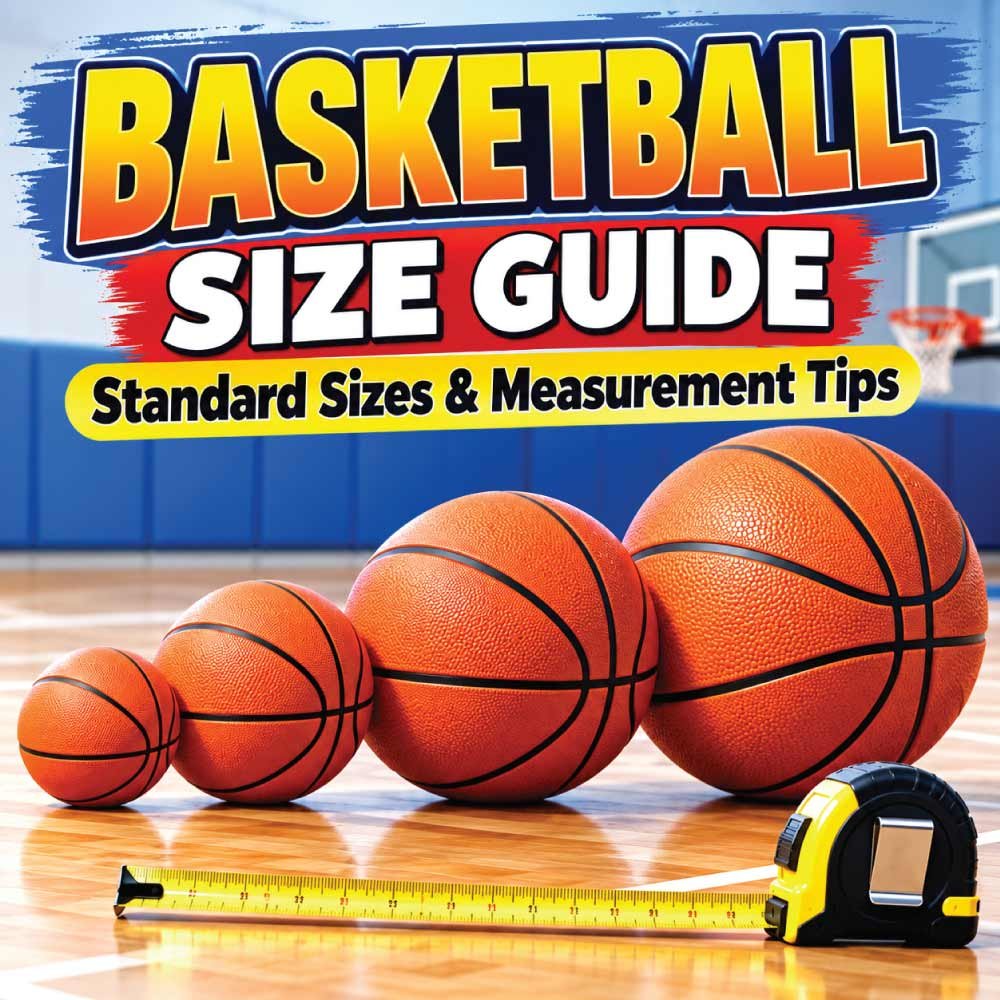
Choosing the right basketball is easier when you understand how ball sizes differ by age, competition, and intended use. A basketball that feels too large or heavy can make shooting, dribbling, and passing harder, especially for younger players. On the other hand, using a ball that is too small may not provide the feel needed for advanced training or regulation competition.
This Basketball Size Guide explains the most common basketball sizes, including Size 3, Size 4, Size 5, Size 6, and Size 7. You will learn their typical circumference, weight, recommended age groups, common uses, and how to measure a basketball correctly.
Whether you are buying a ball for a child, selecting a competition basketball, or simply replacing an old outdoor ball, understanding basketball dimensions can help you make a better choice.
Basketball Size Chart
Basketballs are commonly identified by a size number rather than by diameter alone. The most widely used sizes range from small youth balls to the full-size basketball used in men’s competition.
The chart below provides general size and measurement guidance. Exact specifications can vary slightly depending on the governing organization, competition level, and manufacturer.
| Basketball Size | Typical Circumference | Approx. Diameter | Typical Weight | Common Use |
|---|---|---|---|---|
| Size 3 | 22 in (56 cm) | 7.0 in (18 cm) | 10–12 oz (283–340 g) | Young children |
| Size 4 | 25.5 in (65 cm) | 8.1 in (20.5 cm) | 12–14 oz (340–397 g) | Youth basketball |
| Size 5 | 27.5 in (70 cm) | 8.7 in (22 cm) | 17–18 oz (482–510 g) | Junior/youth play |
| Size 6 | 28.5 in (72 cm) | 9.1 in (23 cm) | 20 oz (567 g) | Women’s and youth competition |
| Size 7 | 29.5 in (75 cm) | 9.4 in (24 cm) | 22 oz (624 g) | Men’s competition |
These measurements are useful as a general reference rather than a substitute for the specifications of a particular basketball.
The Size 7 basketball is the standard full-size ball most commonly associated with men’s high-level basketball. Size 6 is widely used in women’s basketball and many youth programs, while Size 5 is particularly common for younger players.
What Are the Standard Basketball Sizes?
Basketball sizes are designed to match the physical abilities and playing requirements of different groups. The smaller the size number, the smaller and lighter the basketball generally is.
Size 3 Basketball
A Size 3 basketball is a small ball intended primarily for very young children. Its reduced circumference and weight make it easier for small hands to grip, control, and move.
It is often used for introductory basketball activities rather than advanced competitive play.
Size 3 can be a good choice for:
- Young beginners
- Basic dribbling practice
- Indoor recreational play
- Simple passing exercises
- Developing hand-eye coordination
For children who are just learning how a basketball feels, starting with an appropriately sized ball can make basic skills less frustrating.
Size 4 Basketball
A Size 4 basketball is larger than Size 3 but remains significantly easier for young players to handle than full-size basketballs.
It is commonly associated with youth basketball and introductory programs. The ball provides a useful transition toward the larger sizes used by older players.
Size 4 is suitable for:
- Children learning fundamental basketball skills
- Youth recreational programs
- Dribbling and passing practice
- Beginner shooting exercises
Always check the rules of the specific youth league because age and ball-size requirements can differ.
Size 5 Basketball
The Size 5 basketball is one of the most recognizable youth basketball sizes. It is substantially closer to a full-size ball while remaining easier for children to control.
A Size 5 ball is commonly used in junior basketball programs and youth development.
It works well for:
- Elementary and junior-level players
- Youth leagues
- Basketball camps
- Skill development
- Recreational games
Because Size 5 is large enough to introduce players to the feel of a more traditional basketball without the full weight of a Size 7, it can be an effective developmental option.
Size 6 Basketball
A Size 6 basketball has a circumference of about 28.5 inches and is widely used in women’s basketball. It is also used in many youth and junior competitions.
The smaller circumference compared with Size 7 allows players to handle the ball comfortably while still providing a competition-style feel.
Size 6 is commonly used for:
- Women’s basketball
- Girls’ basketball
- Youth competition
- Junior players
- Training and recreational play
For organized basketball, always follow the rules of the specific league rather than choosing a size based only on age.
Size 7 Basketball
The Size 7 basketball is the standard full-size basketball commonly used for men’s competitive basketball.
It has a circumference of approximately 29.5 inches and weighs around 22 ounces. Because it is the largest common basketball size, it requires more hand strength and control than smaller balls.
Size 7 is generally appropriate for:
- Adult men’s basketball
- High-school-level men’s basketball where specified
- College and advanced competition
- Professional-style training
- Adult recreational games
For young players, moving directly to Size 7 can make ball handling and shooting unnecessarily difficult.
Basketball Size by Age
Age is one of the easiest ways to narrow down the appropriate basketball size, but it should not be the only factor. League rules, player size, skill level, and the type of training also matter.
A general guide is shown below.
| Age Group | Common Basketball Size | Typical Use |
|---|---|---|
| 4–7 years | Size 3 | Introductory play |
| 5–8 years | Size 4 | Youth development |
| 8–12 years | Size 5 | Junior basketball |
| Girls and many youth programs | Size 6 | Competition and training |
| Adult women | Size 6 | Women’s basketball |
| Adult men | Size 7 | Men’s basketball |
These age ranges are general recommendations, not universal rules.
For example, one youth organization may use Size 5 for a particular age group while another may specify a different size. If the basketball is being purchased for organized competition, check the league’s equipment rules first.
Basketball Size by Gender
Basketball size also commonly differs between men’s and women’s competition.
Men’s Basketball Size
A Size 7 basketball is generally the standard ball for adult men’s basketball.
Its approximately 29.5-inch circumference provides the full-size playing experience expected in men’s competition. Players should become comfortable with its weight and handling characteristics through regular practice.
Women’s Basketball Size
A Size 6 basketball is widely used for women’s basketball.
Its approximately 28.5-inch circumference is slightly smaller than Size 7, making it easier to handle while still maintaining a competition-oriented size and weight.
Why Are the Sizes Different?
The difference is not simply about making one ball easier or harder. Basketball organizations establish equipment specifications appropriate for their competitions.
The smaller Size 6 ball can also be useful for players developing ball-handling skills, regardless of whether they eventually play with a Size 7 basketball.
Basketball Diameter and Circumference
When researching basketball dimensions, you may see both circumference and diameter listed.
They describe different measurements.
Circumference is the distance around the outside of the basketball. This is the measurement most commonly used when defining basketball size.
Diameter is the straight-line distance across the ball through its center.
For a spherical object, diameter can be estimated from circumference using:
Diameter = Circumference ÷ π
For example, a basketball with a circumference of approximately 29.5 inches has a diameter of roughly 9.4 inches.
Because basketballs are flexible, inflated objects rather than perfectly rigid spheres, real-world measurements can vary slightly.
How to Measure a Basketball
If you want to verify the size of a basketball, measuring its circumference is usually the most practical method.
Step 1: Fully Inflate the Basketball
Inflate the ball to its recommended pressure. Measuring an underinflated basketball can produce a circumference that does not accurately represent its intended playing size.
Do not overinflate it simply to reach a particular measurement.
Step 2: Wrap a Measuring Tape Around the Ball
Use a flexible measuring tape and wrap it around the widest part of the basketball.
Keep the tape level and make sure it follows the surface of the ball without digging deeply into the material.
Step 3: Record the Circumference
Read the measurement where the tape meets itself.
For easier comparison, record the result in inches or centimeters.
For example:
- About 22 inches indicates a typical Size 3 ball.
- About 25.5 inches indicates a typical Size 4 ball.
- About 27.5 inches indicates a typical Size 5 ball.
- About 28.5 inches indicates a typical Size 6 ball.
- About 29.5 inches indicates a typical Size 7 ball.
Small differences are normal because basketball construction and inflation can affect the measurement.
How to Choose the Right Basketball Size
Selecting a basketball is more than simply picking the largest ball available. The correct size should allow the player to control the ball naturally.
Consider the Player’s Age
Age provides a useful starting point, especially for children.
A young player who struggles to grip a large basketball may benefit from practicing with a smaller ball before progressing to a larger size.
Check League Requirements
If the ball will be used for an organized league, league regulations should take priority.
The competition may specify:
- Ball size
- Ball circumference
- Ball weight
- Inflation requirements
- Approved equipment standards
A recreational recommendation does not override an official competition rule.
Consider Hand Size and Strength
Two players of the same age may have very different physical abilities.
If a player cannot comfortably grip or control the ball, a smaller basketball may be useful for skill development. However, competitive training should eventually incorporate the ball size required for the player’s intended competition.
Think About Where You Will Play
The playing surface can also influence the type of basketball you choose.
Indoor and outdoor basketballs are often manufactured with different cover materials and construction characteristics. A ball designed specifically for outdoor courts may withstand rougher surfaces better than a ball intended primarily for indoor hardwood.
Indoor vs Outdoor Basketball Size
Basketball size and basketball construction are related but separate considerations.
An indoor basketball is typically designed for smoother court surfaces and may use materials that emphasize grip and feel.
Outdoor basketballs are generally designed to handle abrasive surfaces such as asphalt or concrete.
Indoor Basketball
An indoor basketball is a good choice when playing primarily on:
- Hardwood courts
- Indoor sports floors
- School or gymnasium courts
- Organized indoor competitions
The ball should still match the required size for the players and competition.
Outdoor Basketball
For outdoor use, look for a ball designed for outdoor courts.
Outdoor play can expose the cover to:
- Rough concrete
- Asphalt
- Dirt
- Moisture
- Temperature changes
The appropriate size remains important, but durability and cover construction become especially relevant.
Also Read:
Basketball Weight Guide
Basketball weight increases with size, although exact weight can vary according to construction and specifications.
| Size | Typical Weight Range | General Player Group |
|---|---|---|
| Size 3 | 10–12 oz | Young children |
| Size 4 | 12–14 oz | Youth players |
| Size 5 | 17–18 oz | Junior players |
| Size 6 | Around 20 oz | Women and youth |
| Size 7 | Around 22 oz | Adult men |
A heavier ball can require more strength and control, particularly during shooting and passing.
This is one reason younger players generally benefit from appropriately sized equipment rather than immediately practicing with a full-size basketball.
Basketball Size Comparison: Size 5 vs Size 6 vs Size 7
The difference between Size 5, Size 6, and Size 7 is particularly important because these are common basketball sizes for youth and competitive players.
| Feature | Size 5 | Size 6 | Size 7 |
|---|---|---|---|
| Circumference | 27.5 in | 28.5 in | 29.5 in |
| Approx. Diameter | 8.7 in | 9.1 in | 9.4 in |
| Typical Weight | 17–18 oz | Around 20 oz | Around 22 oz |
| Common Use | Junior/youth | Women’s/youth | Men’s |
| Handling Difficulty | Lower | Moderate | Higher |
The one-inch circumference difference between adjacent sizes may appear small, but it can be noticeable to younger players.
For a child who is still developing hand strength, the difference between Size 5 and Size 7 can significantly affect dribbling, passing, and shooting mechanics.
Basketball Size 6 vs Size 7
Size 6 and Size 7 are often compared because both are used in organized basketball.
A Size 6 basketball has an approximate 28.5-inch circumference, while a Size 7 basketball is approximately 29.5 inches around.
Size 6 is widely associated with women’s basketball, while Size 7 is commonly used for men’s basketball.
If an adult player is participating in an official competition, use the size specified by that competition. For casual training, either size may be useful depending on the player’s goals.
Also Read:
Basketball Size 5 vs Size 6
Size 5 is smaller and lighter than Size 6, making it particularly suitable for younger players.
Size 6 provides a closer transition toward adult competition sizes and is widely used in women’s basketball.
A youth player moving from Size 5 to Size 6 should spend time practicing:
- Dribbling with both hands
- Chest passes
- Bounce passes
- Layups
- Shooting form
- Ball protection
The goal is not simply to use a bigger ball. The player should be able to control it without changing proper technique.
Common Basketball Sizing Mistakes
Choosing the wrong ball size can affect practice quality. Fortunately, most sizing mistakes are easy to avoid.
Choosing a Ball Only by Appearance
A basketball can look like the correct size while being difficult for the intended player to handle.
Always consider the actual circumference, weight, and recommended use.
Ignoring League Rules
A recreational basketball recommendation may not match a competition requirement.
If the ball is for organized play, check the current rules of the league, school, federation, or tournament.
Buying a Full-Size Ball for a Young Child
A Size 7 basketball is not automatically better because it is the standard adult size.
For a young player, an oversized ball can make basic skills unnecessarily difficult.
Using the Wrong Ball for Outdoor Courts
A premium indoor basketball may not be the best choice for repeated play on rough outdoor surfaces.
Consider the court surface when selecting the ball’s construction and cover material.
Measuring an Underinflated Ball
A basketball’s shape and circumference can change when its inflation level is incorrect.
Measure the ball when it is properly inflated according to its specifications.
Also Read:
Basketball Inflation and Measurement Accuracy
Basketball size should be considered alongside inflation.
An underinflated ball may feel soft and behave differently when bouncing. An overinflated ball may feel excessively hard and can also affect its playing characteristics.
For accurate measurements:
- Check the ball manufacturer’s recommended inflation pressure.
- Inflate it appropriately.
- Allow the ball to settle into its normal shape.
- Measure around its circumference.
- Compare the measurement with the applicable size specification.
Do not use inflation pressure as a way to force a basketball into a particular size category.
How Basketball Size Affects Skill Development
The right ball size can make skill development more productive.
A ball that is too large or heavy may encourage a young player to compensate with poor technique. For example, a child may push the ball with both hands rather than developing a controlled shooting motion.
An appropriately sized ball allows players to focus on:
- Finger control
- Wrist movement
- Passing accuracy
- Dribbling rhythm
- Shooting mechanics
- Ball protection
- Coordination
As players become stronger and more experienced, transitioning to larger basketball sizes can help them prepare for the equipment used in their target competition.
What Basketball Should a Beginner Use?
There is no single basketball size that is ideal for every beginner.
A young child will generally find a smaller ball easier to handle, while an adult beginner should normally learn with the size appropriate for their intended form of play.
For example:
- Young child: Consider Size 3 or Size 4.
- Older child: Size 5 may be appropriate.
- Youth or women’s competition: Size 6 is commonly used.
- Adult men’s competition: Size 7 is generally appropriate.
The most important goal is control. The player should be able to dribble, pass, and shoot without the ball overwhelming their physical ability.
Basketball Buying Tips
Once you know the required size, several other factors can improve your purchase decision.
Check the Size
Confirm the size number and circumference before purchasing.
Choose the Correct Playing Surface
Select an indoor, outdoor, or versatile basketball according to where it will be used most often.
Consider Grip
A good grip helps players maintain control during dribbling and shooting. The preferred surface can vary between players.
Check Construction Quality
Look for construction appropriate to the intended frequency and type of play.
Consider Competition Requirements
For official games, make sure the ball meets the required specifications or approval standards.
Do Not Overlook Durability
If the basketball will be used frequently outdoors, durability can be more important than choosing a ball designed primarily for premium indoor feel.
Frequently Asked Questions About Basketball Sizes
What is the standard basketball size?
The standard basketball size depends on the player and competition. Size 7, with an approximately 29.5-inch circumference, is commonly used for men’s basketball. Size 6, at about 28.5 inches, is widely used for women’s basketball.
What size basketball should a 10-year-old use?
A 10-year-old may commonly use a Size 5 basketball, although youth league requirements vary. The player’s skill level, physical development, and competition rules should also be considered before choosing the final size.
What size basketball is used for women’s basketball?
Size 6 is widely used for women’s basketball. It has an approximate circumference of 28.5 inches and weighs around 20 ounces. However, specific competition rules should always be checked for official games.
What size basketball is used for men’s basketball?
Size 7 is commonly used for men’s basketball. It has an approximate circumference of 29.5 inches and weighs around 22 ounces. Exact competition specifications should be confirmed with the applicable organization.
What is the difference between a Size 6 and Size 7 basketball?
The primary difference is circumference and weight. Size 6 is approximately 28.5 inches around and weighs about 20 ounces, while Size 7 is about 29.5 inches around and weighs approximately 22 ounces.
How do I know what size basketball I have?
Measure the basketball’s circumference with a flexible measuring tape after properly inflating it. Compare the measurement with standard basketball size ranges. You can also check the size marking printed on the ball.
Is a Size 7 basketball too big for kids?
For many young children, yes. A Size 7 basketball is larger and heavier than youth sizes, which can make dribbling and shooting more difficult. Younger players generally benefit from using the size specified for their age group or league.
Can adults use a Size 6 basketball?
Yes. Adults can use a Size 6 basketball for recreational play, skill development, or specific forms of competition. Women’s basketball commonly uses Size 6. The appropriate choice depends on the player’s goals and the rules of the game.
Final Thoughts on Basketball Sizes
The best basketball size is the one that matches the player’s age, competition requirements, physical ability, and intended use. Size 3 and Size 4 are useful for young beginners, Size 5 is common in junior basketball, Size 6 is widely used for women’s and youth competition, and Size 7 is the standard full-size option for men’s basketball.
Before buying, check the ball’s circumference, weight, construction, and intended playing surface. If the basketball is being used for an organized league, always follow that organization’s current equipment specifications.
Understanding basketball dimensions makes it easier to choose a ball that feels comfortable, supports proper technique, and suits the level of play. The right size can make practice more enjoyable while helping players build confidence and control as their skills develop.
