Choosing the right tennis ball is about more than simply picking a ball that looks the correct size. Tennis ball size, pressure, construction, and intended use can all affect how the ball moves, bounces, and feels when you play.
For competitive tennis, standard tennis balls follow established size and performance requirements. However, players can also find modified balls designed for children, beginners, training, and recreational play. These lower-compression options can make learning easier because they move more slowly and bounce at a more manageable height.
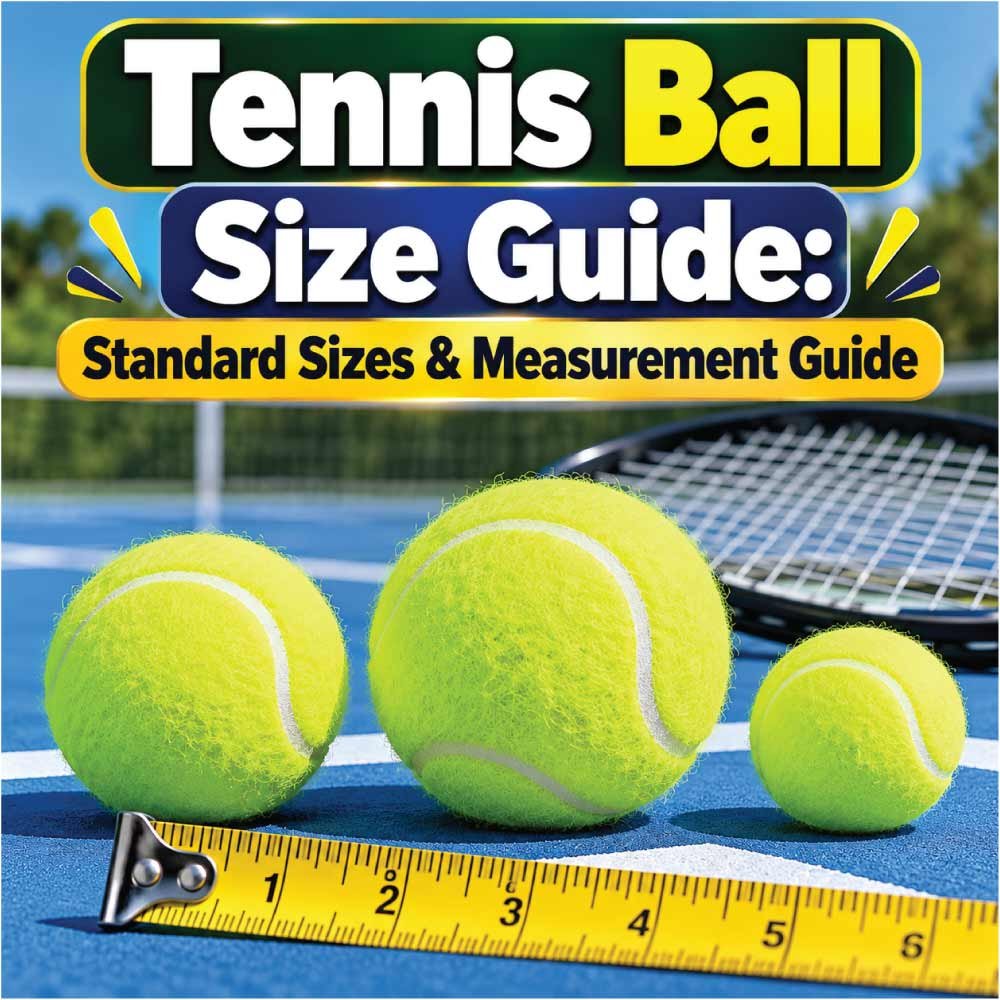
This Tennis Ball Size Guide explains standard tennis ball dimensions, different ball types, pressure levels, junior options, how to measure a tennis ball, and how to choose the right ball for your game. Whether you are buying balls for tournament play, practice, coaching, or casual matches, the information below will help you understand what the numbers mean and what actually matters.
What Is the Standard Tennis Ball Size?
A standard tennis ball is approximately 6.54 to 6.86 cm (2.57 to 2.70 inches) in diameter. Its weight is generally 56.0 to 59.4 grams (1.98 to 2.10 ounces).
These measurements apply to regulation tennis balls used for conventional tennis. The ball is also required to meet performance characteristics related to bounce, deformation, and other playing properties.
Unlike some sports equipment, tennis balls do not have a simple numbered size system such as a size 3, size 4, or size 5 ball. Instead, the standard is based primarily on diameter, weight, pressure, and performance.
Standard Tennis Ball Dimensions Chart
The following table provides a practical reference for regulation tennis balls.
| Measurement | Standard Range |
|---|---|
| Diameter | 6.54–6.86 cm (2.57–2.70 in) |
| Circumference, approximate | 20.5–21.5 cm (8.1–8.5 in) |
| Weight | 56.0–59.4 g (1.98–2.10 oz) |
| Shape | Spherical |
| Typical construction | Rubber core with felt covering |
| Primary use | Regulation tennis play |
The circumference shown above is an approximate value calculated from the standard diameter range. Because a tennis ball is manufactured to be spherical, circumference is not normally the primary specification shoppers use when selecting a ball.
Does Every Tennis Ball Have the Same Size?
Most regulation tennis balls are within the same standard size range, but they may feel different because of differences in internal pressure, rubber construction, felt, manufacturing design, and intended playing surface.
A tennis ball designed for professional or competitive play can therefore feel quite different from a beginner or low-compression ball even if their outside dimensions appear similar.
Tennis Ball Size Chart
A quick size chart makes it easier to compare standard tennis balls with the modified balls commonly used for junior development.
| Tennis Ball Type | Approx. Diameter | Bounce/Speed Characteristic | Typical Use |
|---|---|---|---|
| Standard tennis ball | 6.54–6.86 cm | Full-speed play | Adults, competitive tennis |
| Stage 1 / Green ball | Similar to standard ball | Slightly slower | Beginners, junior progression |
| Stage 2 / Orange ball | Smaller or comparable depending on product | Lower speed and bounce | Developing junior players |
| Stage 3 / Red ball | Often larger than a standard ball | Much slower and lower bounce | Young beginners |
The exact dimensions of modified balls can vary by manufacturer and approved product design. For that reason, stage labels should not be treated as a universal diameter specification.
The main purpose of these balls is not simply to change size. They are designed to alter speed, compression, bounce, and playability so that beginners can develop appropriate technique.
Types of Tennis Balls and Their Sizes
Not every tennis ball is designed for the same player. Understanding the different categories can help you avoid buying a ball that is technically suitable but inappropriate for your level.
Standard Pressurized Tennis Balls
Pressurized tennis balls are the familiar balls used for most competitive tennis.
They contain a pressurized internal core that provides the characteristic lively response players expect. When fresh, these balls generally offer:
- Consistent bounce
- Responsive speed
- Good feel during rallies
- Suitable performance for competitive matches
- Compatibility with standard tennis racquets and courts
Pressurized balls gradually lose their playing characteristics after repeated use, especially when stored outside their original sealed container.
Pressureless Tennis Balls
Pressureless tennis balls use a different construction approach. Their playing characteristics come primarily from the rubber core rather than relying on an internal pressurized gas chamber.
They are often used for:
- Ball machines
- Practice sessions
- Recreational tennis
- Coaching drills
- High-volume training
One advantage is durability. Pressureless balls can retain their basic bounce characteristics for a long time, although their feel and responsiveness can differ from a fresh pressurized ball.
Low-Compression Tennis Balls
Low-compression balls are particularly important for junior tennis and beginners.
They are designed to move more slowly and generally bounce lower than conventional tennis balls. This gives developing players more time to prepare their strokes and react to the ball.
Low-compression tennis balls are commonly categorized into developmental stages.
Tennis Ball Stages Explained
Junior tennis programs often use a progression from red to orange to green before players move fully to standard yellow tennis balls.
Red Tennis Balls
Red balls are generally intended for the earliest stage of tennis development.
They are designed to be significantly slower than a standard tennis ball and provide a lower, more manageable bounce. Some products are also larger than regulation balls.
They can be useful for:
- Young children
- First-time players
- Introductory tennis lessons
- Short-court activities
- Basic hand-eye coordination exercises
The objective is to make the ball easier to track and control rather than forcing a young player to deal with the speed and bounce of a standard ball.
Orange Tennis Balls
Orange balls represent an intermediate development stage.
They generally travel more slowly than a standard tennis ball while providing a playing experience that begins to resemble conventional tennis more closely.
They are often used for:
- Junior players developing technique
- Beginner rallies
- Smaller-court tennis
- Players learning directional control
- Transitioning from red-ball tennis
Green Tennis Balls
Green balls are commonly used as a transition between low-compression junior balls and standard tennis balls.
They generally have a reduced speed or bounce compared with a full-speed ball. This gives developing players a useful bridge toward regular tennis.
Green balls can be appropriate for players who already have basic stroke skills but are still developing consistency, court positioning, and reaction speed.
How Tennis Ball Size Affects Playing Performance
The physical size of a tennis ball is only one part of how it performs. Ball compression and construction can have an even greater effect on the playing experience.
A slower ball gives a beginner more time to:
- Watch the ball
- Prepare the racquet
- Position the body
- Choose a target
- Complete the swing
- Recover for the next shot
A standard ball travels and rebounds at a faster pace, which is why it can be challenging for someone who is still learning basic technique.
Ball Diameter and Bounce
A change in diameter can influence how a ball behaves, but bounce is also strongly connected to its internal construction and compression.
For example, a developmental ball may be intentionally designed to bounce lower than a standard ball. This helps young players practice strokes without having to deal with a ball rising to uncomfortable heights.
Ball Pressure and Feel
Pressurized tennis balls typically have a lively response. When you hit one, the ball compresses against the racquet strings and quickly rebounds.
As a pressurized ball ages, its internal pressure can decrease. The ball may then feel softer and less responsive.
This is one reason a ball that still looks physically intact may no longer feel like a fresh tennis ball.
How to Measure a Tennis Ball
If you want to check the size of a tennis ball, measuring the diameter is the simplest method.
You do not need specialized equipment for a basic check, although precision measuring tools are better when accuracy is important.
Method 1: Measure the Diameter Directly
Place the tennis ball on a flat surface and measure across its widest point.
A caliper provides the most direct measurement because its jaws can measure the distance from one side of the sphere to the other.
For a practical household check:
- Place the ball on a stable surface.
- Position a ruler across the widest visible part.
- Read the distance from one edge to the opposite edge.
- Rotate the ball and repeat the measurement.
- Compare the result with the standard range.
Because the ball is curved, measuring with a ruler can be less precise than using a caliper.
Method 2: Measure the Circumference
You can also measure around the outside of the ball with a flexible measuring tape.
Wrap the tape around the widest section without squeezing the ball.
The relationship between circumference and diameter is:
Diameter = Circumference ÷ π
For example, if you measure a circumference of approximately 21 cm:
21 ÷ 3.1416 ≈ 6.68 cm
That result falls within the typical diameter range for a regulation tennis ball.
Why Measurement Accuracy Matters
A simple measurement can tell you whether a ball is approximately the expected size, but it cannot determine whether the ball meets all performance requirements.
A tennis ball can have an appropriate diameter and still perform poorly because of:
- Lost internal pressure
- Wear
- Damaged felt
- Changes in rubber properties
- Manufacturing differences
- Storage conditions
For competition equipment, physical appearance alone should never be treated as proof of compliance.
Tennis Ball Size vs Weight
Diameter and weight are two different specifications.
A regulation tennis ball has a standard weight range of approximately 56.0 to 59.4 grams. This relatively narrow range helps maintain predictable playing characteristics.
A ball that is heavier or lighter than expected may not necessarily be appropriate for regulation competition.
Why Weight Matters
Weight affects how the ball responds when struck and how it travels through the air.
However, players should not assume that a heavier tennis ball is automatically better. The ball’s overall construction, pressure, felt, and performance characteristics all contribute to how it plays.
For normal recreational purchasing, selecting a reputable regulation ball is generally more useful than trying to identify the ideal weight manually.
Also Read:
Standard Tennis Ball vs Junior Tennis Ball
The biggest difference between standard and junior tennis balls is usually playing performance rather than simple outside diameter.
| Feature | Standard Ball | Junior/Developmental Ball |
|---|---|---|
| Speed | Full | Reduced |
| Bounce | Higher/fuller | Lower or modified |
| Compression | Standard | Reduced |
| Typical player | Intermediate to advanced | Beginner and junior players |
| Learning difficulty | Higher for beginners | More manageable |
| Court format | Full court | Often smaller court |
This comparison explains why choosing a tennis ball based solely on diameter can be misleading.
For a young beginner, a lower-compression ball may be much more suitable even if the player’s eventual goal is to play with a standard ball.
How to Choose the Right Tennis Ball
The best tennis ball depends on who is playing, where it will be used, and what type of tennis is being played.
For Competitive Adult Tennis
Choose a standard regulation tennis ball appropriate for your playing surface and competition requirements.
Pay attention to:
- Ball consistency
- Freshness
- Felt quality
- Intended court surface
- Tournament or league requirements
For Beginners
A standard ball may be appropriate for an adult beginner who has enough coordination and reaction speed to control it.
However, a slower developmental ball can make learning easier, particularly during coaching exercises.
For Young Children
Age alone should not be the only selection factor.
Consider:
- Skill level
- Height and physical development
- Ability to track the ball
- Stroke development
- Court size
- Coaching program
Developmental stages are useful because they provide a progression from slower, easier balls toward standard tennis.
For Practice and Ball Machines
Pressureless balls can be a practical choice when durability is more important than reproducing the exact feel of a fresh pressurized competition ball.
They are especially useful when a player needs a large quantity of balls for repeated drills.
Also Read:
Does Tennis Ball Color Affect Size?
Color itself does not determine the size of a tennis ball.
Standard tennis balls are commonly associated with yellow or optic yellow coloring, while junior developmental balls can use different color combinations to distinguish their stages.
The color is primarily a visibility and identification feature. The actual ball specification comes from its construction and intended category, not simply from its color.
When buying junior balls, look at the product’s developmental stage and specifications rather than assuming that a particular color always means one exact size.
Tennis Ball Size for Different Ages
There is no single tennis ball size that is automatically correct for every child of a particular age.
Instead, junior tennis commonly uses developmental stages.
| Player Level | Common Ball Type | General Purpose |
|---|---|---|
| Young beginner | Red | Introduction and basic coordination |
| Developing junior | Orange | Learning rallies and control |
| More experienced junior | Green | Transition toward standard play |
| Advanced/standard player | Regular ball | Full-speed tennis |
These categories should be treated as general guidance. A coach can often make a better recommendation by observing a player’s technique, movement, and ability to control the ball.
Also Read:
How Long Does a Tennis Ball Last?
The useful life of a tennis ball depends heavily on its construction and frequency of use.
A pressurized tennis ball may lose some of its original playing characteristics even when its felt remains relatively intact. Frequent players may notice changes in:
- Bounce
- Speed
- Responsiveness
- Feel
- Felt texture
Pressureless balls are generally valued for longer-lasting training performance, but they can still become worn and change in feel over time.
Signs a Tennis Ball Needs Replacing
Consider replacing a ball when:
- It feels noticeably softer than a fresh ball.
- Its bounce has changed significantly.
- The felt is heavily worn.
- The ball has become misshapen.
- It behaves inconsistently compared with the other balls in your set.
- It is visibly damaged.
For competitive play, using fresh balls according to the competition’s requirements is more important than trying to extend the life of worn balls.
How to Store Tennis Balls Properly
Proper storage can help preserve the condition of tennis balls.
For pressurized balls, keeping them in their original sealed container until use helps maintain their intended internal pressure.
Once opened, avoid unnecessary exposure to harsh conditions.
Useful storage practices include:
- Keep balls in a clean, dry place.
- Avoid prolonged exposure to extreme heat.
- Keep them away from moisture.
- Store unopened pressurized balls in their original containers.
- Do not intentionally squeeze or deform the balls.
- Keep heavily worn practice balls separate from fresh match balls.
Storage cannot restore a tennis ball that has already lost its original performance, but good habits can help reduce unnecessary deterioration.
Common Tennis Ball Size Mistakes
Buying the wrong tennis ball is often caused by focusing on one specification while ignoring the rest.
Mistake 1: Assuming All Tennis Balls Are Identical
Standard tennis balls are similar in basic dimensions, but their construction and playing characteristics can differ.
Mistake 2: Choosing Only by Age
A child’s age can provide useful context, but skill level and playing environment are also important.
Mistake 3: Confusing Ball Size With Compression
A ball’s outside diameter does not tell you everything about how fast or high it will bounce.
Mistake 4: Using Worn Balls for Serious Practice
Old balls may behave differently from fresh ones, which can affect practice consistency.
Mistake 5: Assuming a Different Color Means a Different Standard Size
Developmental balls use color coding to help identify their intended stage, but color alone is not a complete technical specification.
Tennis Ball Size FAQs
What is the standard size of a tennis ball?
A regulation tennis ball is approximately 6.54–6.86 cm (2.57–2.70 inches) in diameter and weighs approximately 56.0–59.4 grams (1.98–2.10 ounces). Exact performance requirements also cover factors beyond physical dimensions.
Are all tennis balls the same size?
Regulation tennis balls are manufactured within a defined size range, but developmental tennis balls can have different dimensions and playing characteristics. Low-compression balls are designed specifically to provide slower, more manageable play.
What size tennis ball should a beginner use?
An adult beginner can generally use a standard tennis ball, but a lower-compression ball may make learning easier. Young beginners often benefit from developmental red, orange, or green balls depending on their skill and coaching program.
What is the diameter of a tennis ball in inches?
A standard tennis ball has a diameter of approximately 2.57 to 2.70 inches. This corresponds to roughly 6.54 to 6.86 cm.
How much does a tennis ball weigh?
A standard tennis ball weighs approximately 56.0 to 59.4 grams, or about 1.98 to 2.10 ounces. Individual balls can vary slightly within the accepted specification range.
What is the difference between pressurized and pressureless tennis balls?
Pressurized balls rely on internal pressure for their characteristic lively response, while pressureless balls rely more heavily on their rubber construction. Pressureless balls are commonly useful for training and ball machines.
Do tennis balls come in different sizes for children?
Yes. Junior developmental tennis uses balls designed with modified performance characteristics. Depending on the stage, these balls can differ in compression, bounce, speed, and sometimes physical dimensions.
Can I measure a tennis ball with a ruler?
Yes. A ruler can provide a basic diameter measurement if positioned across the widest part of the ball. A caliper is more precise. Measuring circumference with flexible tape is another option.
How do I know if a tennis ball is too old?
A tennis ball may be past its useful life when its bounce, firmness, speed, or feel has noticeably changed. Worn felt or inconsistent behavior is also a good indication that replacement is needed.
Final Takeaway
The standard tennis ball size is approximately 6.54–6.86 cm in diameter, with a weight of about 56.0–59.4 grams. But choosing the right tennis ball involves more than checking its diameter.
For regular tennis, use a regulation ball suited to your court and playing requirements. For beginners and young players, developmental balls can provide a slower, more manageable experience that supports skill development. For intensive training, pressureless balls can offer useful durability.
When comparing tennis balls, look beyond size and consider compression, bounce, speed, construction, intended player level, and playing surface. Understanding these differences makes it much easier to choose a ball that matches the way you actually play.
