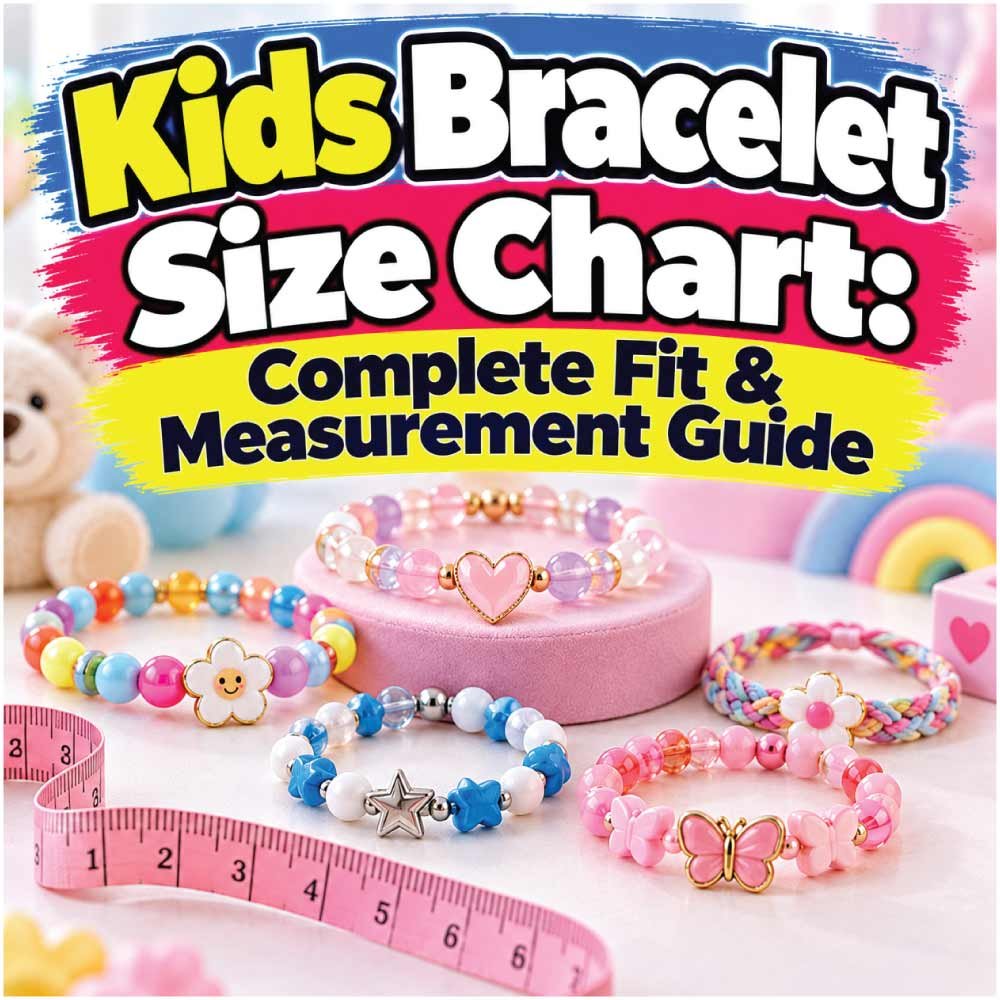
Choosing the right bracelet for a child is easier when you know the wrist measurement and understand how different bracelet styles fit. A bracelet that is too tight can feel uncomfortable, while one that is too loose may slide around or become inconvenient during everyday activities.
This Kids Bracelet Size Chart provides practical guidance for measuring a child’s wrist, selecting an appropriate bracelet length, understanding age-based sizing, and choosing a comfortable fit. Because children’s wrists vary considerably even at the same age, an actual wrist measurement is more reliable than age alone.
Whether you are buying a gift, ordering a personalized bracelet, choosing a friendship bracelet, or checking a bangle size, this guide will help you make a more confident choice.
Kids Bracelet Size Chart by Age
Age can provide a useful starting point when you do not have a wrist measurement, but it should not be treated as an exact sizing standard. Children of the same age can have noticeably different wrist sizes because growth patterns, body proportions, and individual development vary.
The following chart provides general bracelet-length guidance, not a universal standard. Always compare the manufacturer’s sizing information with the child’s actual wrist measurement when possible.
| Age Group | Typical Wrist Circumference | Suggested Bracelet Length | General Fit |
|---|---|---|---|
| 0–2 years | 4.0–5.0 in (10–12.7 cm) | 4.5–5.5 in (11.4–14 cm) | Close, comfortable fit |
| 3–5 years | 4.5–5.5 in (11.4–14 cm) | 5.0–6.0 in (12.7–15.2 cm) | Comfortable with slight room |
| 6–8 years | 5.0–6.0 in (12.7–15.2 cm) | 5.5–6.5 in (14–16.5 cm) | Comfortable everyday fit |
| 9–12 years | 5.5–6.5 in (14–16.5 cm) | 6.0–7.0 in (15.2–17.8 cm) | Relaxed but secure |
| 13+ years | 6.0–7.0+ in (15.2–17.8+ cm) | 6.5–7.5+ in (16.5–19+ cm) | Depends on wrist and style |
These ranges are intended as a starting point rather than a fixed sizing rule. For a better result, measure the child’s wrist and add the amount of extra room appropriate for the bracelet design.
Why Children’s Bracelet Size Matters
A bracelet should be comfortable enough for normal movement without being so loose that it constantly slips down the hand. Getting the size right is particularly important for children because their wrists are smaller and continue to grow.
A well-fitted bracelet should:
- Sit comfortably around the wrist.
- Allow natural wrist movement.
- Avoid leaving deep pressure marks.
- Stay secure without feeling restrictive.
- Have enough room for the intended bracelet style.
- Be appropriate for the child’s age and activity level.
The ideal fit also depends on the bracelet itself. A rigid bangle, flexible chain bracelet, adjustable cord bracelet, and beaded bracelet do not necessarily require the same sizing approach.
For this reason, bracelet length and wrist circumference are related but are not always identical measurements.
How to Measure a Child’s Wrist for a Bracelet
The most accurate way to select a kids bracelet size is to measure the wrist directly. You can do this at home using a flexible measuring tape or a simple strip of paper or string.
What You Need
You only need a few basic items:
- Flexible measuring tape
- String, ribbon, or a narrow strip of paper
- Ruler
- Pen or pencil
A flexible sewing tape is usually the easiest option because it follows the natural shape of the wrist.
Step-by-Step Wrist Measurement
1. Find the wrist position
Measure around the wrist where the bracelet will normally sit. For most bracelets, this is around the narrow area just above the hand.
2. Wrap the measuring tape around the wrist
Place the tape around the wrist without squeezing the skin. Keep it comfortably against the wrist.
3. Record the circumference
Read the measurement where the end of the tape meets the scale. Record it in inches or centimeters.
4. Check the measurement
Take the measurement a second time to make sure the result is consistent. Small measurement differences can affect the final bracelet fit.
5. Add appropriate wearing room
Do not automatically order a bracelet equal to the exact wrist circumference. The required extra space depends on the bracelet’s design and the desired fit.
Measuring With String or Paper
If you do not have a flexible tape measure, wrap a piece of string or narrow paper around the wrist.
Mark the point where the end overlaps. Then lay the string or paper flat against a ruler and measure the length.
This gives you the child’s wrist circumference. You can then compare that measurement with the bracelet seller’s size chart.
Wrist Circumference vs. Bracelet Length
One of the most common sizing mistakes is assuming that wrist circumference and bracelet length mean the same thing.
They do not.
Wrist circumference is the distance around the child’s wrist. Bracelet length refers to the length of the bracelet itself, which may need to be slightly longer to provide comfortable movement.
For example, if a child’s wrist measures 5.5 inches, a bracelet designed to fit exactly 5.5 inches may feel too snug depending on its construction.
The amount of extra space required varies with:
- Bracelet material
- Closure type
- Bead size
- Chain construction
- Bracelet thickness
- Desired fit
- Child’s activity level
Always follow the product’s specific sizing instructions when they are available.
How Much Extra Room Should a Kids Bracelet Have?
There is no single amount of extra room that works for every bracelet. The right allowance depends on the design and how the bracelet is intended to be worn.
A general approach is:
| Desired Fit | Approximate Extra Room | Best For |
|---|---|---|
| Snug | 0.25–0.5 in (0.6–1.3 cm) | Fitted styles |
| Comfortable | 0.5–0.75 in (1.3–1.9 cm) | Most everyday bracelets |
| Relaxed | 0.75–1.0 in (1.9–2.5 cm) | Loose styles and some chains |
These figures are general fitting guidance, not a universal manufacturing standard.
For a child’s everyday bracelet, a comfortable fit is often preferable to an extremely tight fit. However, adding excessive length can cause the bracelet to slide over the hand or catch on objects.
Kids Bracelet Size Chart by Bracelet Type
Different bracelet styles require different approaches to sizing. A flexible bracelet can accommodate movement differently from a rigid bangle.
Adjustable Kids Bracelets
Adjustable bracelets are often convenient because their length can be changed as the child grows.
They may use:
- Sliding knots
- Adjustable cords
- Extension chains
- Toggle closures
- Multiple fastening positions
An adjustable design can be especially useful when the exact wrist measurement is unavailable or when the bracelet is intended to be worn for an extended period.
Beaded Bracelets
Beaded bracelets can require additional consideration because large beads can affect the internal fit.
A bracelet made from small beads may sit differently from one made with large decorative beads, even if both have the same stated length.
When purchasing a beaded bracelet, check whether the listed measurement represents:
- Total bracelet length
- Inside circumference
- Wrist size recommendation
- End-to-end measurement before fastening
If the seller does not explain the measurement, ask before ordering.
Chain Bracelets
Chain bracelets usually have a clasp and may include an extension chain. Their fit can therefore be adjusted within a limited range.
The bracelet should not be so loose that the clasp and chain constantly move around the wrist.
Bangles
Rigid bangles are different because they do not wrap around the wrist like a flexible bracelet. Their inside diameter or opening size can be more important than bracelet length.
A bangle must generally be large enough to pass over the hand while still being appropriate for the wrist.
Kids Bracelet Size Chart in Inches and Centimeters
Having both measurement systems makes it easier to compare international size charts and product descriptions.
| Measurement | Inches | Centimeters |
|---|---|---|
| 4.5 in | 4.5 in | 11.4 cm |
| 5.0 in | 5.0 in | 12.7 cm |
| 5.5 in | 5.5 in | 14.0 cm |
| 6.0 in | 6.0 in | 15.2 cm |
| 6.5 in | 6.5 in | 16.5 cm |
| 7.0 in | 7.0 in | 17.8 cm |
| 7.5 in | 7.5 in | 19.1 cm |
When converting measurements, remember that 1 inch equals 2.54 centimeters. Avoid rounding too aggressively when the bracelet has a precise clasp or rigid construction.
How to Choose the Right Kids Bracelet Size
Once you have the child’s wrist measurement, selecting a bracelet becomes much easier.
Start With the Actual Wrist Measurement
If you can measure the wrist, use that measurement instead of relying primarily on age.
For example, suppose a child’s wrist measures 5.25 inches. Rather than automatically choosing a bracelet based on the child’s age, look for a product whose sizing instructions accommodate that wrist circumference.
Consider the Bracelet Style
A flexible cord bracelet and a rigid bangle should not be selected in exactly the same way.
Consider:
- Is the bracelet flexible or rigid?
- Does it have a clasp?
- Is it adjustable?
- Are there large beads?
- Does the product specify a recommended wrist size?
Think About the Intended Fit
Decide whether you want the bracelet to fit:
- Close to the wrist
- Comfortably with a little movement
- More loosely for a relaxed appearance
For children, comfort and secure wear are generally more important than achieving a particular visual style.
Check the Seller’s Size Chart
Product measurements can vary from one manufacturer to another. A bracelet labeled “small” by one seller may not have the same dimensions as a “small” bracelet from another seller.
Whenever possible, compare your measurement directly with the manufacturer’s chart.
Also Read:
Age-Based Sizing Is Only a Starting Point
Parents and gift buyers often search for a bracelet size by age, but age alone cannot guarantee a proper fit.
A six-year-old child may have a smaller wrist than another six-year-old, while an older child may have a wrist measurement similar to a younger child.
Age-based sizing is most useful when:
- You are buying a surprise gift.
- You cannot measure the wrist.
- The bracelet is adjustable.
- The manufacturer specifically provides age recommendations.
If you can measure the wrist, however, actual wrist circumference should usually take priority.
Common Kids Bracelet Sizing Mistakes
Even a simple bracelet can be difficult to size if the measurement is taken incorrectly.
Measuring Too Tightly
Pulling the tape firmly against the wrist can produce a measurement that is smaller than the child’s natural wrist circumference.
Keep the tape comfortably against the skin without compressing it.
Using Age as an Exact Measurement
Age is not a substitute for wrist circumference. Use age ranges only as general guidance.
Ignoring Bracelet Construction
A rigid bangle, chunky beaded bracelet, and flexible chain can fit differently even when their stated measurements appear similar.
Choosing Too Much Extra Length
More room does not always mean more comfort. An excessively loose bracelet can move over the hand or become inconvenient during play.
Forgetting the Closure
A clasp, toggle, elastic section, or extension chain can change how a bracelet fits and how easy it is to put on.
Confusing Bracelet Size With Jewelry Diameter
Bracelet length, wrist circumference, inside circumference, and bangle diameter are different measurements. Always identify what the product’s number actually represents.
Also Read:
How to Check a Child’s Bracelet Fit
After putting the bracelet on, check how it behaves during normal wrist movement.
A suitable fit should generally:
- Feel comfortable rather than restrictive.
- Allow natural movement.
- Avoid excessive pressure.
- Stay reasonably positioned on the wrist.
- Not constantly slide over the hand.
If the bracelet leaves noticeable pressure marks, feels uncomfortable, or restricts movement, it may be too small.
If it repeatedly slides far down the hand or feels difficult to keep in place, it may be too large.
Bracelet Sizing Tips for Growing Children
Children grow, so choosing a bracelet with some adjustability can be practical.
Choose Adjustable Designs When Appropriate
Adjustable bracelets can provide a wider fitting range than fixed-length designs. This can be useful for gifts when the child’s wrist measurement is unknown.
Avoid Buying Excessively Large Sizes
It may be tempting to buy a much larger bracelet so the child can “grow into it.” However, excessive looseness can make the bracelet inconvenient or insecure.
A better approach is to select a suitable current fit with reasonable adjustment potential.
Measure Again Before Buying Another Bracelet
Wrist size can change as a child grows. If you are purchasing another bracelet months or years later, take a new measurement rather than relying on an old one.
Also Read:
Safety Considerations for Children’s Bracelets
Sizing is only one part of choosing children’s jewelry. The bracelet should also be appropriate for the child’s age, behavior, and activities.
For younger children, parents and caregivers should consider whether the bracelet contains small detachable components that could present a choking hazard.
It is also sensible to remove bracelets during activities where jewelry could catch, become damaged, or interfere with movement.
Consider removing a child’s bracelet during:
- Rough play
- Contact sports
- Swimming
- Activities involving machinery or equipment
- Sleep, when recommended by the product manufacturer
- Any activity where the bracelet could snag
Always follow the product’s age recommendations and safety instructions.
How to Measure a Bracelet You Already Own
If you already have a bracelet that fits the child well, it can provide a useful reference for future purchases.
For a flexible bracelet, measure its length from end to end when laid flat according to the manufacturer’s measurement method.
For a bracelet with a clasp, check whether the measurement includes the clasp and closure components.
For a rigid bangle, measure the inside diameter or compare the opening with the child’s hand and wrist, depending on the sizing system used by the manufacturer.
The important point is to compare measurements taken using the same method. A bracelet’s outside dimensions should not be compared directly with another product’s inside dimensions.
Kids Bracelet Size Chart: Quick Selection Guide
Use this simplified process when choosing a bracelet:
| Step | What to Check | Why It Matters |
|---|---|---|
| 1 | Measure wrist circumference | Provides the most useful starting point |
| 2 | Identify bracelet type | Different styles fit differently |
| 3 | Decide desired fit | Determines how much room is appropriate |
| 4 | Check product measurements | Prevents confusion between size labels |
| 5 | Compare with manufacturer chart | Product-specific sizing is more reliable |
| 6 | Check the finished fit | Confirms comfort and practical wear |
This method is more dependable than selecting a bracelet based on age alone.
Frequently Asked Questions About Kids Bracelet Sizes
What is the average bracelet size for a child?
There is no single bracelet size that fits every child. A general children’s bracelet may fall around 5 to 7 inches depending on age and wrist size, but actual wrist circumference is more reliable than age-based estimates.
What size bracelet should a 5-year-old wear?
A five-year-old may commonly fall within a wrist range around 4.5 to 5.5 inches, but individual measurements vary. Measure the child’s wrist and compare it with the bracelet manufacturer’s recommended wrist size before purchasing.
What size bracelet should a 10-year-old wear?
A 10-year-old may often fit within a bracelet range around 6 to 7 inches, depending on wrist circumference and bracelet style. Measure the wrist whenever possible rather than relying solely on the child’s age.
How much bigger should a kids bracelet be than the wrist?
The amount of additional room depends on the bracelet design and desired fit. A comfortable bracelet may have roughly 0.5 to 0.75 inches of additional room, while snug or relaxed styles may require less or more.
Should a child’s bracelet be tight or loose?
A child’s bracelet should generally be comfortable and secure rather than excessively tight or loose. It should allow natural movement without creating pressure or sliding excessively over the hand.
How do I measure a child’s wrist without a tape measure?
Wrap a piece of string, ribbon, or narrow paper around the wrist without pulling it tight. Mark the overlap, then straighten the material and measure it against a ruler.
Is bracelet length the same as wrist circumference?
No. Wrist circumference measures around the wrist, while bracelet length refers to the bracelet’s physical length. A bracelet may need additional length beyond the wrist measurement to provide comfortable movement.
Are kids bracelet sizes universal?
No. Bracelet sizes are not universally standardized across all manufacturers and styles. Always check the product’s measurement method and compare it with the child’s wrist measurement.
Are adjustable bracelets better for growing children?
Adjustable bracelets can be practical because they provide a range of fitting positions. They can be particularly useful when the child’s exact wrist measurement is unavailable or when some adjustment is desired.
How can I choose a bracelet as a surprise gift?
If you cannot measure the child’s wrist, use the manufacturer’s age or size guidance as a starting point and consider an adjustable design. Keep the receipt or check the seller’s exchange policy if possible.
Final Thoughts on Kids Bracelet Sizing
Finding the right kids bracelet size does not have to be complicated. The most dependable method is to measure the child’s wrist circumference, identify the type of bracelet, and then compare the measurement with the manufacturer’s sizing instructions.
Age-based charts can help when a wrist measurement is unavailable, but they should be treated as general guidance rather than exact standards. Children grow at different rates, and bracelet construction also affects the way a particular size fits.
For the best result, aim for a comfortable, secure fit with appropriate room for movement, and choose adjustable designs when flexibility is useful. Taking a few minutes to measure the wrist before purchasing can prevent an uncomfortable fit and make gift buying much easier.
