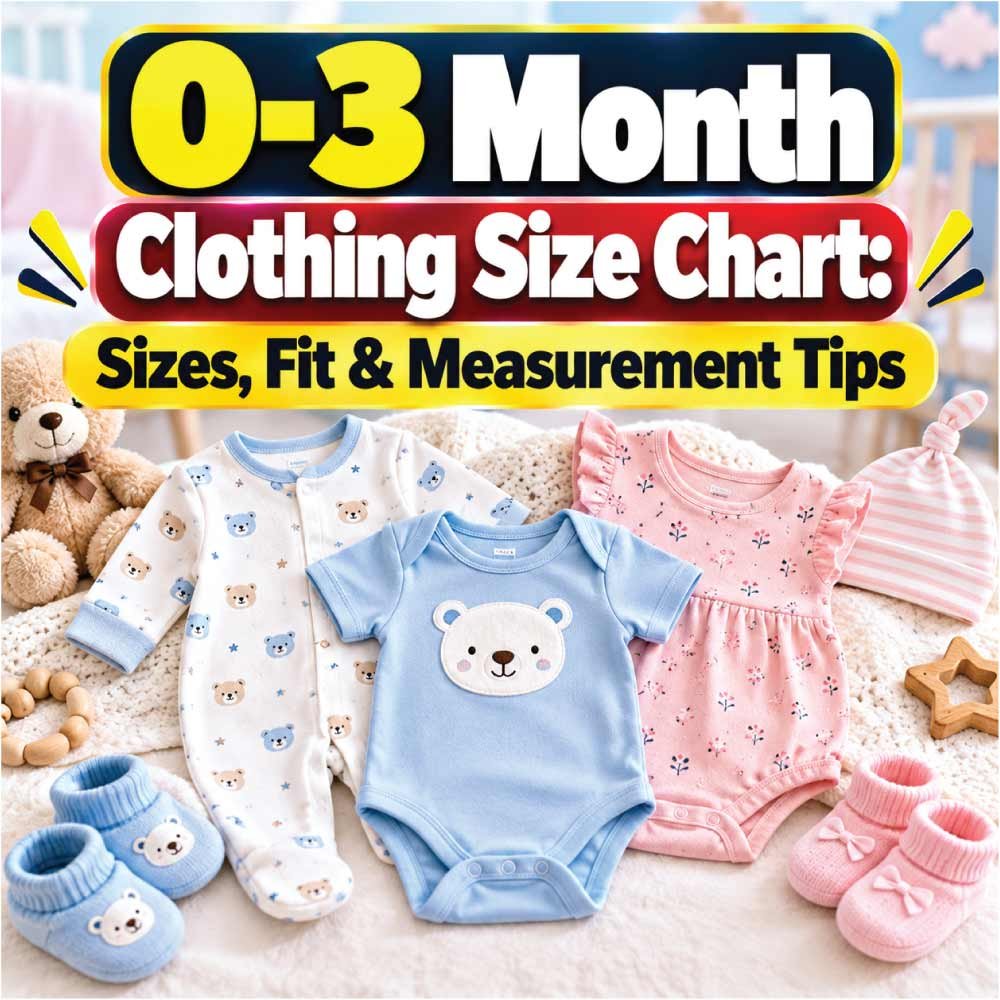
Choosing clothes for a newborn can be surprisingly difficult because 0-3 month clothing sizes are not perfectly standardized. One brand’s 0-3M outfit may fit a small newborn comfortably, while another may work better for a larger baby approaching three months.
The best way to choose the right size is to consider baby’s weight, length, chest, waist, and overall fit, rather than relying on age alone. Babies grow at different rates, and clothing labels are only general guidelines.
A 0-3 month clothing size chart can help parents, grandparents, and gift buyers estimate the right size quickly. However, measurements are usually more reliable than the age printed on the label.
This guide explains common 0-3M measurements, how to measure a baby, how different clothing types fit, and what to do when your baby’s measurements fall between sizes.
0-3 Month Clothing Size Chart
The following chart provides general guidance for babies who are likely to wear 0-3 month clothing. Exact measurements vary between manufacturers, so always check the individual brand’s size chart when available.
| Size | Typical Age | Baby Weight | Baby Length |
|---|---|---|---|
| Newborn | 0-1 month | Up to about 8 lb | Up to about 21.5 in |
| 0-3M | 0-3 months | About 8-12.5 lb | About 21.5-24 in |
| 3-6M | 3-6 months | About 12.5-17 lb | About 24-26.5 in |
These ranges are general sizing guidance rather than universal standards. A baby’s body proportions can also affect whether a particular garment fits.
For example, a long and slim baby may need more length than the weight range suggests, while a shorter baby with a fuller body may need additional room around the chest or waist.
What Does 0-3M Mean on Baby Clothes?
The label 0-3M generally means the garment is designed for babies from birth through approximately three months old. It does not mean every baby will wear that size from birth until the exact day they turn three months.
Age-based labels are simply a convenient starting point.
A baby may fit newborn clothing for only a short time, move directly into 0-3M clothing, or begin wearing 3-6M clothing earlier than expected. Growth rate, body shape, brand sizing, and garment style all influence the actual fit.
0-3 Months vs. Newborn Size
Newborn clothing is generally intended for smaller babies and often has a shorter and narrower fit than 0-3M clothing.
A 0-3M garment typically provides more room for growth. If you are buying clothing before the baby arrives and do not know the baby’s eventual size, purchasing a combination of newborn and 0-3M pieces can be more practical than buying a large quantity of either size.
0-3 Months vs. 3-6 Months
The next common size is 3-6M. It is generally designed for babies who have outgrown the shorter and smaller proportions of 0-3M clothing.
The transition does not happen at exactly three months. Some babies move into the next size earlier, while others remain comfortable in 0-3M clothing longer.
Key Measurements for 0-3 Month Baby Clothes
When selecting baby clothing, three measurements are especially useful: length, weight, and body circumference.
Baby Length
Length is particularly important for one-piece garments such as:
- Bodysuits
- Sleepers
- Footed pajamas
- Rompers
- Jumpsuits
If a garment is too short, it can pull around the shoulders or crotch even when the baby’s weight appears to match the recommended range.
Baby Weight
Weight is commonly included on infant clothing size charts because it provides a quick way to estimate overall garment size.
However, weight should not be considered alone. Two babies can have the same weight while having noticeably different lengths and body proportions.
Chest Measurement
Chest circumference can help determine whether a shirt, bodysuit, sweater, or jacket will provide enough room through the torso.
For fitted clothing, this measurement can be especially useful when a baby’s weight falls close to the boundary between two sizes.
How to Measure a Baby for Clothing
Accurate measurements make it easier to choose baby clothes, particularly when shopping online.
Measure Baby’s Length
Lay the baby flat on a safe, firm surface. Keep the legs as naturally straight as possible without forcing them.
Measure from the top of the head to the bottom of the feet.
Because newborns naturally curl their legs, getting an exact measurement can be difficult. Having another adult gently help can make the process easier.
Measure Baby’s Chest
Wrap a soft measuring tape around the fullest part of the baby’s chest.
Keep the tape comfortably against the body without pulling it tightly. The measurement should represent the baby’s natural body size rather than compressing the torso.
Measure Baby’s Waist
Place the measuring tape around the natural waist area. Again, keep the tape comfortably positioned rather than tight.
For many loose-fitting baby garments, waist measurement is less important than length and overall garment construction.
Use Weight as a Supporting Measurement
Check the baby’s current weight against the manufacturer’s chart. If the weight and length suggest different sizes, examine the garment’s cut and consider which measurement is more important for that particular item.
How 0-3 Month Clothing Should Fit
Baby clothing should be comfortable without being excessively loose or restrictive.
A properly fitting garment should allow the baby to move naturally and should not pull tightly across the shoulders, chest, crotch, or legs.
Look for these signs of a good fit:
- The garment lies comfortably against the body.
- Arms and legs can move freely.
- Fasteners close without excessive tension.
- Seams do not dig into the skin.
- The neckline does not restrict movement.
- There is enough room for normal diaper use.
- The garment does not bunch excessively.
For everyday baby clothes, a little growing room can be useful. However, excessively oversized clothing can interfere with comfortable movement and may make certain garments impractical.
0-3 Month Size by Weight
Many parents search specifically for a 0-3 month clothing size chart by weight because weight is easy to obtain from a pediatric visit or home scale.
Weight can be a helpful starting point, but it should not be the only factor.
| Approximate Weight | Likely Clothing Range |
|---|---|
| Under 8 lb | Newborn or smaller newborn sizing |
| About 8-10 lb | Newborn to 0-3M |
| About 10-12.5 lb | Often 0-3M |
| About 12.5-15 lb | 0-3M to 3-6M |
| Over 15 lb | Often approaching 3-6M, depending on length and brand |
These ranges are intended only as practical guidance. Manufacturer sizing should take priority when a brand provides specific measurements.
A baby with a higher weight but shorter length may fit differently from a baby with the same weight and a longer body.
0-3 Month Size by Length
Length is another important way to estimate baby clothing size.
A typical 0-3M range may accommodate babies around 21.5 to 24 inches long, but brands can use different limits.
When shopping for sleepers or bodysuits, length can sometimes be more useful than weight because the garment needs sufficient vertical room.
If your baby is close to the maximum recommended length, sizing up may provide a more comfortable fit, especially for one-piece clothing.
Choosing Different Types of 0-3M Baby Clothes
Not every garment needs to fit in exactly the same way.
Bodysuits
Bodysuits need enough length to fasten comfortably underneath the diaper. If the snaps are difficult to close or pull against the diaper area, the garment may be too small.
Sleepers and Footed Pajamas
For sleepers, body length is especially important. A baby can fit the weight range but still need a larger size if the sleeper is too short.
Footed styles also need adequate room around the feet so the baby’s toes are not compressed.
T-Shirts
T-shirts are usually easier to fit because they do not need to extend around the diaper area. Chest and shoulder fit become more important.
Pants
For baby pants, consider waist comfort, rise, and leg length. Elastic waistbands should sit comfortably without leaving deep marks.
Jackets and Sweaters
Outer layers should provide enough room for movement and any clothing worn underneath. Avoid choosing a jacket based solely on the baby’s age.
Also Read:
When Should a Baby Move From 0-3M to 3-6M?
There is no universal age when a baby must move to the next clothing size.
Signs that it may be time to move from 0-3M to 3-6M include:
- Bodysuits are difficult to snap.
- Sleeves or legs have become noticeably short.
- The neckline or chest feels tight.
- The baby has limited movement in the garment.
- Diaper area has insufficient room.
- Sleepers are pulling across the body.
- The baby’s measurements exceed the brand’s 0-3M range.
A baby does not need to wait until exactly three months old to move into 3-6M clothing. Fit matters more than the age printed on the label.
What If Your Baby Is Between Sizes?
Babies often fall between two clothing sizes. This is completely normal.
If measurements fall near the upper end of 0-3M, consider the garment type and how quickly the baby is growing.
For example, a slightly larger shirt may still be comfortable, while an oversized sleeper may be less practical.
When between sizes:
- Choose the larger size when extra length is important.
- Check the garment’s actual measurements.
- Consider whether the baby is currently growing quickly.
- Look for adjustable or stretchy features.
- Compare the manufacturer’s chart before purchasing.
- Avoid buying too many pieces in a size the baby may quickly outgrow.
For gifts, 0-3M and 3-6M clothing can both be useful, particularly when you are unsure about the baby’s growth rate.
Also Read:
Why Baby Clothing Sizes Vary by Brand
One of the biggest sources of confusion is that infant clothing sizes are not identical across every brand.
A 0-3M label describes a general target range, but manufacturers can differ in:
- Garment dimensions
- Cut and proportions
- Fabric stretch
- Intended fit
- Closure placement
- Sleeve and leg length
- Sizing philosophy
One brand may produce a roomy bodysuit, while another may make a slimmer version with similar age labeling.
This is why checking the brand’s size chart is more reliable than assuming every 0-3M garment has identical measurements.
Also Read:
Common Mistakes When Buying 0-3M Clothes
Relying Only on Age
Age is convenient but does not account for individual growth. Use age as a starting point and compare it with weight and length.
Buying Too Many Newborn Clothes
Babies can outgrow newborn clothing very quickly. If you are preparing before birth, a balanced selection of sizes is often more practical.
Ignoring Garment Type
A 0-3M T-shirt and a 0-3M footed sleeper do not have identical fit requirements. Consider how the garment is constructed.
Assuming All Brands Fit the Same
Always check the manufacturer’s chart when available, especially when ordering online.
Choosing Extremely Loose Clothing
Growing room can be useful, but excessively large garments may be uncomfortable or impractical. Aim for a comfortable fit rather than simply choosing the biggest available size.
Tips for Buying 0-3 Month Baby Clothes
A few practical habits can make shopping easier.
- Measure before ordering: Use current measurements rather than relying on an old estimate.
- Check the size chart: Brand-specific information should take priority.
- Think about growth: Babies can change size quickly during the first months.
- Buy practical quantities: Avoid purchasing too many pieces in one size.
- Choose comfortable fabrics: Soft, flexible materials can make dressing easier.
- Consider diaper space: One-piece garments need sufficient room around the bottom.
- Look at closures: Snaps, zippers, and openings should be easy to use.
- Account for layering: Outerwear may need additional room over other clothing.
- Keep receipts when possible: This makes exchanging an unsuitable size easier.
0-3 Month Clothing Size Chart: Quick Reference
For a quick overview, use this chart as a starting point:
| Size | Age Range | Approx. Weight | Approx. Length |
|---|---|---|---|
| Newborn | 0-1 month | Up to about 8 lb | Up to about 21.5 in |
| 0-3M | 0-3 months | About 8-12.5 lb | About 21.5-24 in |
| 3-6M | 3-6 months | About 12.5-17 lb | About 24-26.5 in |
Remember that these are general ranges, not universal clothing standards. Brand charts may use different measurements.
Frequently Asked Questions About 0-3M Clothing Sizes
Is 0-3 months the same as newborn size?
No. Newborn and 0-3M are generally different clothing ranges. Newborn clothing is usually designed for smaller babies, while 0-3M provides additional room for growth. However, exact measurements vary between brands.
What weight is 0-3 month clothing for?
A common general range for 0-3M clothing is approximately 8 to 12.5 pounds, although manufacturers can use different weight limits. Check the individual brand’s chart and compare weight with the baby’s length for a better fit.
What size does a 10-pound baby wear?
A 10-pound baby will often fit 0-3M clothing, although newborn clothing may still fit depending on the baby’s length and proportions. Always check the garment’s specific measurements because sizing differs between brands.
How long do babies wear 0-3M clothes?
Some babies wear 0-3M clothing for several weeks, while others may use it for a few months. Growth rate, body length, weight, and brand sizing all influence how long the clothing remains comfortable.
Should I buy 0-3M or 3-6M for a baby gift?
If you are uncertain, both sizes can be useful. 0-3M is appropriate for immediate use for many babies, while 3-6M provides clothing for a later growth stage. Avoid buying excessive quantities of one size.
Does 0-3M mean a baby can wear it until exactly three months?
No. The label is an approximate sizing range rather than a strict age limit. A baby may outgrow 0-3M before three months or continue wearing it afterward if the clothing still fits comfortably.
Is baby length more important than weight for clothing?
It depends on the garment. Length is especially important for bodysuits, sleepers, and other one-piece outfits, while weight provides a useful general indication of overall size. Ideally, consider both.
How do I know when 0-3M clothes are too small?
Look for tight fasteners, short sleeves or legs, restricted movement, pulling around the shoulders or crotch, and insufficient diaper room. If the garment is difficult to close or looks restrictive, it is time to consider the next size.
Final Thoughts on 0-3 Month Clothing Sizes
A 0-3 month clothing size chart is a useful starting point, but the best fit comes from looking at the baby’s actual measurements and the manufacturer’s sizing information.
Weight and length are particularly helpful when choosing clothes online. For one-piece garments, pay close attention to body length and diaper space. If your baby falls between sizes, consider the garment style, available stretch, and how quickly your baby is growing.
Most importantly, remember that 0-3M is a general clothing category, not a universal measurement standard. Checking the brand’s chart and focusing on comfortable movement will help you choose clothes that fit better and last longer.
