
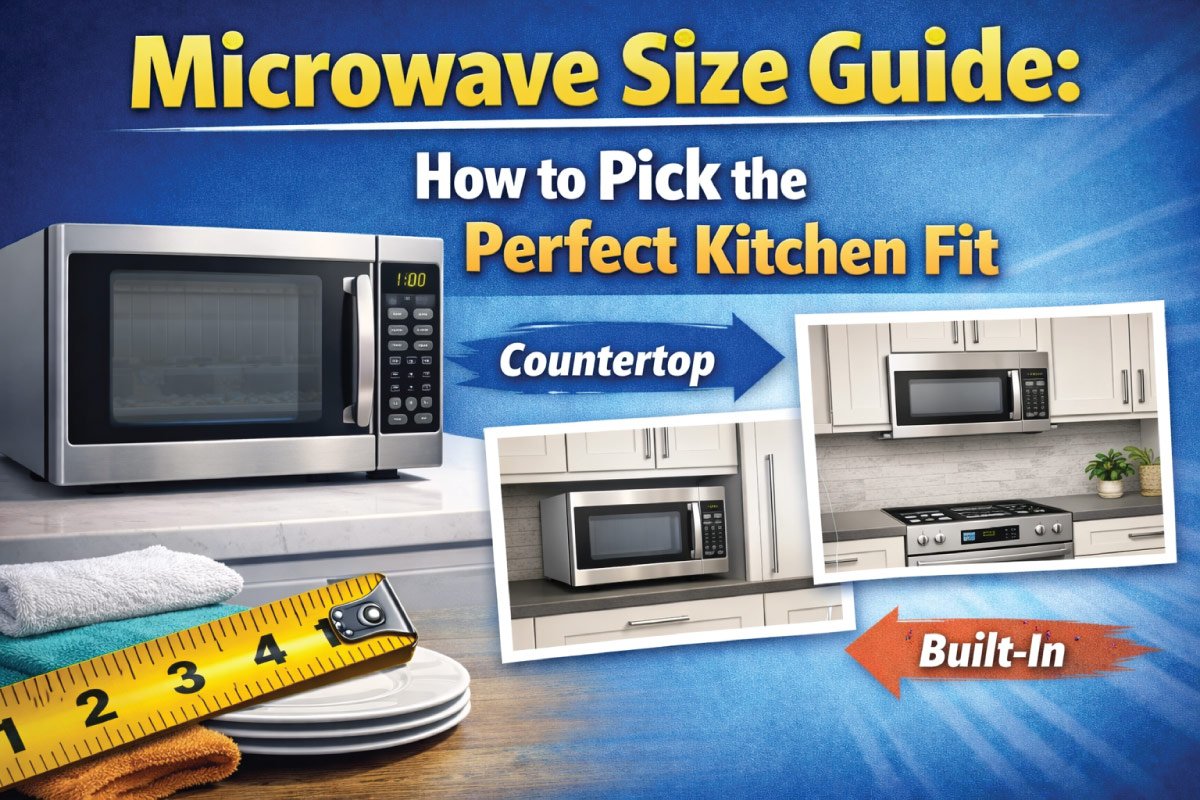
Microwaves are a staple appliance in modern kitchens. They offer convenience, speed, and versatility, from reheating leftovers to defrosting meats and cooking meals quickly. However, selecting the right microwave involves more than just aesthetics or brand reputation. Size is one of the most crucial factors to consider. Choosing a microwave that is too large or too small can affect your kitchen space, cooking efficiency, and overall satisfaction with your appliance.
This guide provides an in-depth look at microwave sizes, types, and how to choose the perfect one for your home. Whether you live in a small apartment or have a large family kitchen, understanding microwave dimensions is essential.
Why Microwave Size Matters
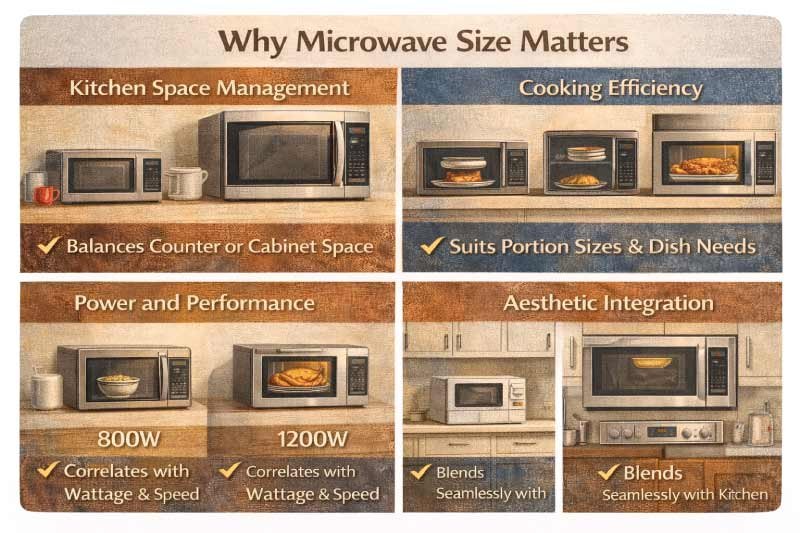
Choosing the right microwave size is essential for both functionality and kitchen harmony. The ideal size balances cooking capacity, counter space, and energy efficiency while complementing your kitchen layout. Selecting appropriately ensures your microwave meets daily cooking needs without overwhelming your space or disrupting the kitchen’s visual flow.
-
Kitchen Space Management: A microwave that is too large can crowd your counter or cabinet space. Conversely, a tiny microwave may not meet your cooking needs.
-
Cooking Efficiency: Larger microwaves generally have more interior space, allowing you to cook larger portions, multiple dishes, or bigger plates.
-
Power and Performance: Size often correlates with wattage. Larger microwaves usually have higher wattage, resulting in faster and more even cooking.
-
Aesthetic Integration: Ensuring that your microwave fits seamlessly with your cabinetry or countertop setup enhances kitchen aesthetics.
Standard Microwave Sizes
Standard microwave sizes are categorized by their interior capacity, which directly impacts cooking space and suitability for different households. Choosing the right size ensures your meals fit comfortably, matches your kitchen layout, and meets your daily cooking needs, whether for a single user, a small family, or frequent large meals.
| Microwave Size | Capacity (cu. ft) | Ideal Use Case | Typical Dimensions (W x H x D) |
|---|---|---|---|
| Compact | 0.5 – 0.9 | Singles, small apartments, occasional use | 17–19″ x 10–12″ x 12–14″ |
| Mid-Size | 1.0 – 1.5 | Couples or small families, everyday use | 19–21″ x 11–13″ x 14–16″ |
| Large | 1.6 – 2.0+ | Families, frequent cooking, large dishes | 21–24″ x 12–14″ x 16–18″ |
Key takeaway: The interior cubic footage determines how much food can fit inside, while external dimensions dictate whether it will fit on your counter or built-in space.
Countertop vs Built-In Microwaves
Microwaves come in two primary installation styles: countertop and built-in. Countertop models offer flexibility and easy relocation, while built-in units provide a seamless, space-saving integration with cabinetry. Understanding their size differences helps you choose the right type for your kitchen layout, cooking habits, and available space.
1- Countertop Microwaves
Countertop microwaves are the most popular choice due to their affordability, portability, and wide range of sizes. Ideal for flexible kitchen arrangements, they can be easily moved or replaced. However, proper measurement is crucial to ensure they fit your countertop while allowing sufficient airflow for safe operation.
| Type | Advantages | Disadvantages | Size Considerations |
|---|---|---|---|
| Countertop | Affordable, portable, easy to replace | Takes up counter space | Ensure the width, height, and depth fit your countertop and allow airflow |
2- Built-In / Over-the-Range Microwaves
Built-in or over-the-range microwaves offer a sleek, integrated look while saving valuable counter space. Many include ventilation features for your stove. Proper sizing is essential, as these units must fit your cabinet dimensions and are typically larger in width and depth compared to standard countertop models.
| Type | Advantages | Disadvantages | Size Considerations |
|---|---|---|---|
| Built-in | Saves counter space, integrated look, extra features | Higher cost, requires installation | Must match cabinet dimensions; usually larger in width and depth than countertop units |
Measuring Your Kitchen Space
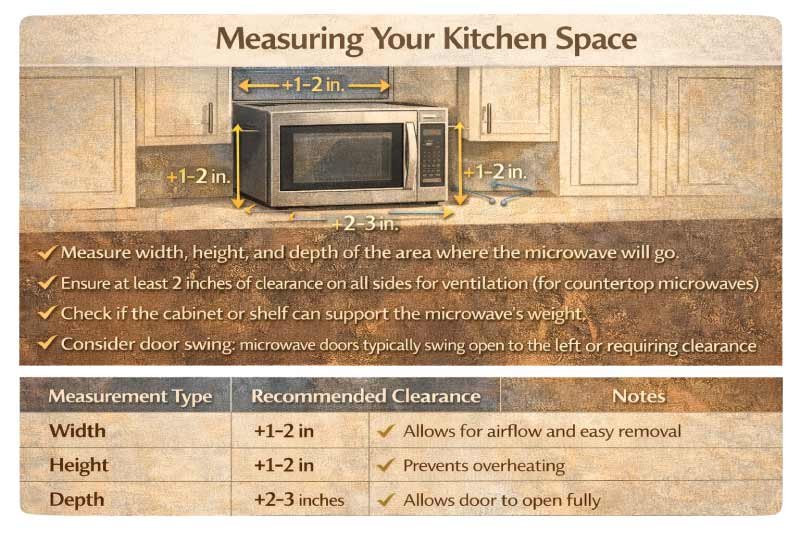
Accurate measurements are crucial when selecting a microwave to ensure it fits your kitchen space and operates safely. Measuring both the available area and the microwave’s interior ensures functionality, proper ventilation, and ease of use. Careful planning prevents installation issues and maximizes countertop or cabinet efficiency.
-
Measure width, height, and depth of the area where the microwave will go.
-
Ensure at least 2 inches of clearance on all sides for ventilation (for countertop microwaves).
-
Check if the cabinet or shelf can support the microwave’s weight.
-
Consider door swing: microwave doors typically swing open to the left or right, requiring clearance.
| Measurement Type | Recommended Clearance | Notes |
|---|---|---|
| Width | +1–2 inches | Allows for airflow and easy removal |
| Height | +1–2 inches | Prevents overheating |
| Depth | +2–3 inches | Allows door to open fully |
| Ventilation | 2 inches min | Essential for safety and performance |
Microwave Capacity Guide
Microwave capacity, measured in cubic feet, determines the size and quantity of dishes you can cook at once. Selecting the right capacity ensures your plates, bowls, and casseroles fit comfortably, matching your household’s cooking needs—from singles and couples to large families or frequent entertainers.
| Capacity (cu. ft) | Ideal Plate Size | Suitable For | Notes |
|---|---|---|---|
| 0.5 – 0.9 | Up to 9 inches | Singles, small meals | Compact, fits small spaces |
| 1.0 – 1.5 | 10–12 inches | Couples, small families | Good for average household meals |
| 1.6 – 2.0+ | 12–14 inches | Large families, big dishes | Ideal for casseroles or party platters |
Tip: Always measure your largest plate to ensure it fits comfortably inside the microwave.
Wattage and Size Correlation
Microwave wattage affects cooking speed and efficiency, and it often correlates with the unit’s size. Higher wattage means faster, more even cooking, while lower wattage suits simple tasks. Understanding this relationship helps you choose a microwave that balances your meal size, cooking habits, and time efficiency.
| Microwave Size | Typical Wattage | Cooking Time Impact | Notes |
|---|---|---|---|
| Compact | 600–800 W | Slower heating, small meals | Ideal for reheating or simple cooking |
| Mid-Size | 800–1,100 W | Faster cooking, moderate meals | Suitable for most households |
| Large | 1,100–1,500 W+ | Fastest cooking, large dishes | Perfect for frequent use and family meals |
Also Read:
Types of Microwaves by Installation and Capacity
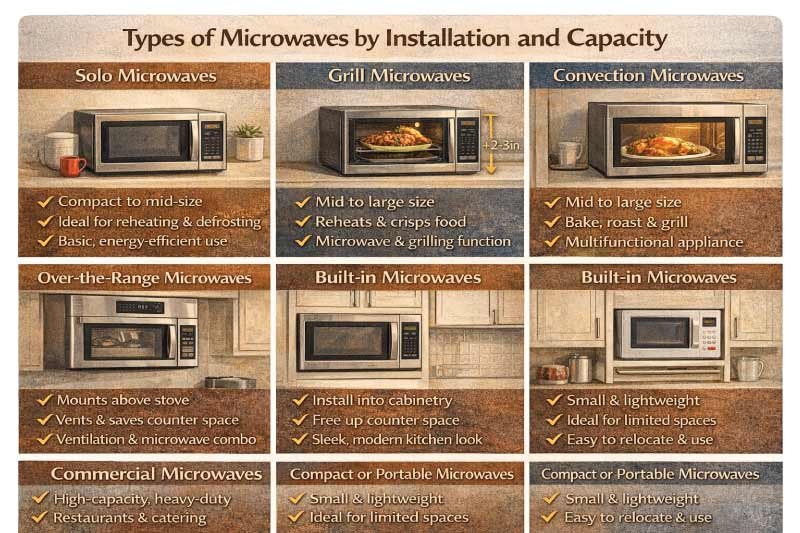
Microwaves come in various types designed to meet different cooking needs, kitchen layouts, and capacity requirements. Understanding each type helps you choose the right model for your space, cooking style, and frequency of use. From basic reheating to full-fledged baking and commercial applications, there is a microwave to suit every requirement.
1- Solo Microwaves:
Solo microwaves are basic models ideal for reheating, defrosting, and light cooking. They are usually compact or mid-size, making them perfect for small households or offices. While they lack advanced features like grilling or convection, they are energy-efficient, simple to operate, and often more affordable than multifunctional units.
2- Grill Microwaves:
Grill microwaves include a grilling element that enables browning, roasting, and crisping of foods. These are typically mid to large size, suitable for families who want a versatile appliance without needing a full oven. They combine microwave speed with the grilling function, offering more cooking options in a single unit.
3- Convection Microwaves:
Convection microwaves merge microwave heating with a convection oven, allowing baking, roasting, and grilling. These mid to large size units are ideal for those who want a multi-functional appliance, capable of preparing a wide range of dishes, from cakes and pastries to roasted meats, all in a compact kitchen space.
4- Over-the-Range Microwaves:
Over-the-range microwaves are mounted above the stove, saving counter space and often integrating a ventilation system. They are usually large and suitable for busy kitchens where space optimization is crucial. These models combine microwave functions with fan ventilation, helping to reduce cooking odors while providing easy access above the cooktop.
5- Built-in Microwaves:
Built-in microwaves are seamlessly integrated into kitchen cabinetry, offering a sleek, modern look. They require precise measurements and installation but free up countertop space. Available in various sizes, these microwaves are ideal for homeowners looking for a high-end finish while maintaining functionality and easy access.
6- Commercial Microwaves:
Commercial microwaves are designed for high-volume cooking, featuring powerful output and large capacity. They are commonly used in restaurants, cafeterias, or catering setups. Built to withstand heavy usage, these microwaves cook food quickly and consistently, making them essential in professional kitchens where speed and reliability are crucial.
7- Compact or Portable Microwaves:
Compact or portable microwaves are the smallest models, perfect for students, offices, or kitchens with limited space. They offer essential cooking functions like reheating and defrosting, and their lightweight design allows easy relocation. Despite their size, they are highly practical for everyday use where simplicity and portability are priorities.
| Microwave Type | Size Range | Features | Ideal Users |
|---|---|---|---|
| Solo | 0.5–1.5 cu. ft | Basic cooking, reheating | Singles, light users |
| Grill | 1.2–2.0 cu. ft | Browning, grilling | Families, cooking enthusiasts |
| Convection | 1.2–2.2 cu. ft | Baking, roasting | Home chefs, bakers |
| Over-the-Range | 1.6–2.0 cu. ft | Ventilation, space-saving | Families, integrated kitchens |
| Built-in | 1.5–2.0 cu. ft | Sleek design, flush installation | Modern kitchens |
| Commercial | 2.0+ cu. ft | Heavy-duty cooking | Restaurants, catering |
| Compact/Portable | 0.5–0.8 cu. ft | Portability, small meals | Dorms, offices, small kitchens |
Also Read:
Choose the Right Microwave for Your Needs
Selecting the ideal microwave depends on household size, cooking habits, and available space. Balancing capacity, wattage, and installation type ensures efficiency and convenience. From compact units for singles to large, high-power models for families, choosing the right microwave helps you cook faster, fit meals comfortably, and optimize your kitchen layout.
-
Single or Couple: Compact (0.5–1.0 cu. ft) with 600–900 W is sufficient.
-
Small Family: Mid-size (1.2–1.5 cu. ft) with 900–1,100 W for everyday use.
-
Large Family or Frequent Cooking: Large (1.6–2.0+ cu. ft) with 1,100–1,500 W for big dishes.
-
Kitchen with Limited Counter Space: Consider built-in or over-the-range models.
| Household Size | Recommended Microwave Size | Power (Watts) | Notes |
|---|---|---|---|
| Single | Compact 0.5–0.9 cu. ft | 600–900 | Ideal for reheating and small meals |
| Couple | Mid-size 1.0–1.5 cu. ft | 900–1,100 | Versatile for daily cooking |
| Small Family | Mid-size 1.2–1.5 cu. ft | 900–1,100 | Can cook larger meals efficiently |
| Large Family | Large 1.6–2.0+ cu. ft | 1,100–1,500+ | Perfect for parties and frequent cooking |
Additional Considerations
When choosing a microwave, size isn’t the only factor. Door style, turntable dimensions, weight, portability, and additional features like convection or grilling can impact usability and space requirements. Considering these elements ensures the microwave fits your kitchen layout, accommodates your cookware, and meets your cooking preferences effectively.
-
Door Type: Some microwaves have side-opening doors, others slide open. Make sure it suits your kitchen layout.
-
Turntable Size: Larger turntables allow bigger dishes; some models have removable or square turntables for more capacity.
-
Weight and Portability: Compact microwaves are easier to move, whereas built-in units are permanent.
-
Features vs Size: More features often mean larger size. Convection and grilling functions require additional space.
Also Read:
Conclusion
Choosing the right microwave involves understanding your kitchen space, cooking needs, and the appliance’s size. Compact microwaves are ideal for small spaces or single users, mid-size units suit small families, and large microwaves are perfect for those who cook often or have bigger households.
By carefully measuring your space, considering the interior capacity, wattage, and intended use, you can select a microwave that maximizes efficiency, enhances convenience, and integrates seamlessly into your kitchen. The right microwave is not just a tool—it’s an investment in smarter, faster, and more enjoyable cooking.
Also Read:
FAQs:
How do I know what size microwave to buy?
Choose a microwave size based on your cooking habits, kitchen space, and household needs. Consider internal capacity (liters or cubic feet), external dimensions for countertop or built-in placement, and the size of dishes you frequently use. Larger families may prefer 30+ liter models, while singles or couples can use 20–25 liters.
Can a 20 litre microwave fit a dinner plate?
A 20-litre microwave can usually fit a standard dinner plate, which is about 10–11 inches in diameter. However, larger platters or multiple plates may not fit comfortably. Always check the microwave’s turntable diameter and internal width to ensure your plates and cookware fit without touching the walls.
What is a microwave used for?
A microwave is primarily used for quickly heating, reheating, or defrosting food. It can also cook simple meals, steam vegetables, and even bake small items depending on the model. Microwaves use electromagnetic waves to excite water molecules in food, making them faster than conventional ovens for everyday cooking tasks.
Is a 20 litre microwave big enough?
A 20-litre microwave is suitable for singles, couples, or small households. It can handle reheating, small meals, and basic cooking tasks. However, it may be limiting for large dishes, family meals, or bulky cookware, making larger 25–30 litre models more practical for bigger households.
What’s the difference between an oven and a microwave?
An oven cooks food using dry heat, which browns and crisps it, making it ideal for baking and roasting. A microwave uses electromagnetic waves to heat food quickly from the inside out. Ovens take longer but provide texture, while microwaves prioritize speed and convenience without browning.
What does 1.7 cu ft microwave mean?
A 1.7 cubic foot microwave refers to its internal capacity—the amount of usable cooking space inside. This is roughly equivalent to 48 litres. Larger cubic footage allows for bigger dishes, multiple plates, or larger portions, making it suitable for families or frequent meal preparation.
Can you put metal in a microwave oven?
No, you should generally avoid putting metal in a microwave, as it can cause sparks, fires, or damage the appliance. Small, microwave-safe metal trims or containers may be allowed in some models, but always check the manufacturer’s instructions before use to ensure safety.
