
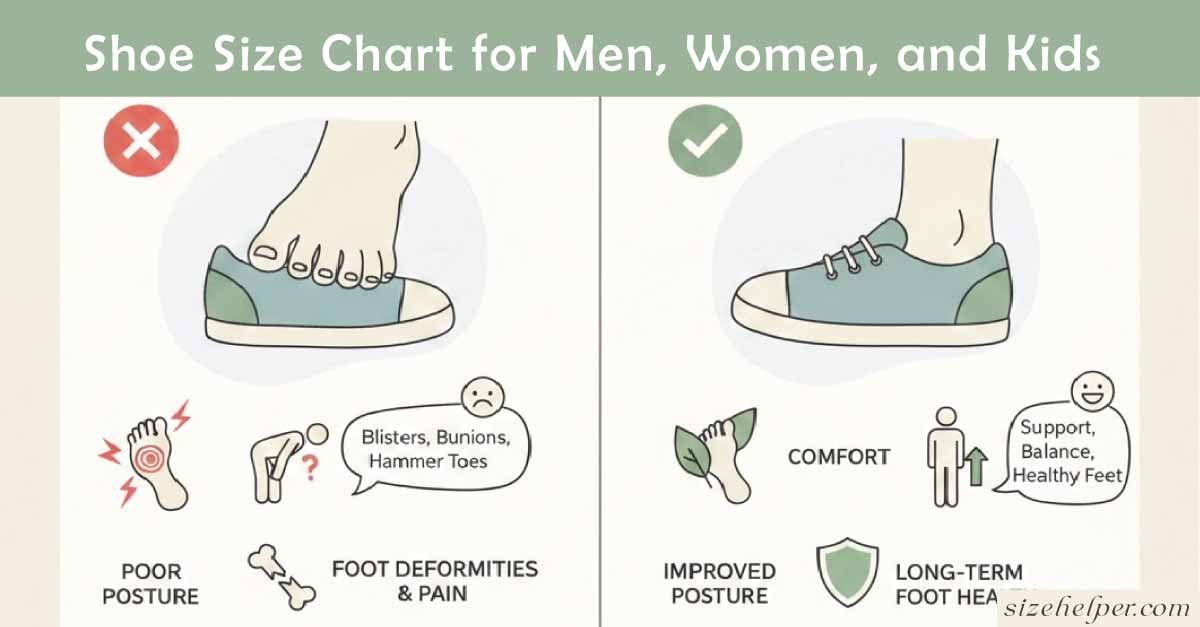
It is much more important to get the right shoe size than most individuals would think. Shoes are the things that we tend to wear almost daily and they tend to take a lot of time but how many people do not know the correct size to wear, and they indeed carry with them their whole life wearing the wrong size. Incorrectly fitting shoe may be a source of discomfort, pain, issues with the posture, and even permanent foot ailments. This is the reason why it is important to know a shoe size chart, particularly in the modern world where people do online shopping as a norm.
A shoe size chart assists you in matching the length of your feet with the proper shoe size in various areas, sexes and age groups. It does not matter whether you are purchasing shoes to men, women, children, or you are purchasing an international brand, a clear chart of the shoe sizes will not leave you at cross roads and will make a sure decision with confidence.
In this detailed guide, we will explain how shoe sizes work, how to measure your feet correctly, why shoe sizes vary, and how to read shoe size charts accurately. We will also include easy-to-understand tables so you can quickly find the right size for your feet.
Why Shoe Size Charts Are Important
Shoe size charts are present since there is no universal system of sizing. Various countries, brands and manufactures consider different standards. The size 9 shoe in the United States is not the same one in the United Kingdom or the European world. The shoe sizes of the brands of the same country might be slightly different.
When you rely only on guesswork or past experience, you risk buying shoes that feel tight, loose, or uncomfortable. A shoe size chart provides a reliable reference based on foot length, which is the most accurate way to determine shoe size. This is especially helpful when shopping online, where trying shoes before buying is not possible.
How Shoe Sizes Are Determined
Shoe sizes are developed using standardized measurement systems that are created to fit footwear to the best fit to a foot length. Although sizing practices depend on the region, the majority of systems involve taking accurate measurements of the feet to make them comfortable and provide the balance and appropriate support to be used daily.
1- Foot Length as the Primary Measurement
The basis of shoe sizing is the foot length which is measured behind the heel to the tip of the longest toe. The measurement gives a uniform starting point of establishing size. Because the length of toes is different in each individual, a proper measurement will prevent the shoe to be tight or loose.
2- Role of Width in Shoe Sizing
Length is the primary consideration but foot width also contributes to a lot of comfort. Other sizing systems have width categories to have narrow, standard, and wide feet. The disregard of width may lead to pressure, slipping, or pain, despite the correct shoe length.
3- Measurement Units Used Worldwide
There is no uniform units and scale of sizing used in different regions. The European system of shoes sizes is predominantly centimeter-based whereas the US and UK ones use inches with distinct numbering systems. Due to such variations, shoe size charts tend to incorporate both foot length and local size conversions.
How to Measure Your Foot Correctly at Home
To use any shoe size chart, it is necessary to measure your feet at home. Proper measurements will allow you not to make a mistake by buying tight or loose shoes, minimize the chances of discomfort, and enhance the overall fit, particularly when you are buying online and cannot even test the shoes.
1. Prepare Your Feet for Accurate Measurement
Start by lengthening your feet on a hard and flat surface when you are standing straight up but not sitting. Put on the kind of socks that you normally wear with your shoes and evenly distribute your weight. This stance lets your feet have a natural spread and it is a more realistic fit in daily wear.
2. Measure Foot Length Step by Step
Place a sheet of paper flat on the floor with one edge touch the wall. Stand on the paper with your heel gently pressed against the wall, then mark the tip of your longest toe. Measure the distance between wall and mark with a ruler/ measuring tape with precision.
3- Select the Correct Measurement for Sizing
We always have one foot a little bigger than the other and one should never overlook this. The bigger foot should always be used so as not to constrict the shoe size. To achieve optimum results, it is advisable to measure your feet at night when the natural swelling has taken place.
Men’s Shoe Size Chart
Men’s shoe sizes are generally wider and longer than women’s shoes. Most men’s shoe size charts include US, UK, and EU sizes along with foot length.
Men’s Shoe Size Chart (Approximate)
| Foot Length (cm) | US Size (Men) | UK Size | EU Size |
|---|---|---|---|
| 24.5 cm | 6.5 | 6 | 39 |
| 25.0 cm | 7 | 6.5 | 40 |
| 25.5 cm | 8 | 7.5 | 41 |
| 26.0 cm | 8.5 | 8 | 42 |
| 26.5 cm | 9.5 | 9 | 43 |
| 27.0 cm | 10 | 9.5 | 44 |
| 27.5 cm | 10.5 | 10 | 45 |
| 28.0 cm | 11 | 10.5 | 46 |
This table serves as a general reference. Individual brands may slightly adjust sizing, so it is always wise to check the brand’s specific size chart when available.
Women’s Shoe Size Chart
Women’s shoe sizes differ from men’s sizes not only in length but also in width and overall shape. On average, women’s shoes are about 1.5 sizes smaller than men’s shoes for the same foot length.
Women’s Shoe Size Chart (Approximate)
| Foot Length (cm) | US Size (Women) | UK Size | EU Size |
|---|---|---|---|
| 22.0 cm | 5 | 3 | 36 |
| 22.5 cm | 5.5 | 3.5 | 36.5 |
| 23.0 cm | 6 | 4 | 37 |
| 23.5 cm | 6.5 | 4.5 | 38 |
| 24.0 cm | 7 | 5 | 38.5 |
| 24.5 cm | 7.5 | 5.5 | 39 |
| 25.0 cm | 8 | 6 | 40 |
| 25.5 cm | 8.5 | 6.5 | 41 |
Women’s shoes vary greatly by style. Heels, flats, boots, and sneakers may fit differently even when labeled with the same size.
Kids’ Shoe Size Chart
Feet of children are rapidly developing and proper sizing is highly essential. When shoes are too small, the natural development may be curtailed and when they are too big they may be unstable and uncomfortable.
Kids’ Shoe Size Chart (Approximate)
| Foot Length (cm) | US Size (Kids) | UK Size | EU Size |
|---|---|---|---|
| 12.0 cm | 5C | 4 | 20 |
| 13.0 cm | 6C | 5 | 22 |
| 14.0 cm | 7C | 6 | 23 |
| 15.0 cm | 8C | 7 | 25 |
| 16.0 cm | 9C | 8 | 26 |
| 17.0 cm | 10C | 9 | 27 |
| 18.0 cm | 11C | 10 | 29 |
| 19.0 cm | 12C | 11 | 30 |
Children’s feet should be measured every few months to ensure proper fit as they grow.
Men, Women and Kids, Shoe Size Chart PDF
It is a downloadable PDF shoe size chart, which contains concise and reliable sizing guidance on men, women, and children. It is easy to view and print and will assist you in getting the right size of shoe depending on the length of the foot and the standards of the region.
International Shoe Size Conversion Explained
International shopping of shoes is an accepted thing but the variations in size are perplexing. A pair of shoes marked size 42 in Europe does not necessarily mean size 42 in other countries. Shoe size charts that include conversion tables are used to fill this gap.
To illustrate, a size 9 of a US men would normally translate to a size 8 of the UK and a size 42 of the EU. Likewise, a size 8 of US women tends to translate into a size 6 of the UK and a size 39 of the EU. Such conversions are approximate and this is why foot length is the most sound method of measuring it.
Understand Shoe Width and Fit
Comfort cannot be ensured only by its length. The width of the foot is a significant factor in the feel of the shoe. Too small pairs of shoes squeeze the foot whereas too big pairs are loose and unsteady. Popular labels of width are narrow, standard, wide and extra wide. The normal width of men is normally denoted by D whereas the normal width of women is commonly denoted by B. When possible, people should always check width information whether they have broader or narrower feet.
Shoe Size vs Shoe Fit
Two shoes of the same size may be very different due to design, materials and construction. Athletic footwear is more likely to be more cushioned and flexible whereas formal shoes can be harder. Leather Shoes tend to stretch a little over time but synthetic ones do not tend to do so. A good shoe must be comfortable during the initial usage. Your toes have to move freely, there should be no pressure points and there should be no slipping of your heel.
Final Thoughts
A shoe size chart is one of the most useful things that can be acquired by someone who is purchasing footwear. It eliminates any form of uncertainty, helps discourage any form of discomfort and also ensures that your shoes are supporting your feet accordingly. Being a wise foot measurer and shoe size chart, you can be sure that you have picked up good fitting and comfortable shoes to wear all through the day.
It does not matter whether you are shopping locally or globally, or you are buying shoes on behalf of yourself or your children, it will be easier to make a better choice and prevent some common mistakes in sizing. Comfortable shoes are not all about the fashions, however, they are a necessity to their healthy feet and comfort in daily life.
👣 How to Measure Men’s Sizes can be tricky if you don’t know the right method. This full guide with detailed chart helps you measure your feet accurately, choose the perfect shoe size, and avoid discomfort. Read the full post to never guess your size again!
